Archaeologists have long studied ceramics discovered in their digs. Recording information about these findings, however, has traditionally been limited to two-dimensional representations (e.g., sketches & photographs) or data (e.g., text descriptions, numeric information such as dimensions, estimated dates, etc.).
New 3D modeling technology is now being used in archaeological research to capture richer visual information about ceramics discovered in the field.
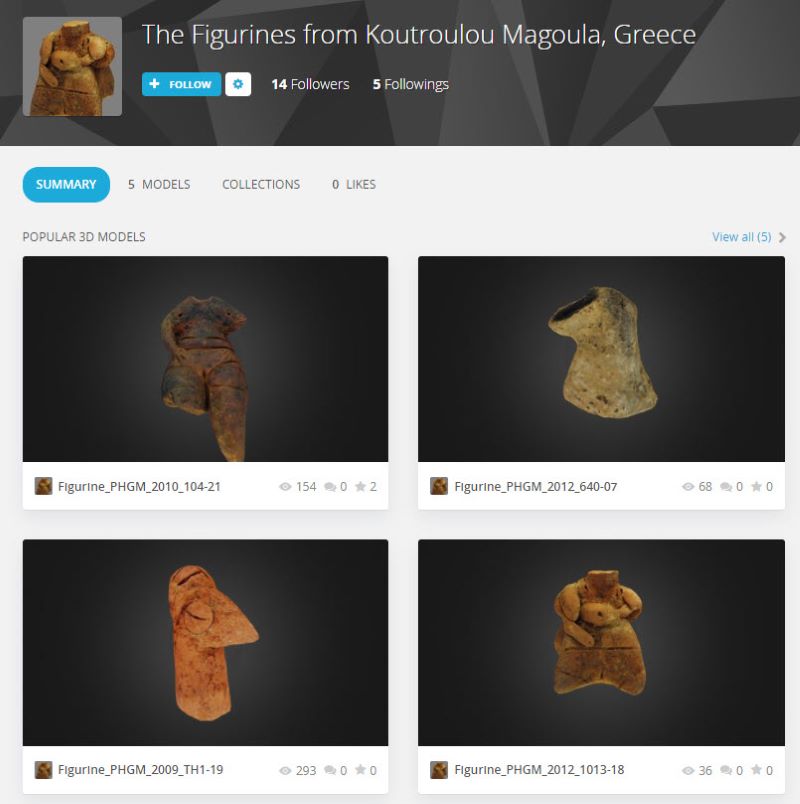
As an example, I point to 3D models of clay figurines discovered at Koutroulou Magoula in Greece. The figurines depict human, animal or hybrid forms made of local clay.
Many of these figuines were painted, incised and otherwise decorated. Human fingerprints remain on some specimens, remnants from the original makers’ pressing fingers into the damp clay. These clay figurines form one of the largest collections of Neolithic figures in all of Greece.
Researchers have used a combination of technologies such as multi-faceted photography, 3D scanning, reflectance transformational imaging and multispectral photography to transform 2D images and descriptive data into marvelous 3D visualizations.
Viewing these 3D models is not the same sensual experience as holding these small clay items in your hands, but it’s pretty darn close.
There is a lot of work going into replicating texture in visual terms, so the viewer gets a tactile sense of the object even though he/she cannot actually hold the clay object. With Reflectance Transformation Imaging (RTI) technology, an object is photographed from a stationary position, but light is moved to different positions around the object, creating different specular highlights and shadows. Software is then employed to blend the different digital images together, and specular highlights can be adjusted to replicate the qualities of particular materials like clay. (Light reflections off clay are quite different than light reflecting off shiny steel.) Laser scanning can produce very finely modulated 3D models of objects – and this technique has in fact been used to record and visualize individual fingerprints on Hohokam clay figurines. Scanning light across a Nabean lamp sherd revealed what was identified as a left-hand thumbprint from the vessel.
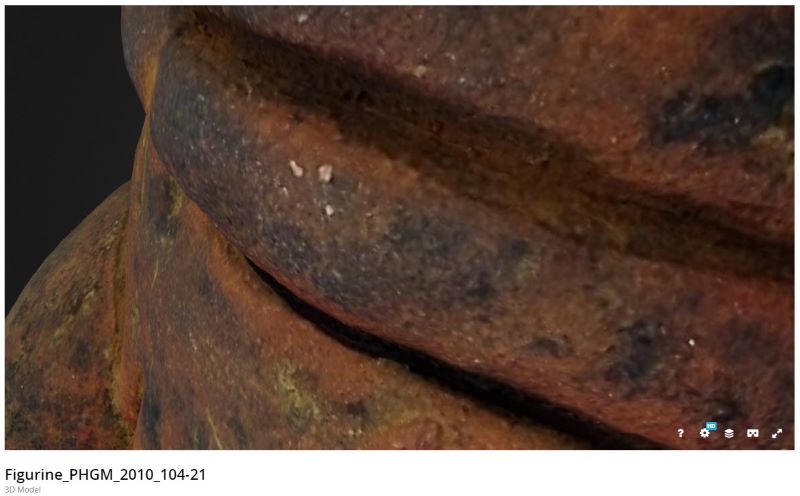
What’s amazing is the ability to zoom into these 3D visualizations to almost microscopic levels. Here is a screenshot of one 3D model (Figurine PHGM_2020_104-21), showing a close-up of carved lines depicting rolls of fat on the tummy of the figurine.
Karen Orsillo is a dedicated, long-time ceramic artist who specializes in nerikomi using brightly colored clay. While she has experimented with a wide variety of ceramic techniques through the years, she keeps coming back to nerikomi.
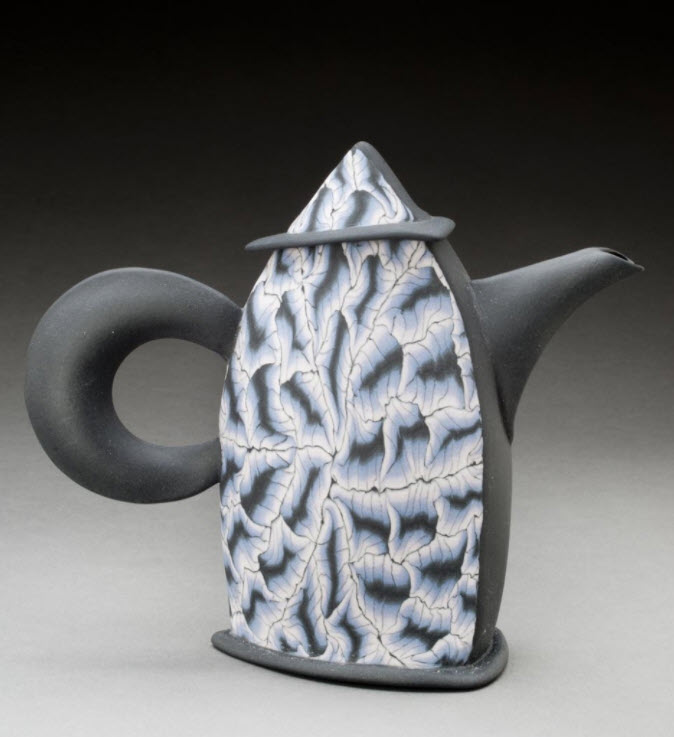
It’s a labor-intensive process – especially as Karen practices the craft. She builds very subtle changes in clay to build smooth, almost seamless gradations from one hue to another. She then “subdivides” these panels of clay into distinct shapes, and combines the shapes to create vibrant, energetic patterns, and out of that end result she assembles her final forms. The results are striking.
JW: On your website you show your process in some detail. What interests me is the subtle gradations you’re able to achieve when you combine different colored clays. What’s the secret?
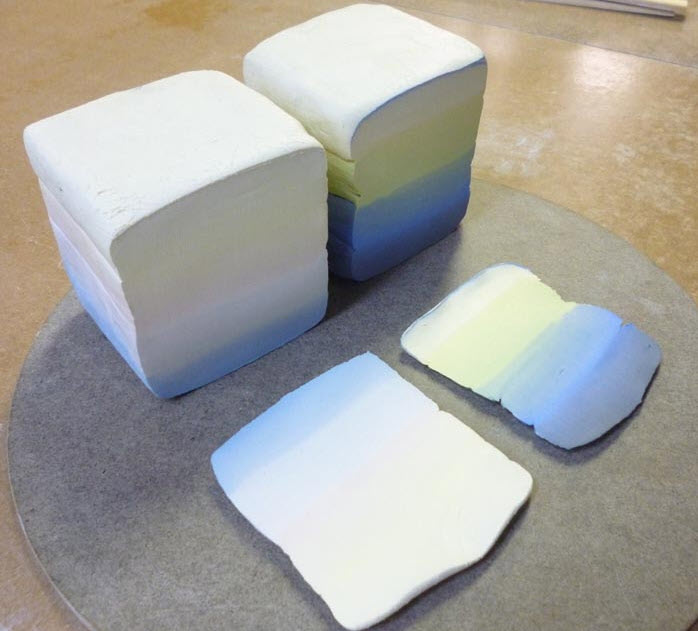
KO: The gradation effect in my work is achieved by wedging small increments of one colored clay into another and then stacking them one on top of the other in order. It is time consuming but worth the effort. Another technique for achieving gradations is called the skinner blend, borrowed from polymer clay techniques. Though I do greatly admire the work of the colored clay artists I know who use the skinner blend method, I have experimented with it but still prefer the wedging and stacking process.
JW: Your process of first building the clay blocks followed by then creating vessels out of those assembled blocks looks time-consuming. What energizes and motivates you through what must be long hours of building a piece?
KO: Yes my colored clay work entails a long, time-consuming process. Some parts are more enjoyable than others. I’ll start with the least enjoyable parts. Wedging the initial colors is a chore that must be done to begin the rest of the process. Often good music (with a bit of dancing added) will get me through.
Then when the pots are at the bone dry stage I need to clean up the surface of every piece before it goes into the bisque kiln. The work is very fragile at this point so I need to stay very focused so as not to break the work.
I’m most excited about building the patterns and the forms though these are the most time consuming parts of the process.
I can see the patterns coming together as I build them and am always excited to slice off the first slab to see the finished pattern. Combining the pattern into a form is the most challenging but compelling part of my work. Finding the form that allows the pattern to be enhanced and not fight with it.
Since most of my patterns are quite visually active I usually keep the lines of the form clean and simple. So the tedious parts of the process happen at the beginning and the end but the stuff in between keeps me energized… along with some good music.
JW: You mention you keep a low profile and don’t promote your work a lot. How did you settle into your balance of creative work vs. promotion and marketing work? Are you comfortable with the balance you’ve reached?
KO: This is the hardest question for me to answer. It’s complicated! I think most artists have to find a combination of ways to make a living. I love the making part most and teaching classes and workshops has always been enjoyable for me. I also love learning new processes and sharing them and this keeps me energized. Making money alone was never a motivation for me so I view selling as a necessity to be able to continue doing what I love.
Fairly early on I realized that colored clay lent itself very well to jewelry and so I developed a line of jewelry that sold well. So when allowed, I had both pots and jewelry in my display at shows. The jewelry became my “bread and butter” income but pots have always been my first love.
I have been fortunate to be doing this during the time when high quality craft shows were available and well attended. This meant that the promoters of the show did the advertising etc. I also am fortunate to have been a juried member of the League of NH Craftsmen which offers a number of selling opportunities to its members. So through a combination of doing craft shows, having work in gallery shops, teaching and occasional shows in galleries I have been able to get by. In the early days I had another non-art related job to supplement my income.
Promoting my work has always been a balancing act. I have avoided the newer venues of online selling and social media in general. I am 69 and so no longer have as much pressure to make money as I did or I think I would have to be online and social media. As I’ve gotten older I find that craft shows are/were a physically challenging endeavor requiring a lot of lugging and setup and often long driving times. The good ones get expensive between entry fees and accommodations and travel etc. Galleries take some percentage of the money but they are doing the promoting and selling and displaying for you in a fixed location where customers can find your work. Teaching can be very rewarding if you enjoy it, which I do.
All of these ways of making a living have worked for me in varying combinations over the years. Today, I think it would have been smart to get into the online venue sooner. The technology still seems daunting! But this has been what is sustaining the people I know during the pandemic.
JW: Your work also has unique patterns – how do you get that effect?
KO: Like so many artists, the patterns I create are most often inspired by nature where amazing patterns and colors abound. It begins with studying a flower, plant or bird plumage, etc. in detail. I then begin to break it down into parts, choosing shapes and color combinations that I can build with colored clays to mimic the original inspiration. As I’m working with one pattern I often get new ideas for another pattern to try next.
JW: Where did you learn this nerikomi process?
KO: During college I encountered The Book of Penland Crafts which featured the colored clay work of Jane Pieser. I started with the information she shared in that book.
After college, I was struggling to continue the nerikomi process with porcelain on my own and encountering many technical problems with cracking and warping. A potter friend told me about a Japanese ceramic artist Makoto Yabe who was teaching in the Boston area at Radcliffe – now the Harvard Ceramics Program – and also at the Decordova Museum School in Lincoln, MA. I took classes with him at both places. He was an amazing teacher of all ceramic processes and I learn so much from him but in particular he was able to help me with the technical problems inherent in the nerikomi process. I’m not sure I would have continued with colored clay if I had not met Makoto.
JW: Did you explore other ceramic processes? What attracted you to nerikomi?
KO: I have explored many, many clay processes over the years: throwing, all forms of handbuilding, high fire reduction, low fire, soda firing, woodfiring, burnishing and pit firing and more. I love them all! That is the compelling thing about clay – there are so many directions and possibilities. But I always continued with colored clay. I enjoy not only the complexities of the of the process but the challenge of combining color, pattern and form well together. There are endless possibilities!
JW: What attracted you to ceramics in the first place?
KO: I was most interested in art throughout my youth and especially in high school. My high school didn’t offer ceramics but I took a class at Newton Pottery in Newton, MA, and loved it right away. I loved the feel and the smell of the clay. I started out throwing and was able to center and pull a cylinder fairly quickly which encouraged me to keep going. Shortly after that I decided I wanted to go to college to major in art and for ceramics to be my concentration. Still loving it!
JW: After a lifetime of making ceramics and working with clay, what advise would you offer to ceramic artists?
KO: I guess my advice would be to keep your passion for clay alive by allowing yourself time to explore and not to let sales and money be what dictates your making. Of course you need to think about making money but don’t let it rule what you make. Also I’m truly grateful to have found clay and feel fortunate to be able to do something creative and fulfilling for my whole life. I’ve always appreciated that fact but it just gets stronger as I get older. As artists we are very fortunate and rich in spirit even if not in money….be grateful!
The Everson Museum in Syracuse, NY, holds one of the largest collections of ceramics in the United States (over 6,000 pieces).
I contacted Garth Johnson, Curator of Ceramics at the Everson Museum, for guidance on how to approach this vast collection. We had a lengthy conversation about the museum, it’s history in advancing appreciation of ceramics as an art form, the collection itself, and his vision, as Curator, for working with and building the Museum’s ceramic collection. I’m dividing our exploration of the Everson into several posts due to the immense wealth of content to cover.
So – how can we best explore this museum collection?
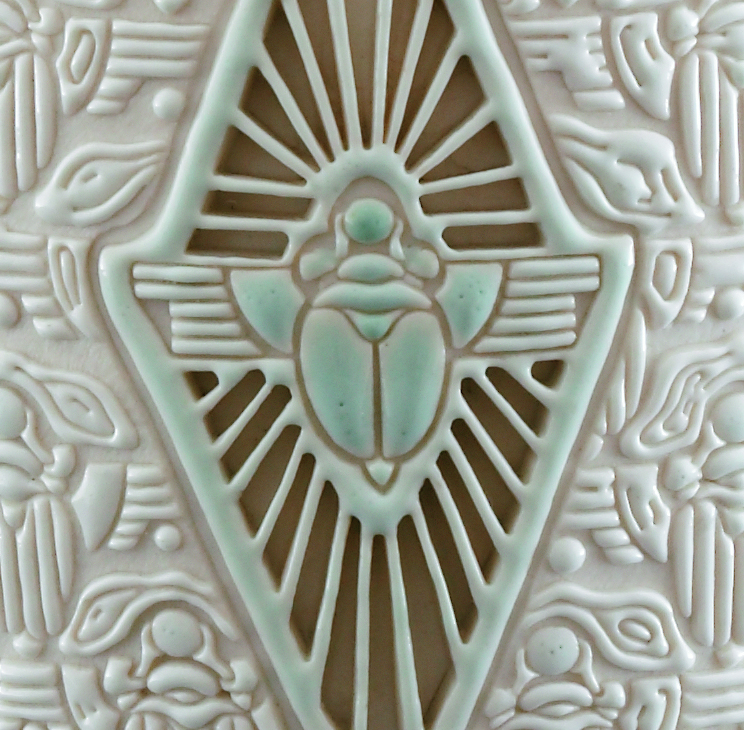
Garth first pointed me to Scarab Vase, created in 1910 by Adelaide Alsop Robineau. It is a centerpiece of the Everson collection (one Everson director referred to this porcelain vase as the “Mona Lisa of the ceramics world”). Adelaide Robineau burst on to the international ceramics scene by exhibiting the work, and winning the Grand Prize, at the Turin International Exposition in 1911.
The Scarab Vase was exhibited around the country before being acquired by the Everson Museum in 1930.
Robineau reportedly spent over 1,000 hours creating the detailed surface decoration (left).
Interestingly, the Scarab Vase was one of several art pieces famously stolen from art collections in 1989.
I won’t spend too much time discussing the Scarab Vase because more details are available in….
The Everson Museum Blog
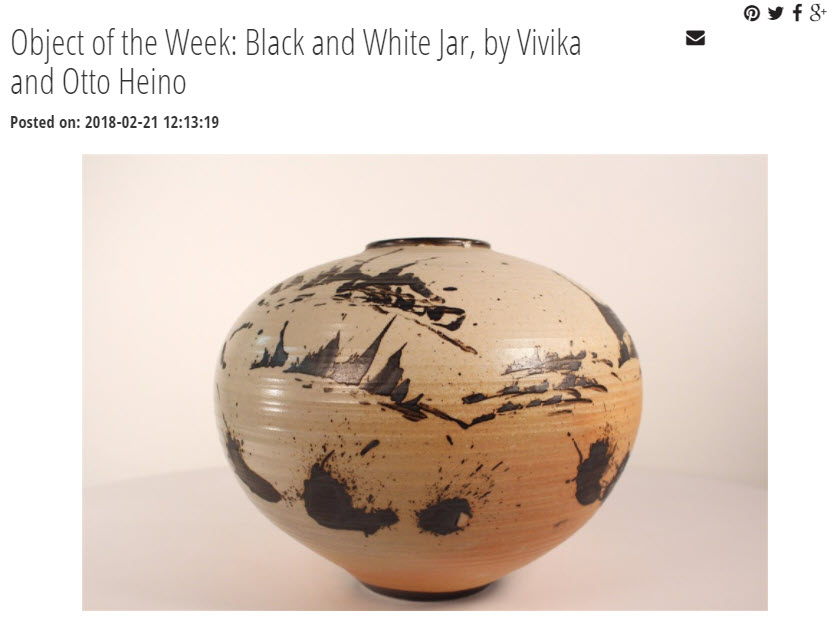
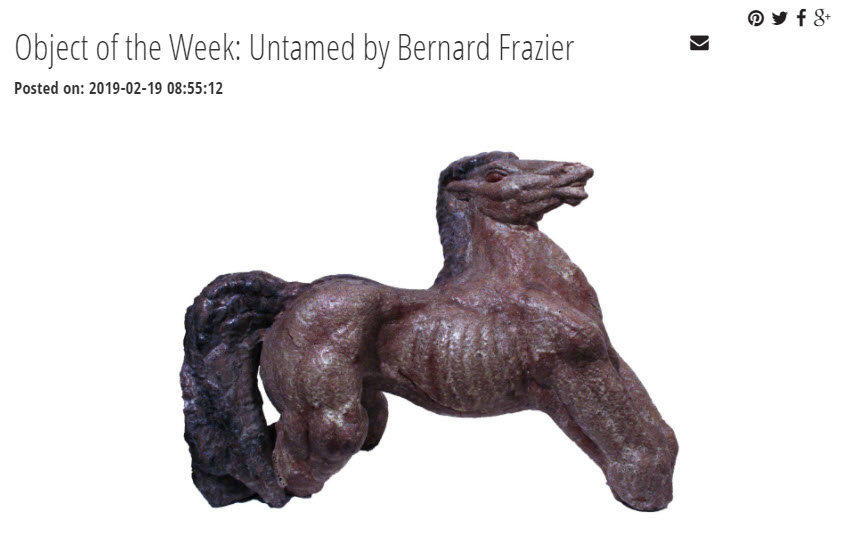
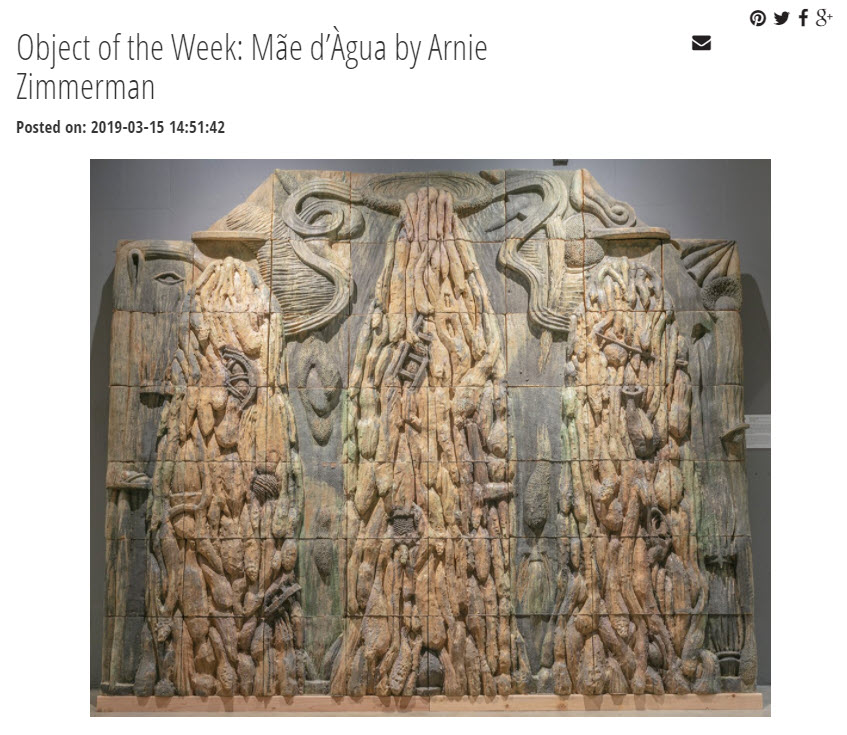
The Everson Museum maintains a blog featuring an “Object of the Week” from the Museum collection. This Museum blog is one way to explore the Everson Museum ceramic collection. The first Museum blog post, in fact, features The Scarab Vase. Although not all Objects of the Week are ceramic, many are. Here are several interesting blog articles featuring objects from the Museum’s ceramic collection:
The above are selected blog articles from the Everson Museum. Unfortunately, I do not see any index to artists or posts, or any way to filter the blog articles by type of work (e.g., ceramics), but that may come later. In the mean time, you can scroll through the blog pages to find articles of interest.
Upcoming in this guide to the Everson Museum Collection:
News about MILLIØNS, the new Everson Museum cafe that integrates contemporary functional ceramics with dining experience for museum patrons
Ceramic Object Study Sessions, a webinar-based investigation of different themes related to ceramics
Ceramics Database, a searchable, publicly-accessible online database of many of the Everson’s ceramic pieces
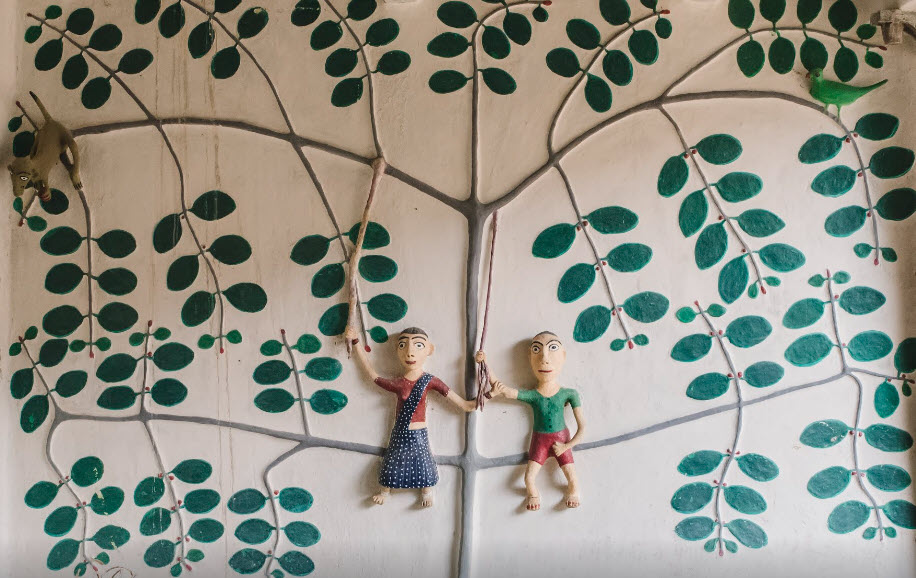
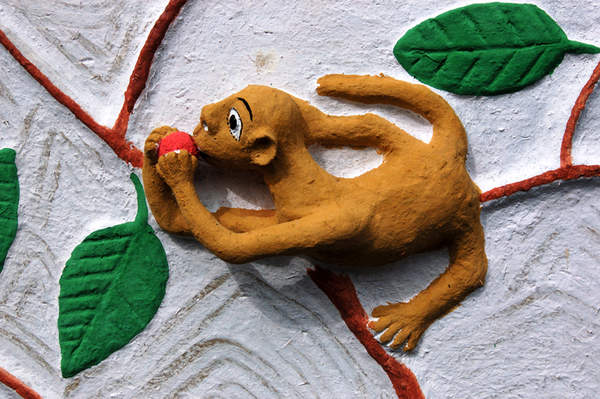
I found two articles by Dastkari Haat Samiti (an Indian non-profit organization) about wonderful art created by self-taught folk artist Sonabai Rajawar. Sonabai transformed her home into a magical, imaginative world to delight and entertain herself and her son from their isolated misery.
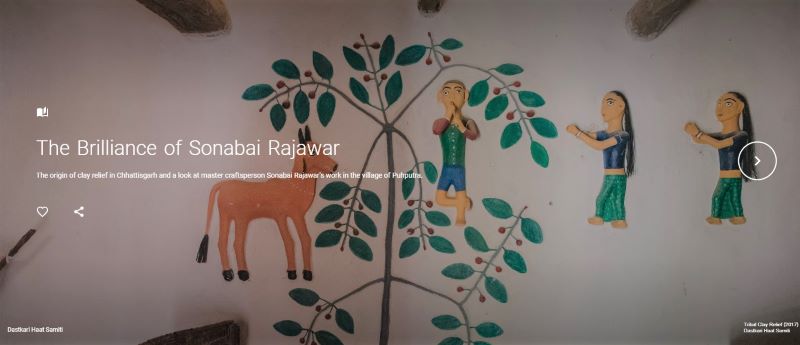
Sonabai lived in an isolated village in rural India in the latter half of the 20th century. She began decorating her house with painted murals and low-relief clay sculptures in the 1950s. “The Brilliance of Sonabai Rajawar” video provides a portrait of the artist.
What goes unmentioned in “The Brilliance of Sonabai Rajawar” video are the details of her life. Sonabai was married at age 14 to an older man and for 10 years was unable to bear children. At the insistence of her husband, Sonabai lived within the walls of her rural house, ostracized from her family and community. After 10 years Sonabai bore a son, but her jealous husband continued to isolate her and her son inside their home. Because they were poor, the only toys Sonabai could provide her son were toys she created herself. So she dug clay from the sides of her well and molded the clay into toys for her child. Her son laughed with joy.
Springing from those initial efforts, Sonabai began painting and decorating the walls of her house with simple murals and clay bas-relief sculptures to delight her child. She also added elaborate decorative lattices to her home.
More details of Sonabai’s difficult life can be found in this online article and in a short film (trailer below):
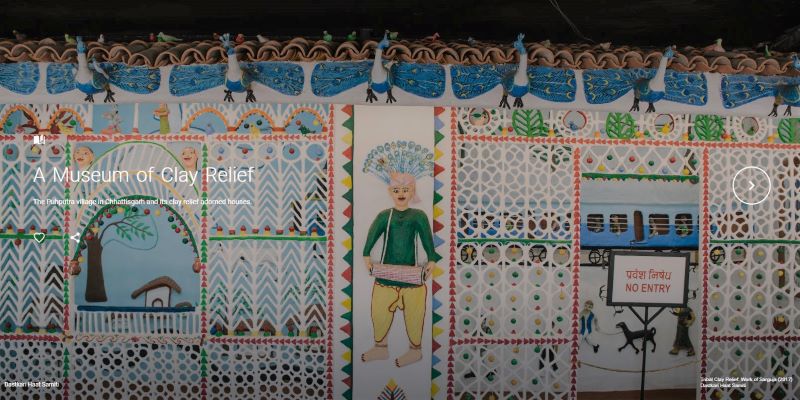
Although Sonabai died in 2007, the artistic tradition she started has continued by other local artists. The second article entitled “A Museum of Clay Relief” shows village walls in Sonabai’s village of Puhputra in central India.
You can see additional examples of Sonabai’s later work on this YouTube video:
“Wolf” from the series “Happily Ever After”, a wall installation with sound featuring well-known fairytale characters.
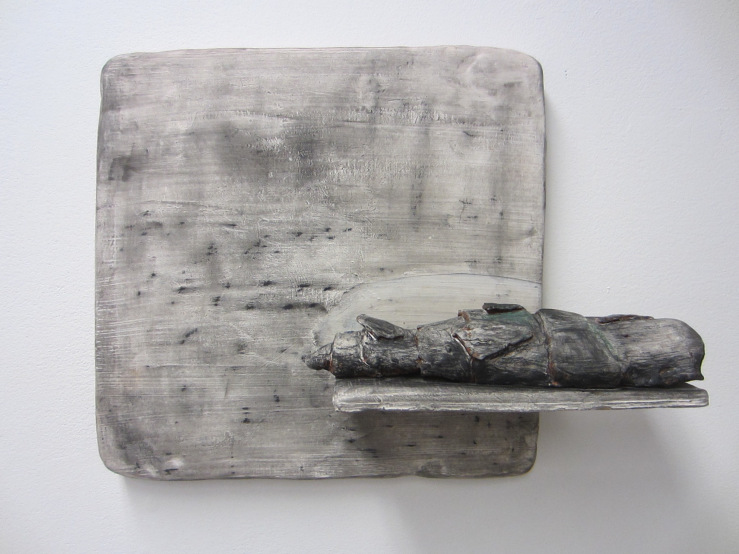
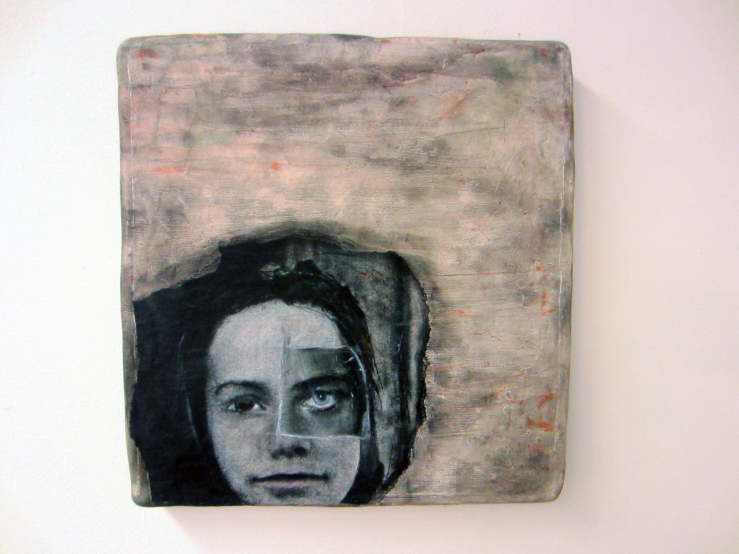
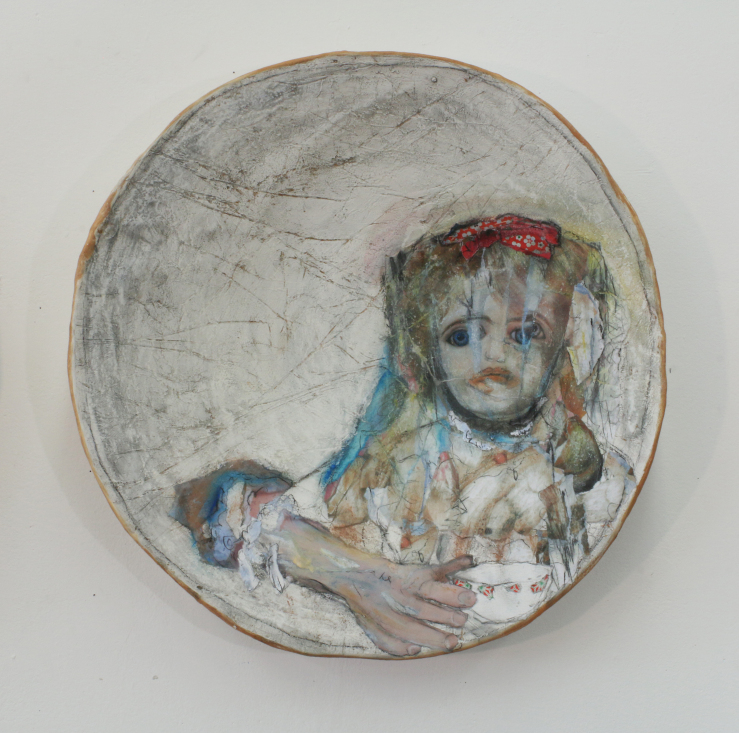
Pamma FitzGerald is a very interesting multimedia artist who combines ceramics with collage, charcoal, pastel and other materials to create visually compelling, layered works of art. Pamma has two fine art degrees from the Alberta College of Art and Design (ACAD), one in drawing and the second in ceramics. She fuses those skills with an interest in characters (from folktales, legends and historical points in time) to create unique worlds in which the viewer can wander, wonder and explore. Perhaps Pamma can explain things more clearly, so I point you to this video from a few years ago:
JW: You studied and create works in multiple media, including ceramics. How did that come about?
PF: Although I do admire artists that stick to a single medium and hone and perfect it, I would feel flattened by that limitation. Each medium, method and technique I use informs another – and I find intermingling traditionally disparate media exciting too.
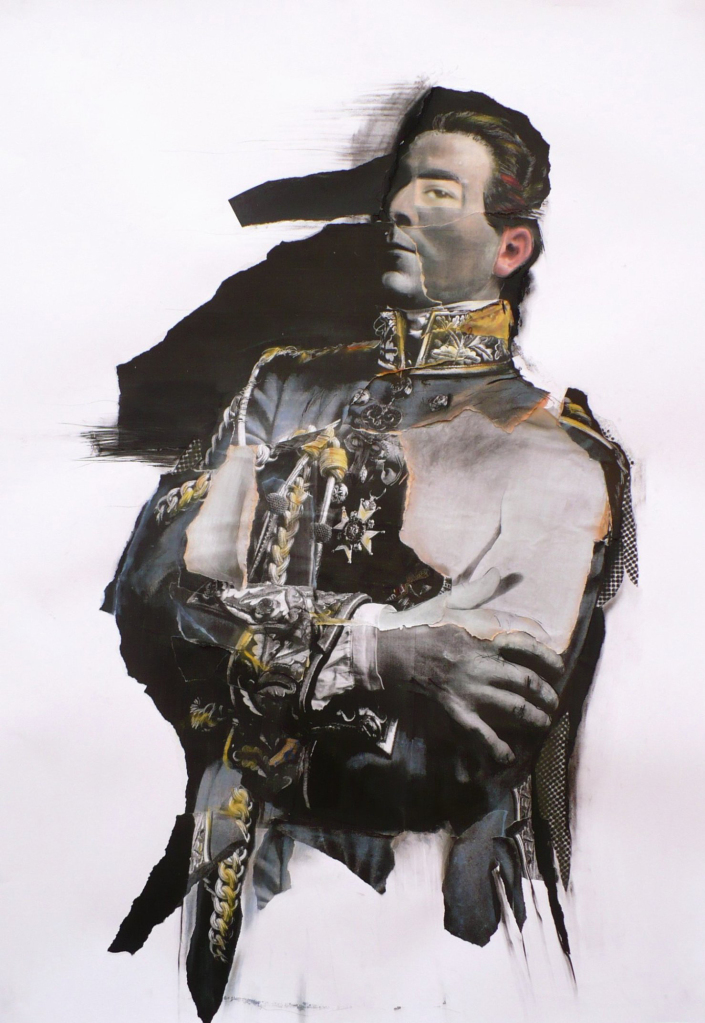
Emperor, to the right, is a combination of collage and drawing, and is part of my series Les Contes de Fées – moments from well-known fairytales.
JW: What attracts you to ceramics? And what can you do in ceramics better than in other media?
Nothing compares to manipulating clay with your hands, and I feel a finished piece using clay reflects that intimacy with the medium.
JW: On your website it’s a bit tricky detecting which parts of your “clay” work is actually clay vs. collage, charcoal, pastel or gel. (For example, “The attic door had been left open” and “It happened on the first flight” — are these clay plates? So the clay is essentially the ground upon which you sketch, paint and apply other imagery?)
PF: The two pieces you mention are a mix of clay, paper, pastel, charcoal (and a gel to fix the pastels). Calling clay the ground puts it down in my mind so I won’t call it that! In fact, the drawing (drawing being mark-making of any kind) is usually decided on before the clay comes into play. But I make different works in different ways too. I have used many different types of mark-making on clay – printing, mishima, decals, etc, but collage alongside clay has resonated for me for the last few exhibitions and projects. (My next project is already percolating and will be quite different!)
JW: What are your sources of inspiration?
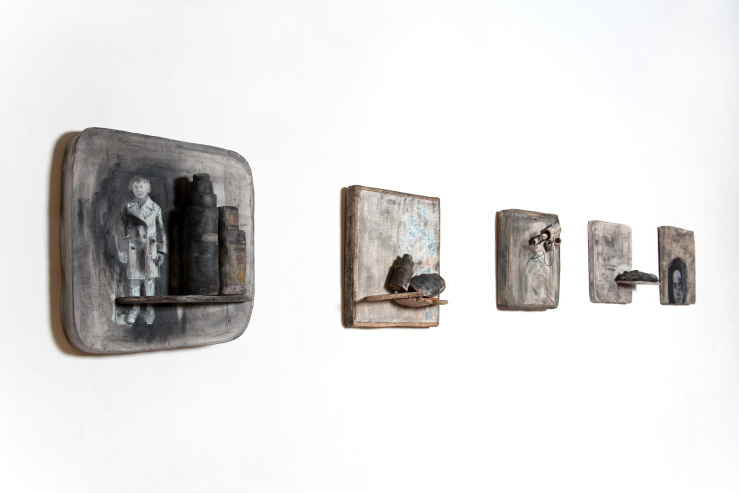
PF: If I have a story about a piece in my head it makes the piece feel much richer, personal and multi-layered for me. I feel a need to tell that story and present it in a different way so that viewers will be able to see it from a different point of view. Examples of this are the five pieces that comprise ‘Left Behind’.
This body of work tells the story of a village in France – Oradour-sur-Glane – that was annihilated in June 1944. Nearly all its 642 inhabitants were rounded up, the men were taken to barns and shot, and the women and children were taken to the church and burned to death. After the massacre occurred, the village buildings were all burned to the ground. A few people escaped including one 8 year old boy, and the title ‘Left Behind’ refers to them. The ones who when their entire families and all their friends had been murdered were left behind with survivor guilt and excruciating sadness. To make this piece, I researched the story extensively and I visited the village that has been left as it was on that fateful day as a reminder of man’s inhumanity to man.
JW: It also looks like you incorporate poetry and linguistics (audio recordings) into your work. Will you tell me about that?
PF: For the exhibition ‘Unhappily ever after’. I was motivated to make pieces after reading a book of poems by Tyler B. Perry, a friend of mine here in Calgary.
All of the 5 pieces are characters from well-known fairytales, and as we all know, those old fairytales could be pretty brutal. I made Red to reflect the moment she comes face to face with the wolf and Hansel as he watches his father abandon him in the woods for example.
Red from the series “Unhapplily Ever After”
Goldi, from the series ‘Unhappily Ever After’
After I had made 3 pieces, I reversed the process with Tyler and I created pieces that he then wrote poems for. In the exhibition viewers could press a button corresponding to each piece and listen to the poem via headphones. It turned out that visitors to the gallery spent a lot of time with my pieces whilst thoroughly enjoying the poems (children especially!)
Tyler and I also collaborated on the exhibition Caught and he read the poems at the opening. He made the works come alive. I’ve always enjoyed collaborating with other artists – it just makes everything that much richer as everyone offers something different.
Valerie Lowe, from the series “Caught” featuring 1920s era criminals moments after they were arrested
JW: I see numerous references to WWI and WWII in your work – are those reflections somehow of where you physically live?
PF: My interest in the two world wars was always lurking in the background. I was born in London and lived with grandparents who had lived through the bombings in the Second World War. Every one I knew had the same shed in the garden and it was only recently that I discovered those common sheds had in fact previously been air raid shelters. There are many more vestiges of war that still lurk in London. But it is in France in the little villages that memories of war still leaves scars. Every single family has a connection to those who died in the wars. My children’s great-grandfather was also killed in France in the First World War, a father of 2 little girls. His story appears in my work too.
“Papa Came Home With Presents”, large-scale collage and charcoal piece from the series “Jeter de la Poudre aux Yeux”
Pamma was recently awarded an Alberta Foundation for the Arts grant for the exhibition she’s working on – 10 large-scale collage/drawings and 8 ceramic/collage wall pieces. The exhibition, entitled “Jeter de la Poudre aux Yeux”, is an exploration of romantic and idealized imagery of war derived from French postcards of the WWI era (1914-1918).
Dividing her time between two locations, Pamma will create the 10 large-scale collage/drawings in Alberta, Canada. Pamma will travel to France to work on the 8 ceramic pieces. She will use French clay, fire her pieces in France, and exhibit her work in a French gallery located within a renovated tile factory which once made tiles from the same clay.
Readers can see more of Pamma’s work on her website.
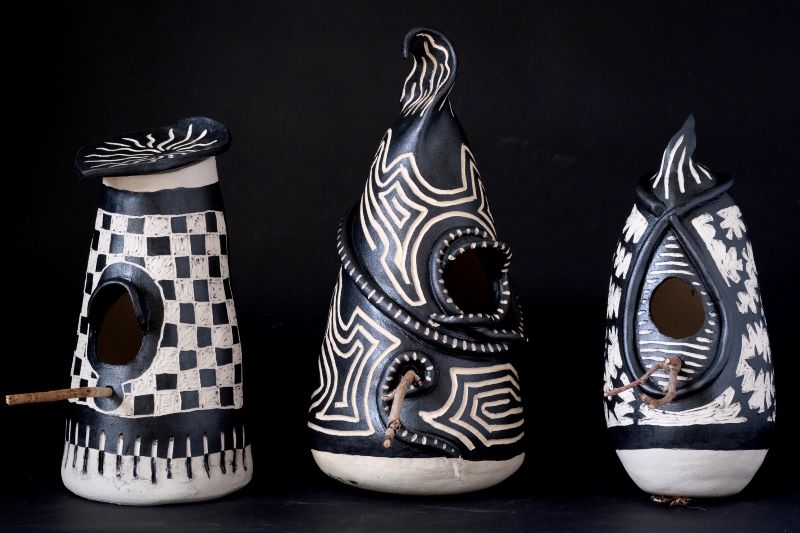
I started a series of Sgrafitto birdhouses in the fall as a way to inject levity and fun into the shortening days of winter. It’s been a pleasure to work on them. And it was fun to have these to fire when I quarantined with Coronavirus.
My wife came down with COVID-19 through exposure at work. The entire family then got it. Fortunately, none of us experienced serious symptoms and we’re through our quarantine period. In my case, though, I can’t shake off continued lethargy and shortness of breath. A ski day reservation came and went this weekend, for example, and I simply lacked the oomph to make it happen. Not the way I want to live my life.
Nonetheless, we’re on the mend. It’s a new year. We approach 2021 with hopes for a successful rollout of vaccines worldwide, a new political era of cooperation and civility, and a return to laughter in our homes and communities. I’m also hopeful that a few birds will enjoy new nests.
Thomas Frye set up a pottery factory outside London in 1748. Frye located his factory close to the London stockyards and availed himself of plentiful cattle bones from slaughtered animals. Frye threw the bones into his ovens to reduce the bones into ash, and then included a substantial portion of that bone ash (45%) in his clay body recipe. This clay body made with bone ash came to be called “bone china”. Because such a large amount was produced in England for an extended period of time, we now refer to this type of pottery as “English bone china”.
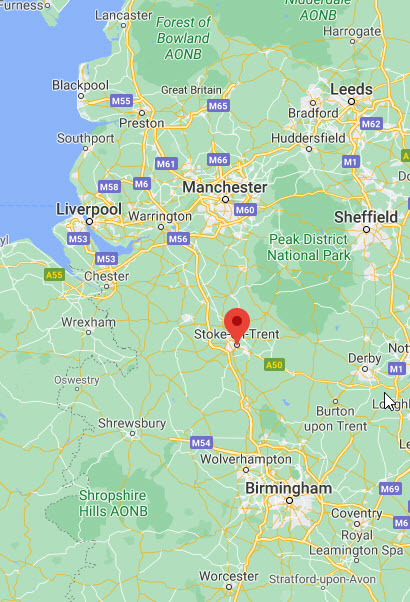
In the 1780s Josiah Spode modified Frye’s formula and set up a large-scale bone china factory near Stoke-on-Trent, England.
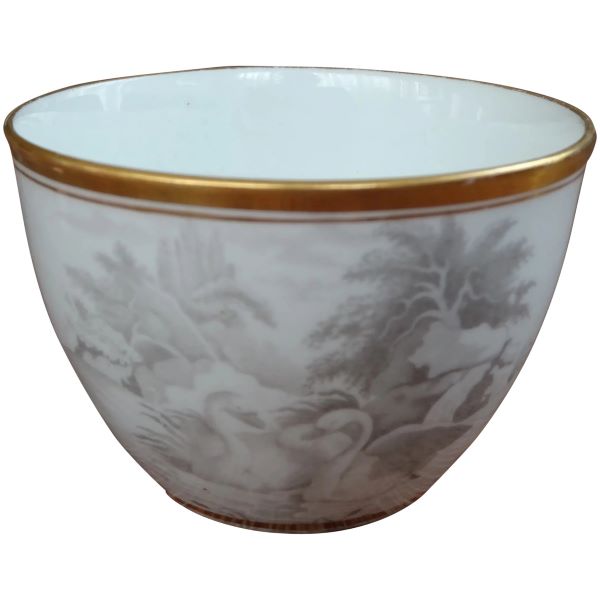
Illustrated on the right is an early (1808-1820) Spode bone china cup. A design including two swans was transferred from an engraving onto the cup surface, fired, then decorated with an identifiable Spode gold rim before final firing.
First Period Spode bone china tea cup in pattern 557
Stoke-on-Trent was ideally situated for large-scale pottery works. Ample coal for firing and local clay for earthenware ceramics had sparked early ceramic production in the area. In the 1760s, Josiah Wedgwood (founder of Wedgwood pottery factory) had began construction of the Trent and Mersey Canal, which connected Stoke-on-Trent with port towns of Liverpool (to the northwest) and Hull (to the northeast). Merchants imported china clay and other primary ingredients needed for bone china to Stoke-on-Trent via the Trent and Mersey Canal.
Spode and other bone china factories in Stoke-on-Trent thrived for almost 200 years. Prominent bone china producers located in Stoke-on-Trent include Wedgwood, Spode, Royal Doulton, Minton and Baker & Co.
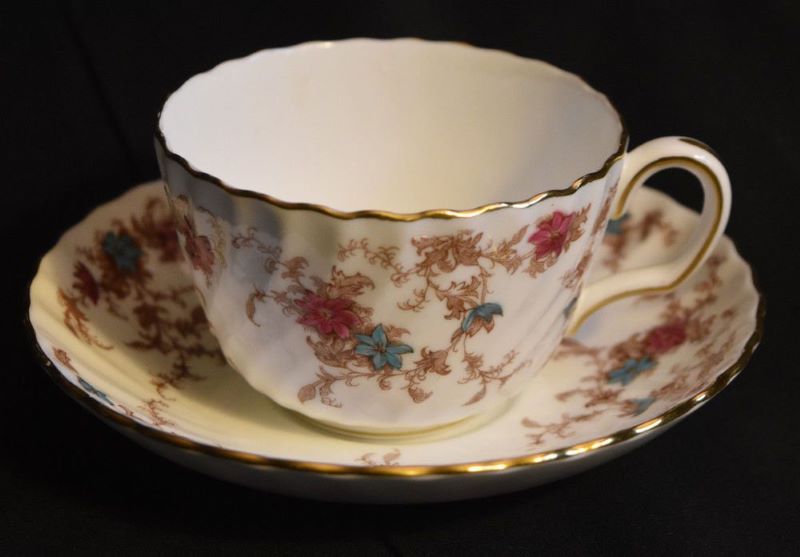
Illustrated to the left is a Spode bone china teacup from later years.
The Gladstone Pottery Museum in Stoke-on-Trent preserves a few of the 2,000 brick pottery ovens (called “bottle ovens”) that once peppered the region. This video contains historic footage of how these bottle ovens were filled and fired to make production volumes of English bone china during their heyday.
An enormous amount of bone china was produced in in Stoke-on-Trent, England over 200 years. Bone china has gone out of favor in recent decades as lifestyles have become more casual. Engaged couples infrequently list bone china dinnerware on their wedding registries. My wife and I have a set – and haven’t used it for years. Nevertheless, a wide variety of bone china is still produced and exists from earlier eras. Do a quick Google search for English bone china and you’ll see thousands of examples from different producers and different eras. Here is a tiny sampling:
I came upon Jaroslav’s ceramics via his website. I found his work to be a wonderful exploration of two different themes: the first being very lyrical – almost musical – exploration of shape, form & motion, the second being a focus on the abstract qualities inherent in clay and glaze itself, as material.
Shape, Form and Motion
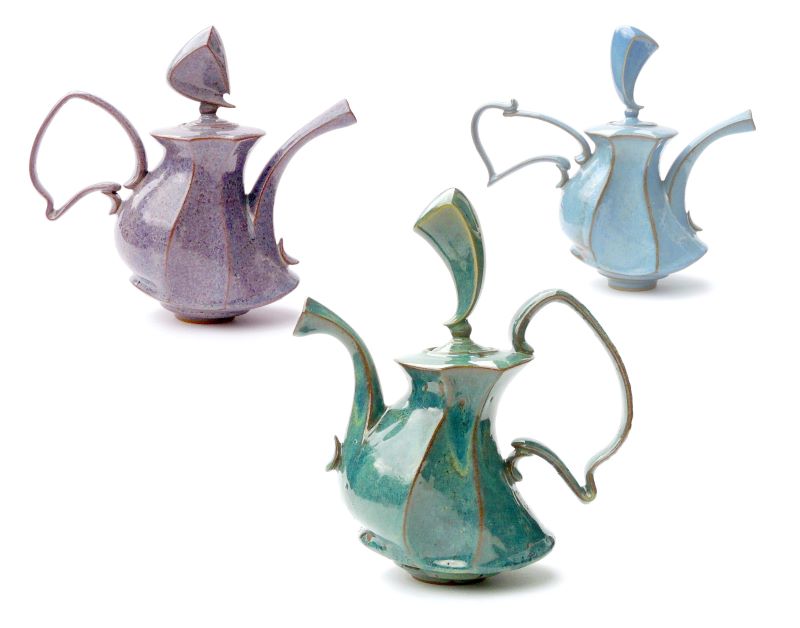
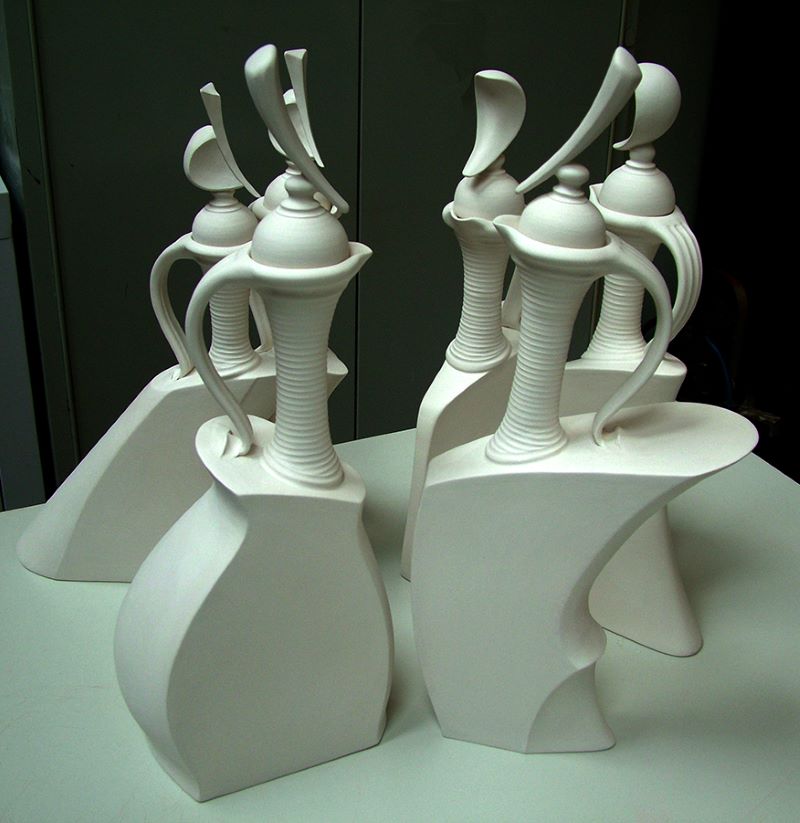
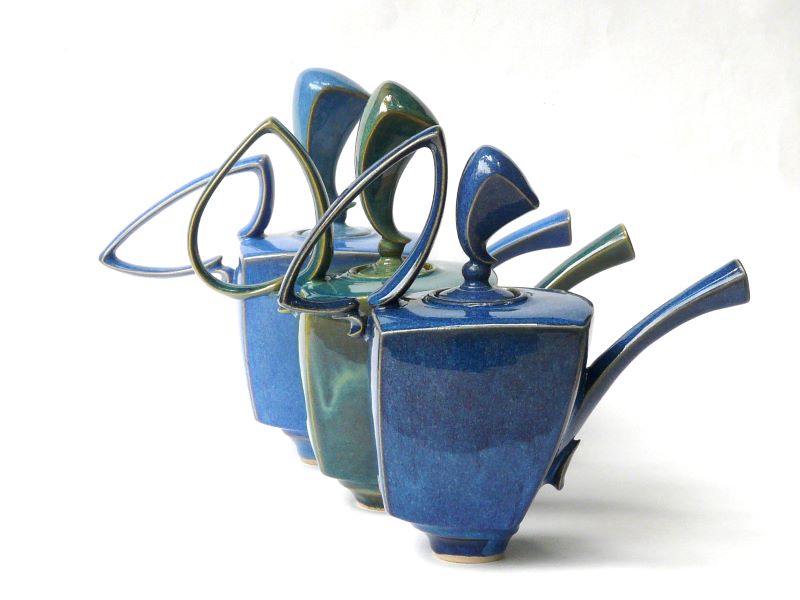
These three teapots illustrate the first theme of shape and form.
They dance, they gyrate, they slither and wiggle and prance together. I find my eyes exploring not just the shape of each vessel, but also the negative space Jaroslav defines by his physical forms – and even the negative shapes formed between the three teapots. I hear music.
Jaroslav tells me about this dimension of his portfolio:
“When I enrolled to do my Master’s degree in 3D design (in Farnham, UK) I realized that the workshop equipment at the university was so advanced that there were virtually no technical or material constraints in the studio. I wanted to make a good use of the opportunity. I was looking for an appropriate challenge.
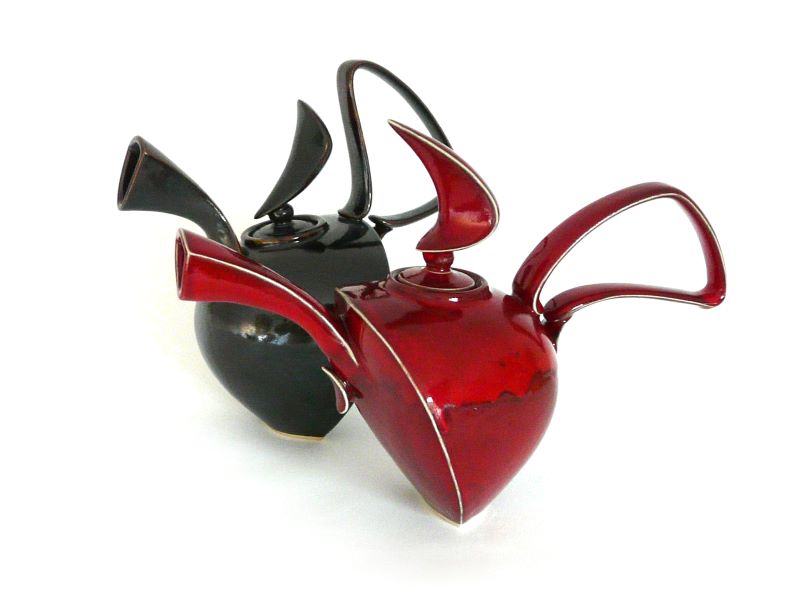
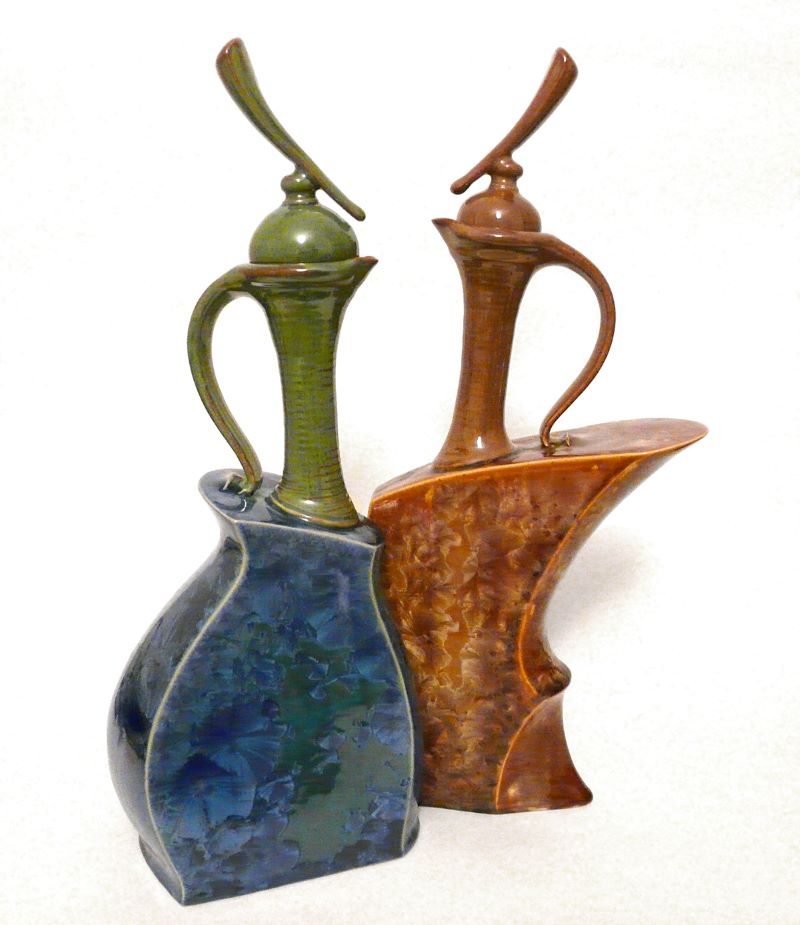
“In due course I conceived vessels to be geometrically stylized, gendered forms, representing couples dancing tango, and crystalline glazes made noble patterned dresses on the dancing couples.
“I went to a local dance school and shot some footage of couples taking tango dance lessons.
“This gave me a new way of looking at the ceramic vessel and working out a truly individual body of work. In particular, I employed the idea of duality and unity of the two interacting counterparts, the concept of ‘lead and follow’ that shows as a varying degree of tension which makes a whole new kind of expressive means in my work.
“There are surprisingly many analogies between music and fine art. I’m far from being the first one to explore this phenomenon. There have been a few composers that sought inspiration in fine art and vice versa – artists studying and practicing music to boost their creativity.
“I personally employ music as a source of inspiration on multiple levels. I exploit the analogies between the rhythmic patterns in music and visual art, the nature of different modes and scales (12 semitone color wheel vs. 12 semitone temperament of the octave), respectively – musical chords vs color chords and chord sequences, and not least – the composition of the artwork vs the composition in music. This may or may not be very obvious, as I find no point in following the analogies strictly and literally. I much rather use them as a tool that helps to unlock new creative solutions through analysis of potential combinations of the variables in the game. This can be both frustrating and incredibly exciting at the same time. The ‘golden rule’ is to keep it natural, not for the sake of shocking newness.
“The pairs and triads I use emerge out of multiple concepts – again. On one hand it’s to do with the idea of a musical chords or perhaps a choir where each voice is interrelated with one another – linked by a common theme, and yet has sufficient independence to act in its own right.
“The idea of ‘lead and follow’ as well as ‘lead, accompany and support’ (base, mid and treble – if you like) is inevitably present and makes a fundamental importance to me. One can also look at these pairs and triads from a perspective of modular approach that makes perfect sense in product- and vehicle design. The pieces are similar and uniform in style and expressive qualities, yet are individually different – like siblings, like children of the same parents.”
Abstract Qualities of Material
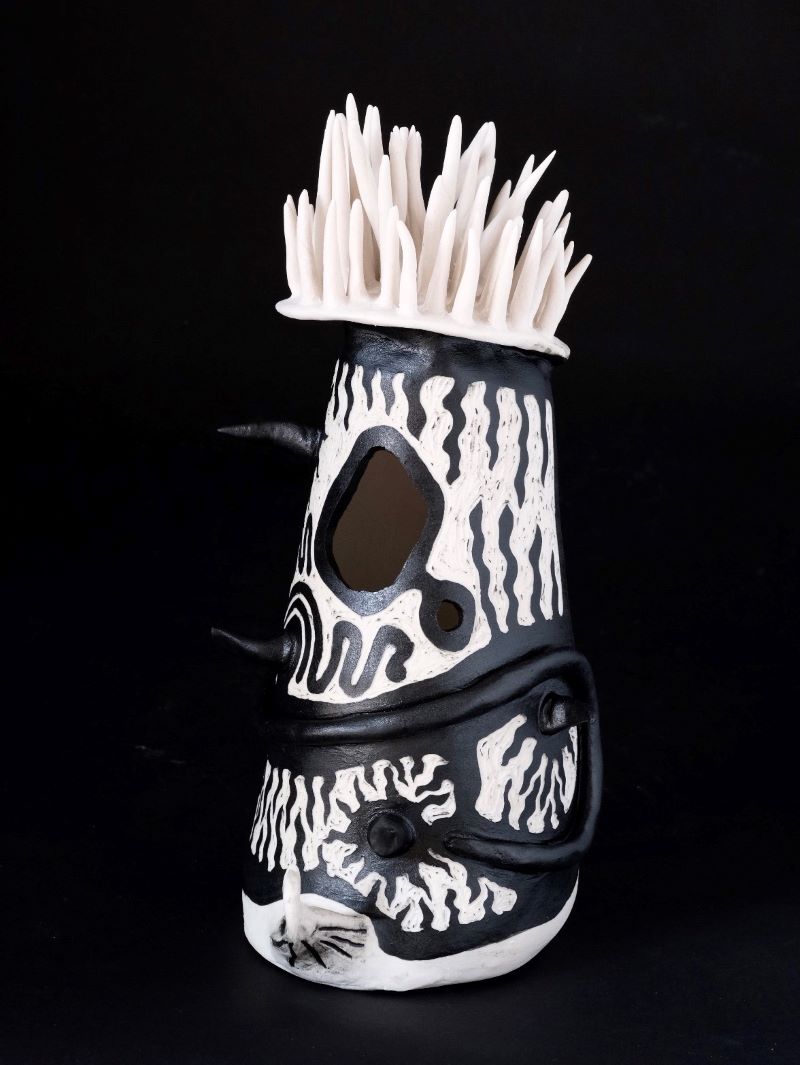
Distinct from these studies of shape, form and motion, Jaroslav also creates pieces that explore the abstract qualities of clay itself, and also the abstract qualities of crystalline glazes.
To illustrate Jaroslav’s interest in clay as material, I point to this sculptural piece:
“I have a need to explore new things to keep my creativity going,” Jaroslav says. “I don’t worry particularly about maintaining a high commercial profile, my success always follows sooner or later when I keep true to myself.”
“Based on the axiom of ‘less is more’ I formulated a working hypothesis that a complex surface pattern works better on simple shapes, whereas complex forms require a subtler finish. To find objective answers I decided to push both – the shapes and the surface patterns towards complexity and see to what extent ‘less is more’ is actually true.”
Jaroslav’s second body of work explores surface patterns that reach toward complexity and abstraction on a platform of simple, non-distracting shapes.
“I naturally seek inspiration in virtually anything that brings me joy of discovery: chemistry, geology, petrography, fabric design, music, dance, oriental cooking, art of massage, vehicle design, natural patterns of the micro- and macro world. In fact, I tend to seek inspiration in anything but ceramics, which is probably what makes my creations unique.
Bridging both themes, Jaroslav has explored crystalline glazes on his teapots. These glazes make “noble patterned dresses on the dancing couples,” he says. Crystalline glazes have “high-failure” rates, but they do add an element of abstraction to the surfaces of his teapots.
“In all fairness I just had a strong desire to work with exquisite and complex vessel shapes on one hand – and an urge to grow some crystals on the other,” Jaroslav explains.
From where does Jaroslav’s inspiration and intellectual approach to ceramics spring? He told me about his background:
“I am a Ukrainian descendant of multi-ethnic ancestors, born (in 1973 in Kiev, Ukraine) into a highly intelligent family of artists, sculptors, musicians and scientists. My creativity is driven by a passion for color, shape and vivid impressions of momentum. I constantly explore the natural world, fine art, science, music and dance, building my body of work on a broad multicultural background. I have a keen interest in foreign languages; my outdoor nature led me to adventurous rambling around the globe. I have lived and worked in Ukraine, Hungary, Slovenia, Croatia, Macedonia, Kenya, Taiwan and the UK. I’ve been to most countries all across Europe, enjoying everything local and authentic.
“From earliest childhood I’ve been surrounded by the attention and creativity of my parents and grandparents. They tried their best to show me the finest examples in world’s heritage of fine and decorative art, ethnic as well as classical music, and dance. I spent a lot of time listening to my mum or grandma playing piano, my dad playing guitar and singing. My grandad took me with him outdoors to draw and paint the native Ukrainian landscape, so I guess I knew the smell of fresh oil on canvas and the drips of watercolor pretty much from the age of three or so.
“I started with painting and drawing. I think I was rather strong in perspective drawing, still life and landscape. I was really interested in principles of color harmony and fundamentals of composition. In pursuit of getting better at portraying, I went to the local art school, where I also tried wood carving and the potter’s wheel. I did enjoy very much studying the folk ornaments, font styles and human anatomy, but pottery and ceramic technology was something we never had in the family before, so these subjects absolutely prevailed and obsessed my mind.
“I tend to revisit different concepts and techniques from time to time, but I try not to make any fixed plans for the future, since creativity is something spontaneous and unpredictable. An element of surprise and discovery has to be there in order to keep the ideas fresh and exciting.”
Carry on, Jaroslav!
Jaroslav’s website contains additional examples of his work.
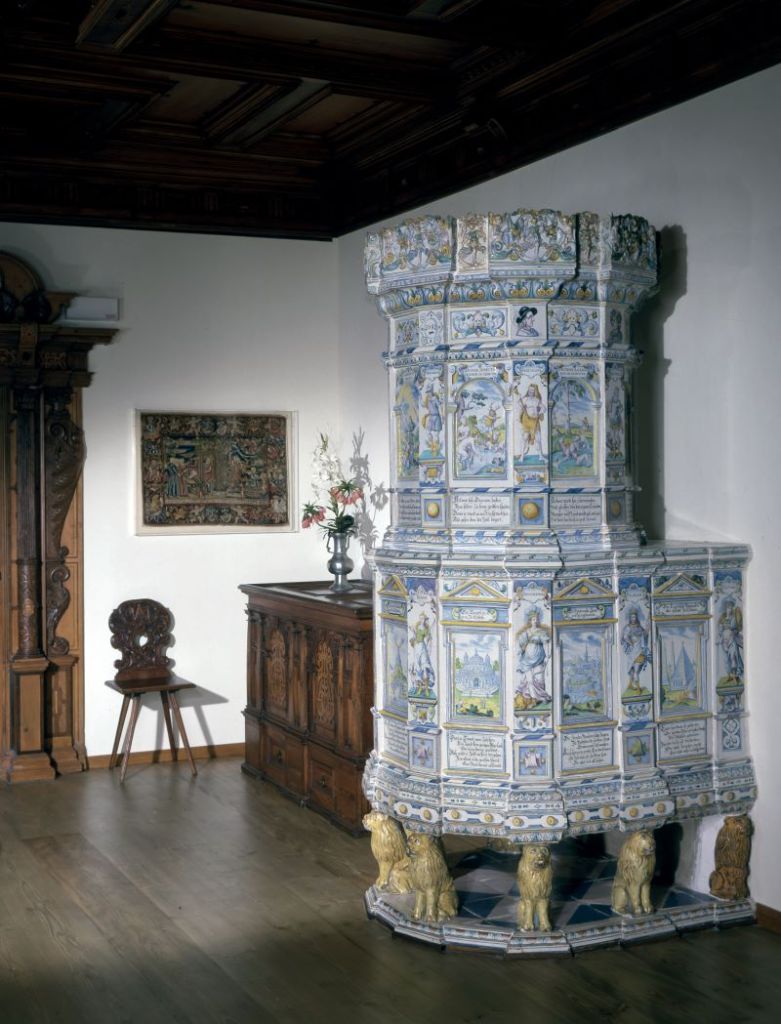
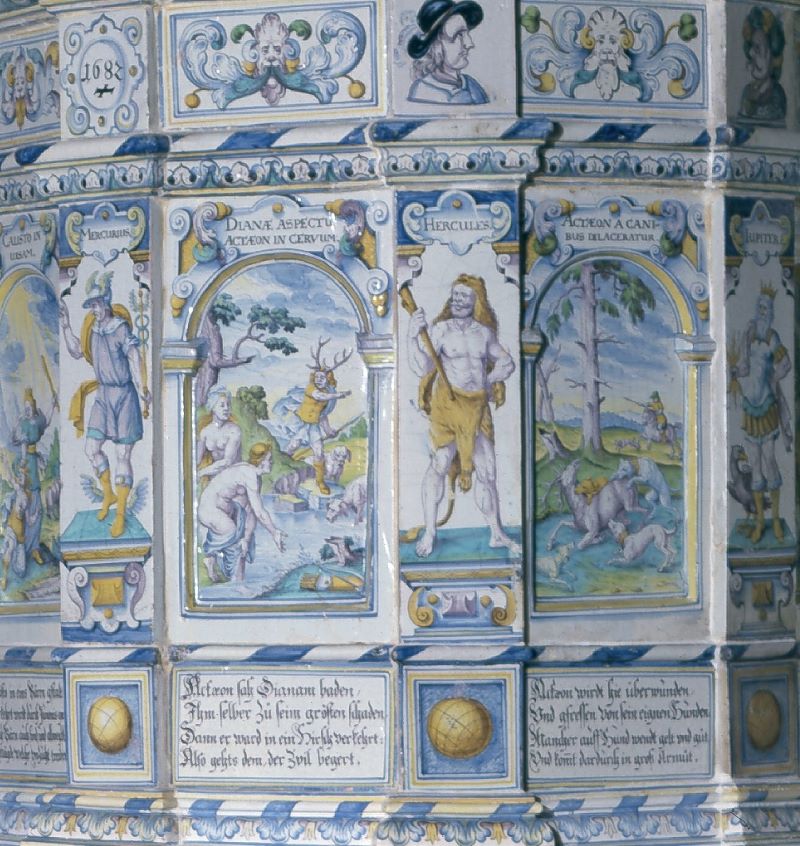
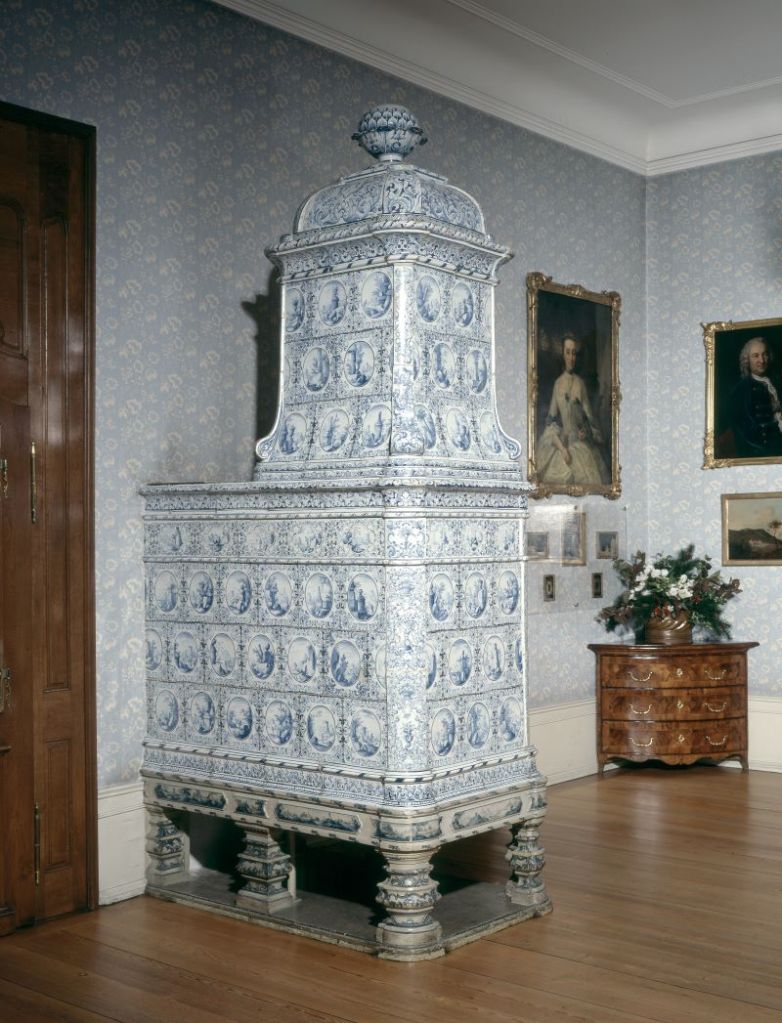
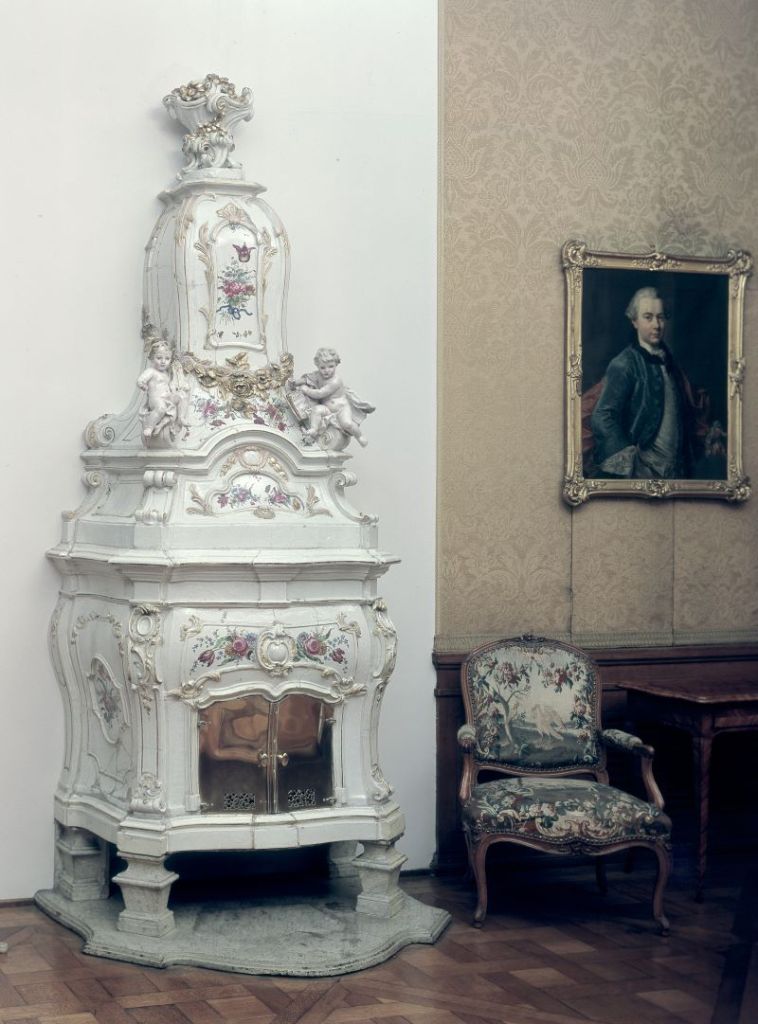
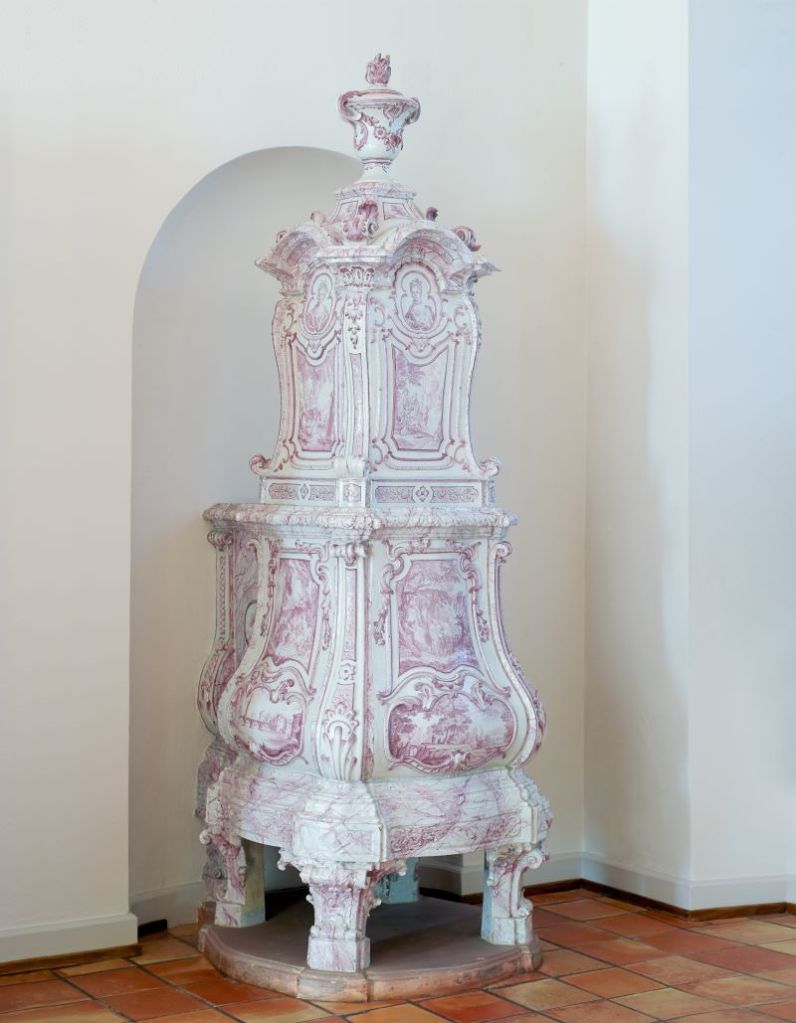
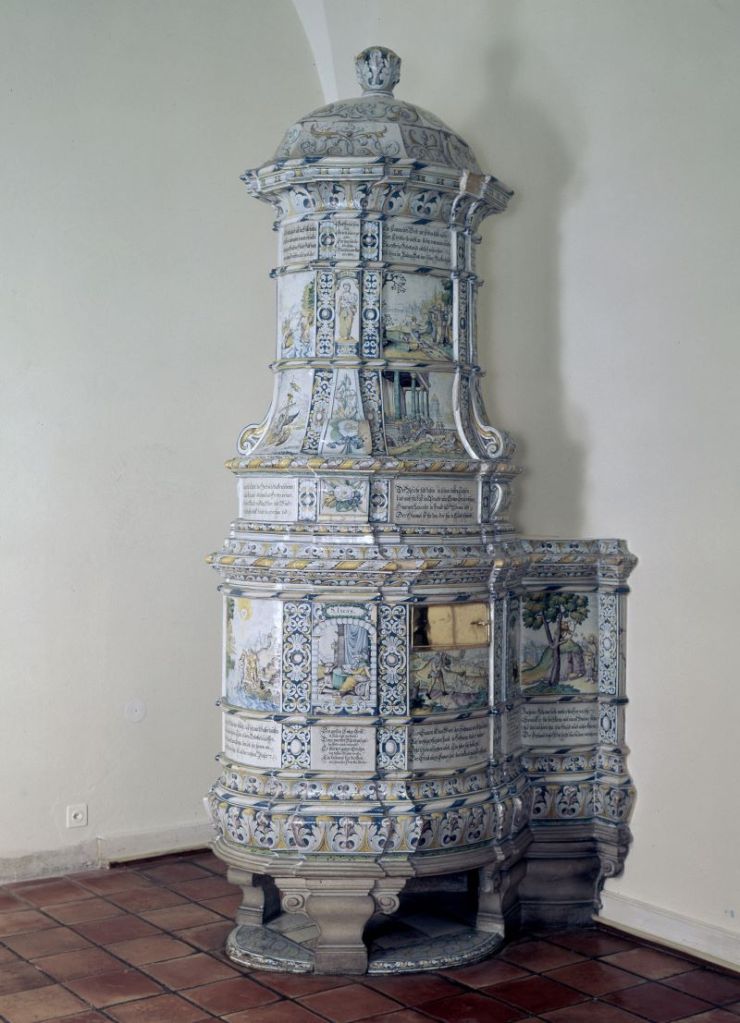
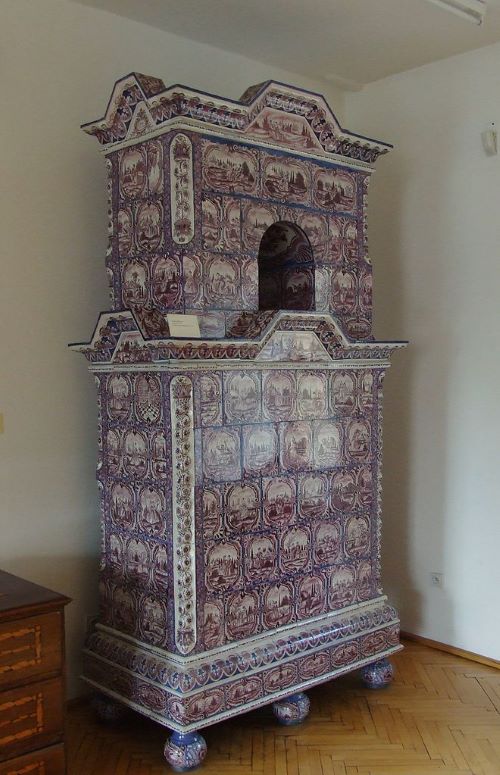
Take a few minutes during the cold winter months to enjoy these Swiss ceramic tile stoves. Ceramic factories in Winterthur and Zurich produced elaborate tile stoves for wealthy Swiss patrons from about 1550 through the mid-1700s. The stoves provided radiant heat to keep rooms cozy during long Swiss winters. The enclosed stove chamber also contained sparks to reduce risk of fire.
ⓒHistorisches Museum Basel, Maurice Babey
The stove above, displayed in an architectural setting, gives you a sense of the scale of these pieces. Looking at a close-up of this piece (below), you can see some of the marvelous detailed work on inset tiles, as well as the structural elements of the pieces.
ⓒHistorisches Museum Basel, Maurice Babey (detail)
I found several examples of these tile stoves in the online collection of the Basel Historical Museum. Click the images to link to museum information about each piece.
ⓒHistorisches Museum Basel, Maurice BabeyⓒHistorisches Museum Basel, Maurice BabeyⓒHistorisches Museum Basel, Natascha JansenⓒHistorisches Museum Basel, Maurice Babey
Another wonderful example of a Swiss tile stove is exhibited at the Metropolitan Museum in New York, shown below. The piece is displayed in a larger architectural setting (the “Swiss Room”) so you can visualize how these stoves may have originally appeared in homes of wealthy Swiss patrons.
Stove, ca. 1684–85; Attributed to the pottery of David II Pfau; Metropolitan Museum of Art
A detail shot of this piece from the Met’s website:
Stove, ca. 1684–85; Attributed to the pottery of David II Pfau; Metropolitan Museum of Art
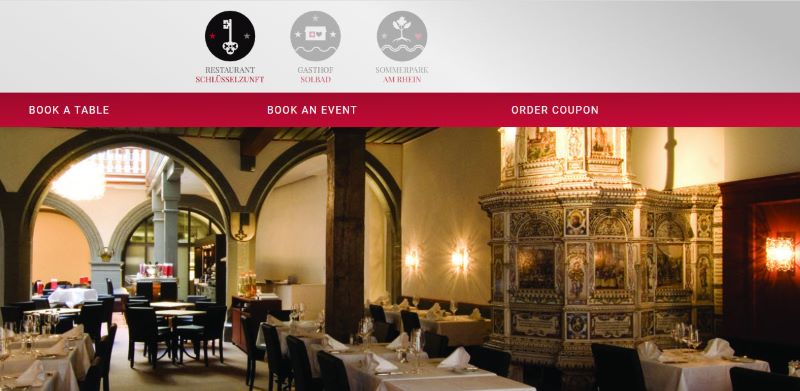
A few ceramic stoves are scattered around different buildings in Swiss cities. I found this image of a ceramic stove in Restaurant Schlüsselzunft in Basel, Switzerland, on their website.
Ceramic stoves are efficient heaters. They take longer to heat than, say, metal, but once heated the ceramic stove will radiate this heat over a long period of time – for 18 to 36-hours in some cases. Mark Twain had some observations about the efficiency of these “German stoves” in his book “Europe and Elsewhere”:
“Take the German stove, for instance … it is by long odds the best stove and the most convenient and economical that has yet been invented.
To the uninstructed stranger it promises nothing; but he will soon find that it is a masterly performer, for all that. It has a little bit of a door which seems foolishly out of proportion to the rest of the edifice; yet the door is right; for it is not necessary that bulky fuel shall enter it. Small-sized fuel is used, and marvelously little at that. The door opens into a tiny cavern which would not hold more fuel that a baby could fetch in its arms. The process of firing is quick and simple. At half past seven on a cold morning the servant brings a small basketful of slender pine sticks – say a modified armful – and puts half these in, lights them with a match, and closes the door. They burn out in ten or twelve minutes. He then puts in the rest and locks the door, and carries off the key. The work is done. He will not come again until the next morning. All day long and until past midnight all parts of the room will be delightfully warm and comfortable, and there will be no headaches and no sense of closeness or oppression. In an American room, whether heated by steam, hot water, or open fires, the neighborhood of the register or the fireplace is warmest – the heat is not equally diffused throughout the room; but in a German room one is as comfortable in one part of it as in another. Nothing is gained or lost by being near the stove. Its surface is not hot; you can put your hand on it anywhere and not get burnt.
Consider these things. One firing is enough for the day; the cost is next to nothing; the heat produced is the same all day, instead of too hot and too cold by turns; one may absorb himself in his business and peace; he does not need to feel any anxieties or solicitudes about his fire; his whole day is a realized dream of bodily comfort.
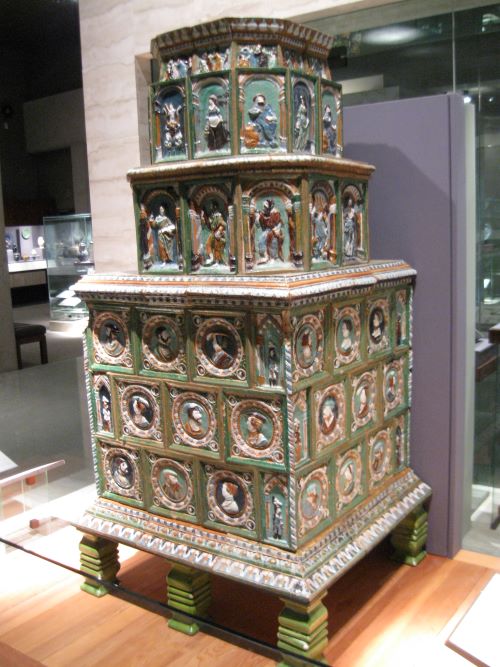
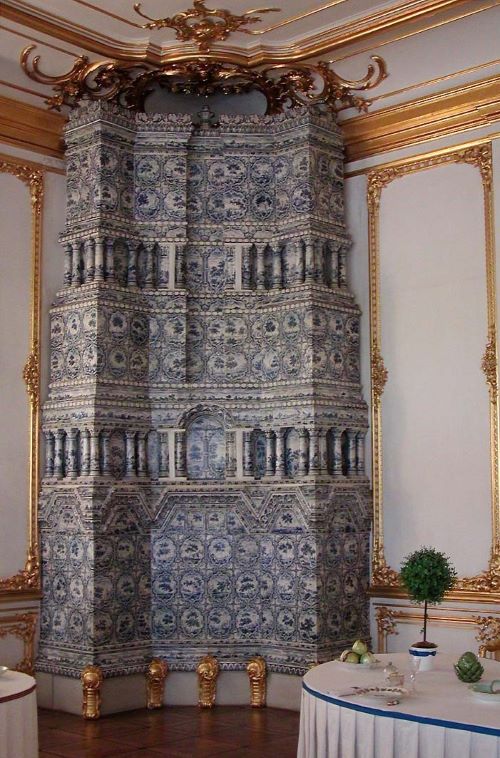
For this reason ceramic tile stoves were used across Europe. I found interesting examples of tile stoves made in Germany, Latvia, Poland and Russia.
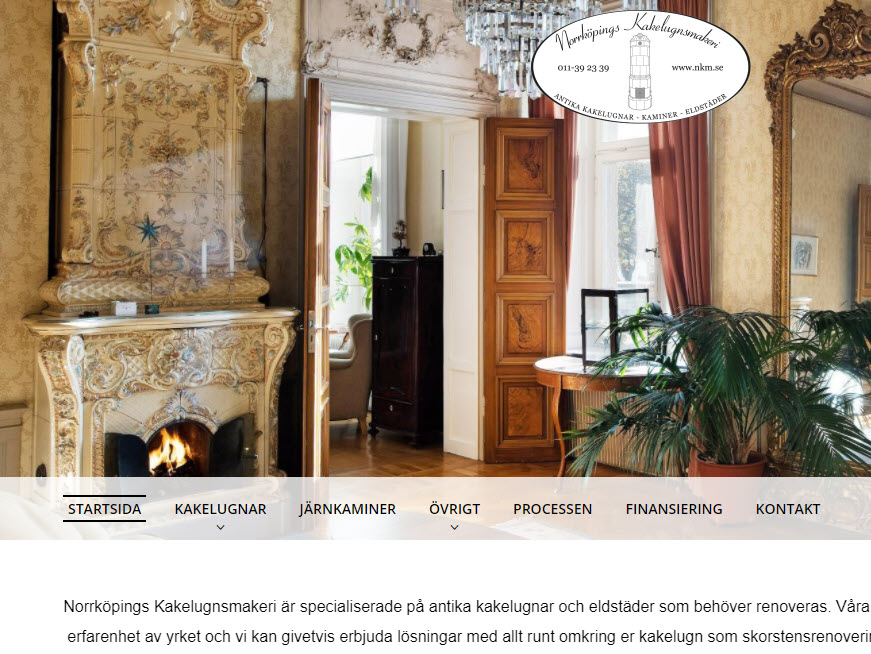
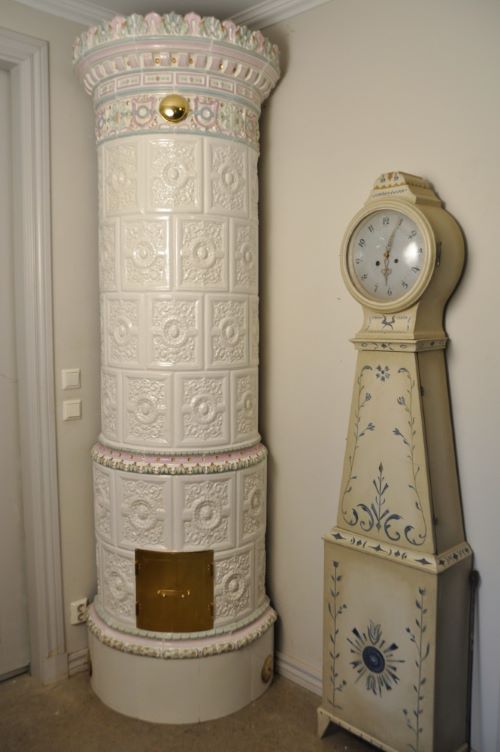
Ceramic tile stoves are still produced and used today. Most producers I found are located in Scandinavia, particularly in Sweden. Norrköping Kakelugnsmakeri, a Swedish company “specializing in antique tiled stoves and fireplaces that need renovation” offers a variety of tiled stoves for sale. Click here or on the image below to access their website.
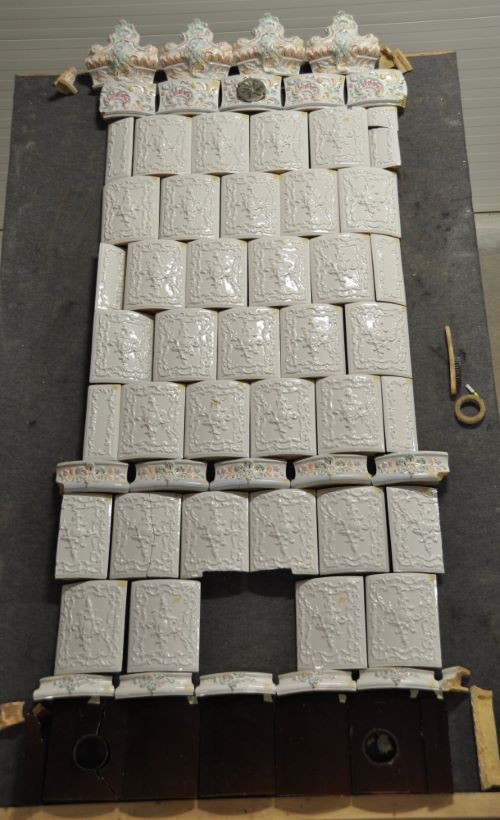
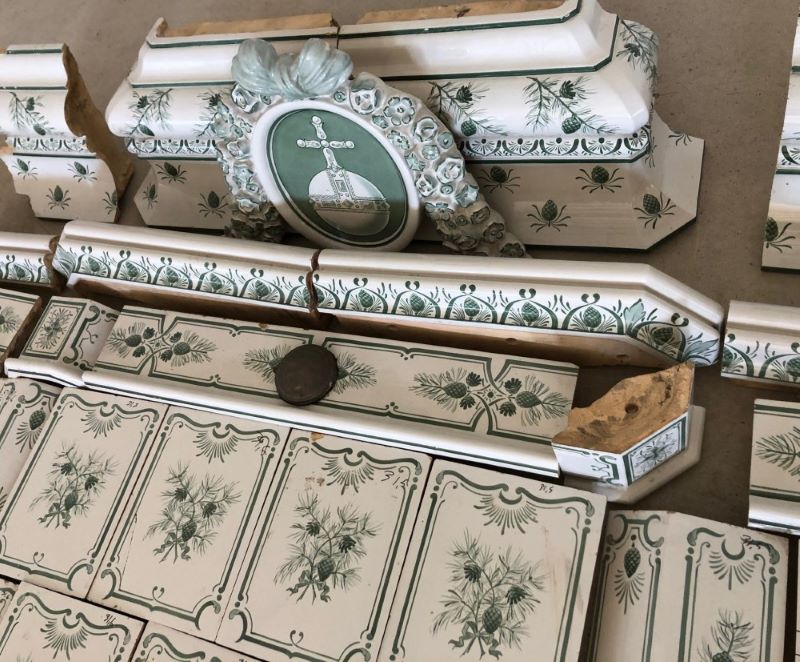
Some Norrköping product photos show disassembled parts, indicating how these stoves are built and assembled.
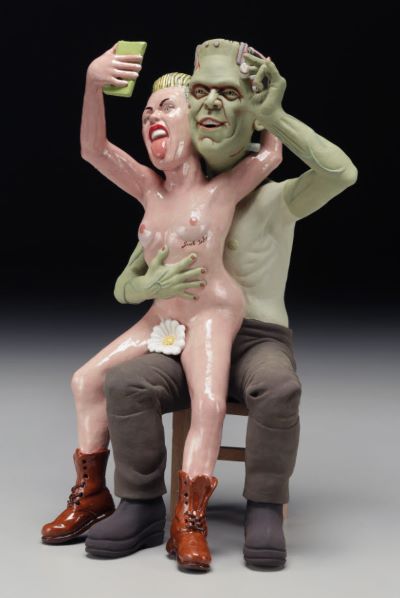
I like Russell Biles’ work. A lot. But I admit not everyone shares my enthusiasm. My wife, for example. I say this guy is provocative, she says he picks at scabs. Perhaps it depends on your perspective or approach to art. Everyone should be able to agree that he is a skilled craftsman and extremely imaginative.
JW: How do you work? Do you sketch ideas out first and then build them out in clay? Will you tell me about your process?
RB: All my hand-built work is very thin coil built. I model plastilina for the cast work. I like to work directly out of my head with little if any drawing. When making a specific person I use photos. I prefer hand-building. I have developed a very technical style of hand-building on my own.
JW: Are there 2-3 pieces you could discuss in particular detail: where the idea originated, how you made it, decisions you made along the way, etc?
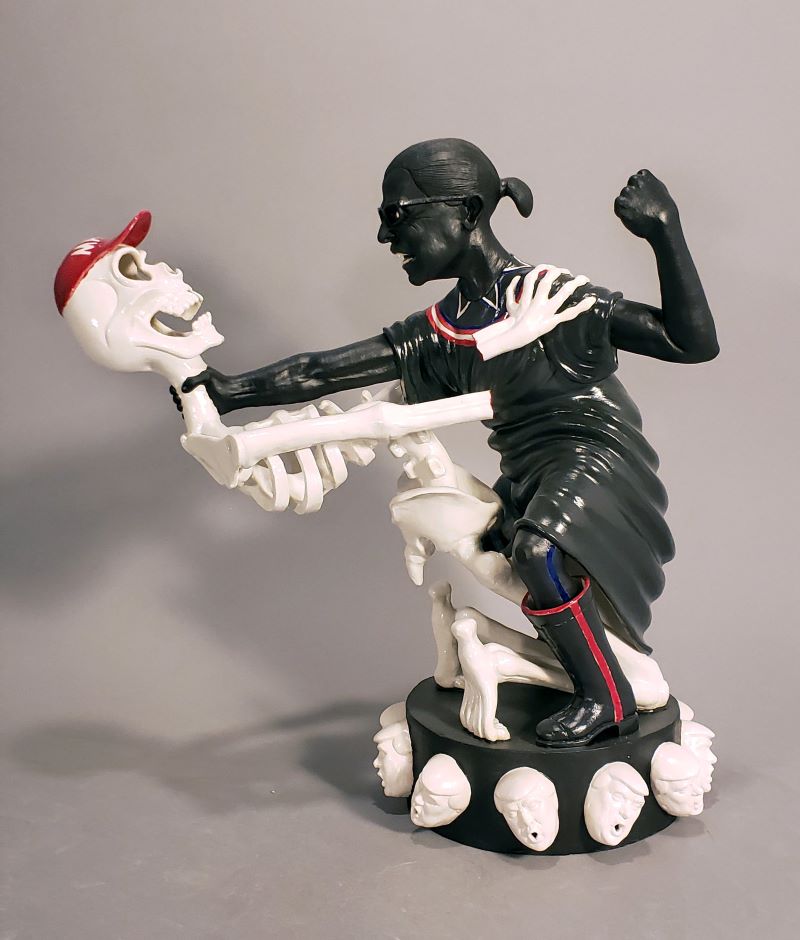
RB: Let’s first look at a sculpture I call “Captain America Calling.”
After I decided to do a RBG piece about her struggle, the image of Granny from the Beverly Hillbillies kept going through my head. (I’m a big fan and have great respect for the Beverly Hillbillies and did a very successful piece “Beverly Hillbillies 911” which was acquired by the RAM; I can recall every TV episode.) The episode that kept going through my head was when the Beverly Hillbillies took on professional wrestl’n – It was Grappll’n Granny vs the Boston Strong Girl and family.
Captain America Calling
Captain America Calling – detail
This is how I saw RBG in her fight against death to defeat Trump. Having taken care of my parents, I knew exactly the struggle RBG was going through. This was a classic fight against death and evil for the good of our country and the human race.
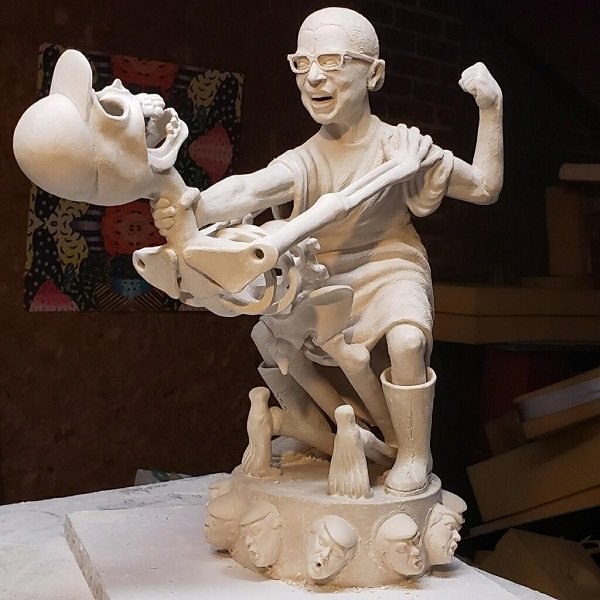
Capitan America Calling – in process (Photo: East City Art)
The image developed from the bottom up which is how I work. The choice of black and white was a reversal of the perception white is good and black is evil (a concept I’ve frequently used).
To the left: “Capitan America Calling” in process.
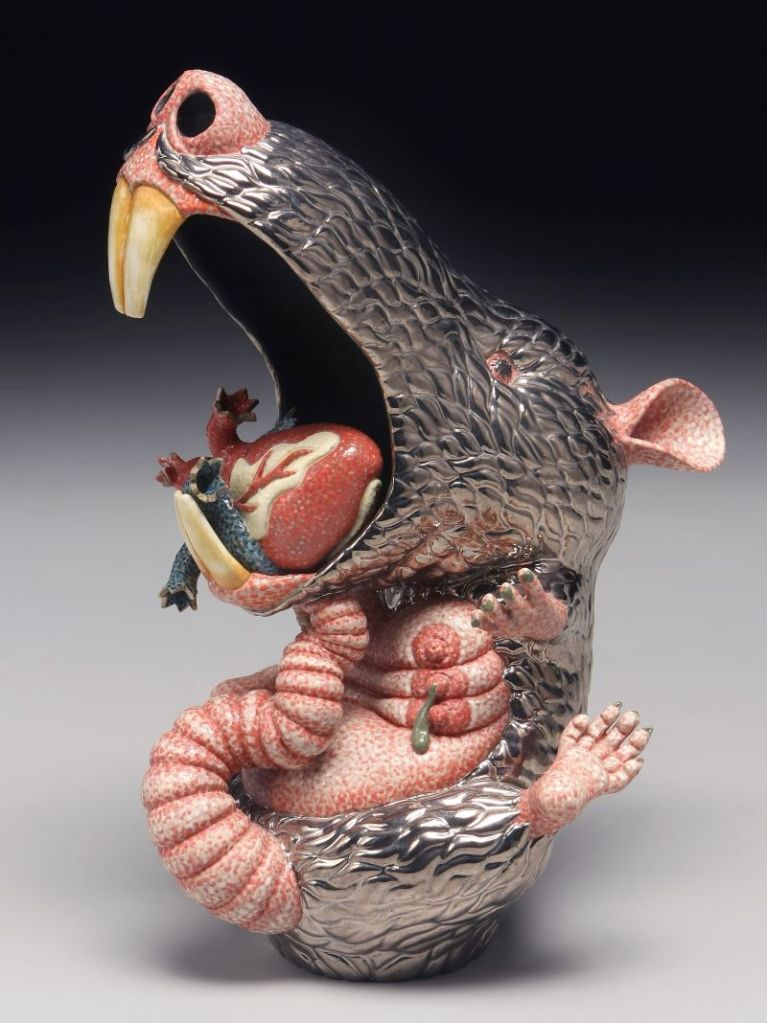
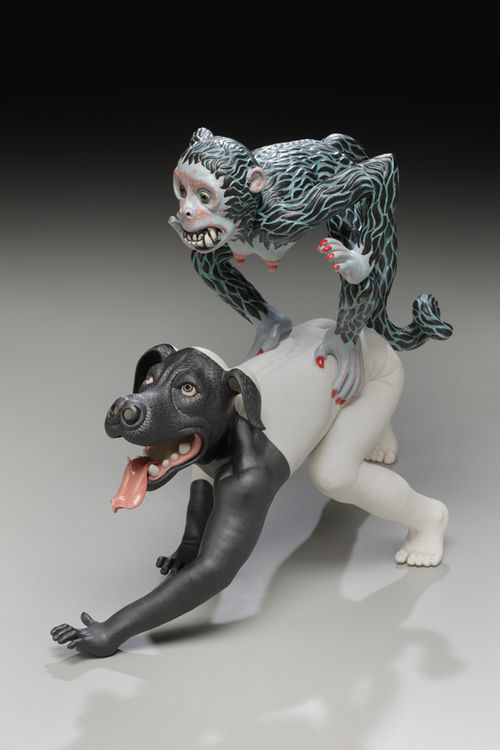
The second piece I choose to describe is “Nuts” because it was recently acquired by the AMCA and I had to give them an explanation. My belief is every man is possessed by a dog and monkey (monkey drives the dog nuts). They represent the struggle or need for lust and it’s confusion with love. My representation is personal but also inspired by “Night of the Iguana” by Tennessee Williams and the subsequent movie. (This film review may help explain.)
Nuts
I have successfully used the dog and monkey theme in several sculptures.
Here is another example.
JW: Can you give me a sense of the scale of your figurative work? Some pieces look very small, others look quite large.
RB: I have slip cast works up to 13 ft. long.
JW: You made clay monsters and animals as a child. How have those “characters” changed since your days as a child? And do those changes reveal anything about you?
RB: As Charles Bukowski said, “I don’t hate people. I just feel better when they’re not around.”
Growing up I was considered very shy and paid the price. Now I’m labeled anti-social (born this way). In the first grade I would draw monsters all over my work papers with dots along the bottom of the page (these were people). Now people are the monsters. Actually people have always been monsters to me.
I think this change reveals I’m better at articulating myself without fear of repercussions. Also, I’ve learned to be social.
JW: I see many commercial, religious and political references in your work. Do you incorporate this iconography consciously or do the references come spontaneously?
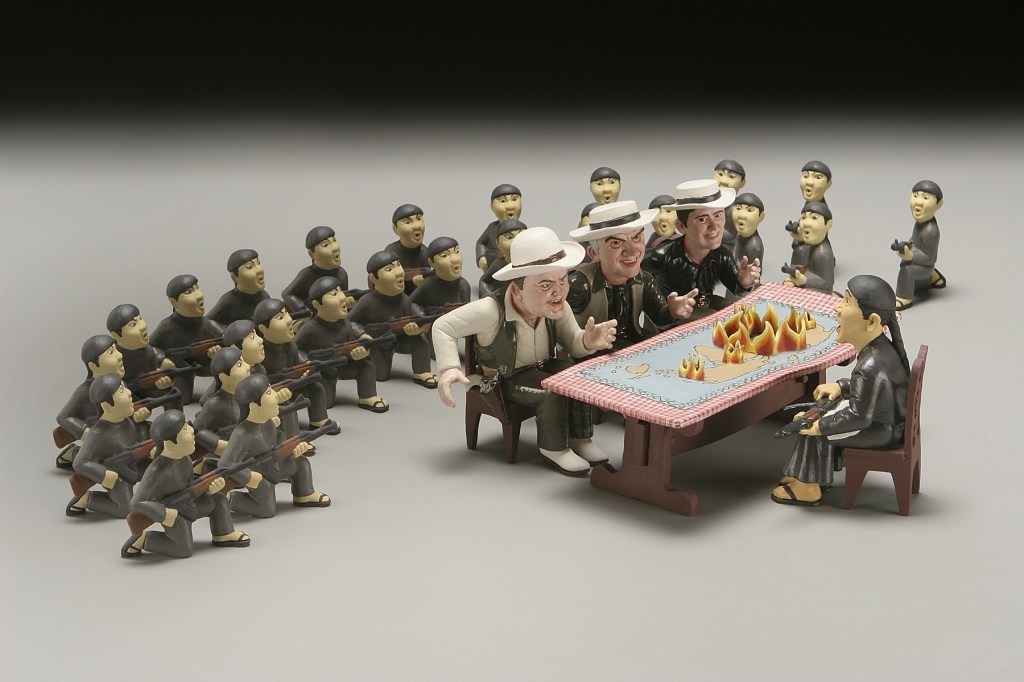
RB: Very conscious. The images are direct reflections of our culture.
I was born and raised a Christian. I deeply believe Christian philosophy but not the magic. Religion good and bad is another reflection of our culture.
JW: Is there a trajectory or some type of progression in your figurative work?
RB: I think I will always critique our culture but I do believe my imagery has evolved. I produce what appears in my mind and what appears is figurative. Will I make pure abstract or feel good shit for the market? I don’t think so.
JW: How important is widely distributing your work and making it affordable to a wide audience?
RB: Making affordable work is very important to me. I really enjoy seeing people being able to own a piece of my work regardless of their economic situation. At one point I made gumball machines where anyone could get a series of my work for pennies.
Making affordable work is a creative challenge. People usually don’t realize that I make every one of the little pieces and although they are cast they take a lot of work – mind-numbingly boring work. The main creative challenge is simplifying the image in my head into a form that can be made from a two piece mold. Early pieces such as cookie jars took up to 13 piece molds and at that point the complex mold became a piece of art.
JW: How would you define your work and what you’re trying to achieve with your ceramics?
RB: I would define my sculpture as an honest critique of our culture from my perspective. The issues I pursue are historically and culturally relevant. My work represents subjects regardless of their popularity or political correctness and reach a broad audience on many levels. As far as pure ceramics go I would like to be able to say I can take the Pepsi challenge with any porcelain hand-builder in the world.
More of Russell’s work can be viewed on his website.






























 JTW Ceramics