The Museo Larco in Lima, Peru, has an extensive collection of Moche pottery. Moche pottery, made in what is now Peru from about 150-800 AD, is fantastically creative and well worth exploring.
Museo Larco – Lima, Peru
Moche potters used molds extensively to create vessels in the shapes of animals, vegetables & plant forms, faces, and humans engaged in a variety of activities, perhaps most famously, sexual activity.
Due to the pandemic, Museo Larco is closed. The museum does, however, have two virtual exhibitions covering portions of their collection: selected items from the permanent collection, and a tour of the “erotic room“. In both virtual exhibits, you move through internal museum spaces by clicking on circles, and from that circle you can rotate your view 360 degrees as well as zoom in to some extent.
To be candid, the image quality is not great, and you can only zoom in so far. But the virtual exhibitions give you a sense of the museum itself and the broad range of Moche ceramics.
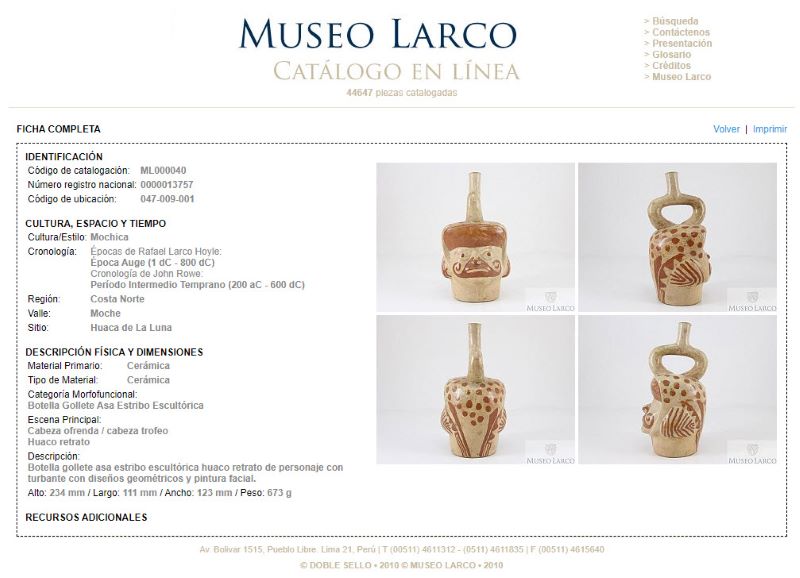
Museo Larco has digitized its entire collection and it is available online to the public. There is a search page, but unfortunately I found several key words (in English and Spanish) didn’t work well. I ended up just using “Moche.” Since there are so many items in the collection, scrolling through, page after page, isn’t very efficient. When you get to a particular object, the images are again adequate but not amazing. Still, I commend the museum for putting its entire collection online.
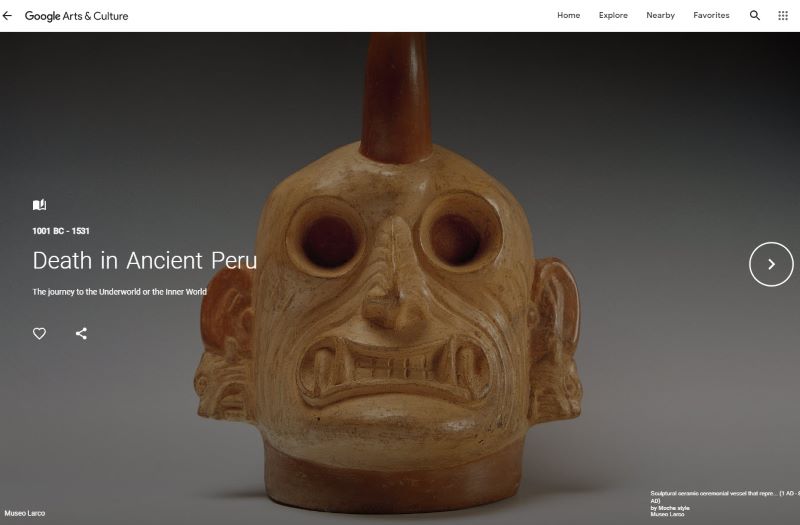
Easier to use, although undoubtedly less comprehensive, are resources offered through the Google Arts and Culture website. That site offers two “stories” and several “collections.” One story is “Death in Ancient Peru” and provides some larger context on the theme will examples of ceramics and textiles from the Museo Larco collection.
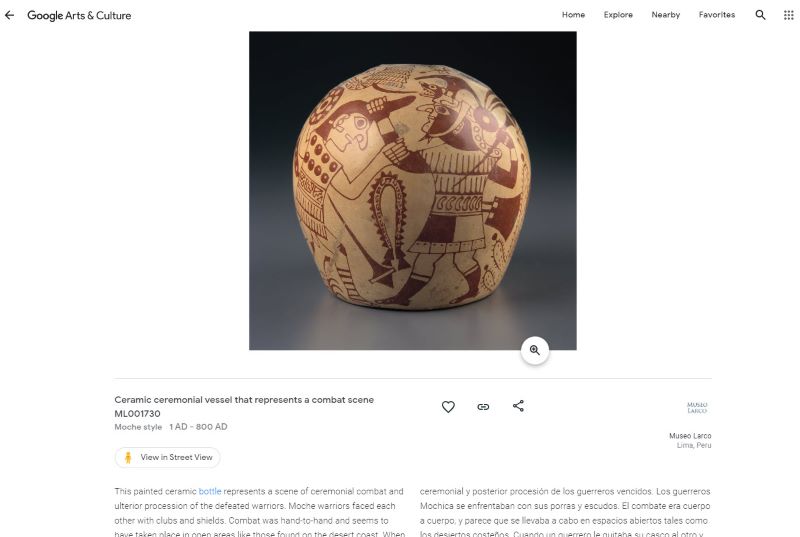
The Google Arts and Culture collections feature more examples of the museum collection, plus detailed information on each piece – essentially catalog information with text descriptions (in Spanish and English), dimensions, provenance, etc. The site also allows the viewer to zoom into the image which is very nice.
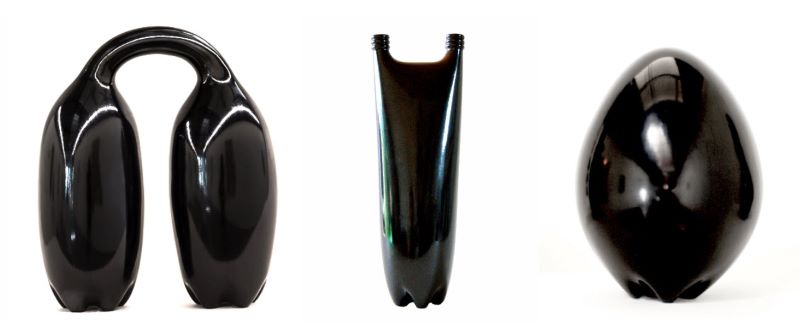
Jami Porter Lara’s work is inspired by plastic water bottles used by immigrants who walk across the Southwestern US border into the United States from Mexico.
Her work is stark, simple, focused and elegant.
To me it speaks of the land from whence it springs, and of the people who inhabit that land (even temporarily).
Jami first touched art by taking a drawing class in her mid-20s. At age 40, Jami returned to school to earn a BFA at the University of New Mexico, first concentrating in painting and drawing. She took a course that ultimately changed her artistic trajectory. She explained this transformative experience as follows:
In 2011, I traveled with a small group of artists to a remote stretch of the U.S.-Mexico border with a program called Land Arts of the American West. Our group spent a week camped in the high desert grasslands of Coronado National Forest, and I spent days roaming the rolling hills of its southern extent, where the international border is marked by a low vehicle barrier.
On my walks I found many indications of human passage through the region, but the most common things I found were two-liter plastic bottles that had been used to carry water. In the same places I found bottles it is also possible to find potsherds left by the Mogollon culture thousands of years before.
Soon after, our group crossed the international border and traveled to Mata Ortiz, the northern Mexican village renowned for its ceramics. We spent a week with Hector and Graciela Gallegos who taught us how to make low-fire ceramic vessels in the same ways they have been in that region for tens and hundreds and thousands of years. We learned to forage and prepare clay, build with coils, burnish with a stone and reduction fire in a pit.
Upon my return to New Mexico, I kept thinking about how the plastic bottle and the ancient potsherd are essentially the same thing. Both were precious objects — vessels, capable of sustaining human life. I also began to think about them as evidence of a continuous flow — of people, culture, plants, animals, and objects — that continues in spite of attempts to sever it.
I wanted to connect the plastic bottle to a long lineage of vessels that have been used to carry water through deserts, and in so doing, to reveal my connection to the long lineage of humans who have—driven by necessity or desire—traveled these lands before or despite national boundaries.
And so the project began with two simple rules: I would 1) use the oldest local ways of working with clay to make vessels that 2) reference the plastic bottle, the most iconic and ubiquitous vessel of my time.
My methods are the same as I learned in Mata Ortiz. I harvest and prepare clay from a site near my home, build with coils, burnish with a stone, and reduction-fire in a pit.
The materials and technique and central to the concept of the work — the point is to make these contemporary sculptures in more or less the same way that ceramics have been made in the region for millennia. Therefore pit firing has been integral to the project from the beginning. There was quite a bit of trial and error involved in figuring out the timing, and then again lots more failure as the vessels got larger. It is a risky process, but for conceptual reasons I’ve never seen kiln firing as an alternative.
JW: You mentioned your current work as a “project” – which suggests a body of work through a set period of time.
JPL: This project constitutes my whole history with ceramics, with the exception of a semester of Ceramics 101 at UNM, which, you may be interested to know, left me vaguely positive but mostly agnostic on the medium. It wasn’t until the experiences described above that I dedicated myself to it, and despite an ongoing ceramics project of many years, I still don’t identify as a ceramist.
“I grapple with what it means to be an artist who makes things in a culture of too many things … I’m making things that imitate the things we have too many of…”
JW: How do you reconcile being an artist who makes more things in a culture of too many things?
JPL: The blackware plastic bottle project was a way of placing myself dead center within the predicament of what it means to be a thing-maker in a world of too many things.
One of the ways of reckoning with it was the process itself. I foraged the clay. I foraged scrap lumber otherwise destined for landfills from construction sites. And a firing time of only about 1.5 hours meant that compared to the energy intensity of most ceramic production, my process used relatively few resources.
And finally, the low fired clay sculptures can practically melt back into the earth.
JW: What’s next?
JPL: In August I have a solo exhibition of brand new work titled “Terms and Conditions” opening at Gerald Peters Gallery in Santa Fe. It is a multidisciplinary project including textiles, sculptures, lithographs, neon, and porcelain.
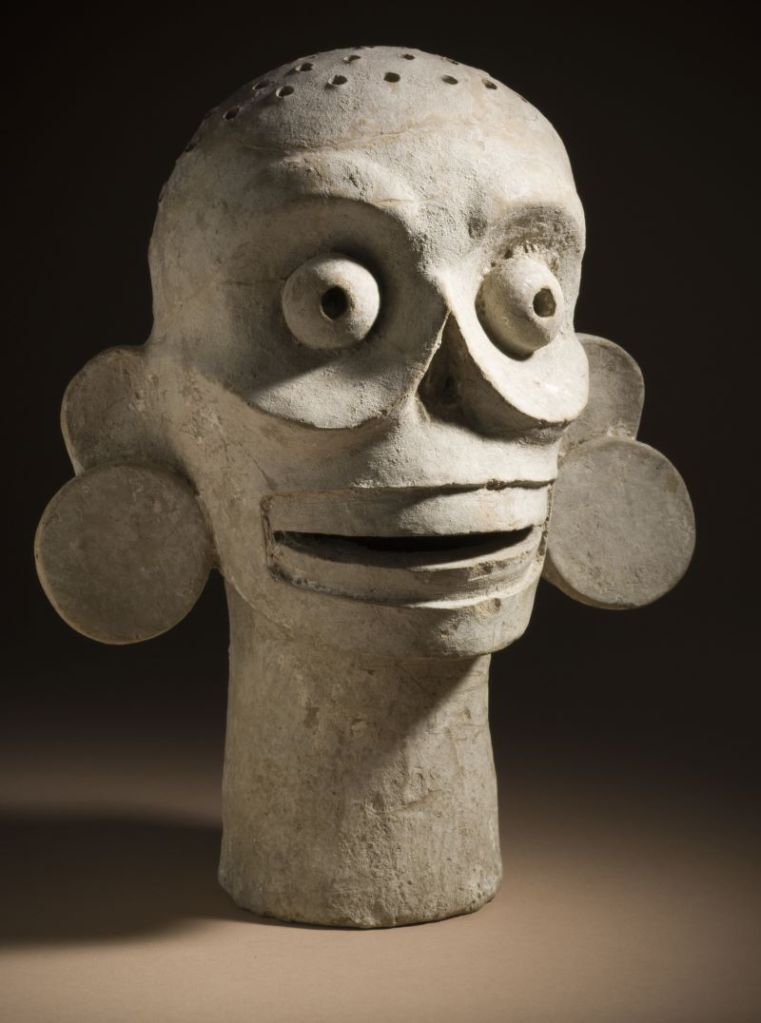
The Los Angeles County Museum of Art (LACMA) has an extensive collection of ceramics from around the world. I’m just beginning to explore its collection online. The museum seems to have an extensive collection of ancient ceramic vessels from Central and South American cultures.
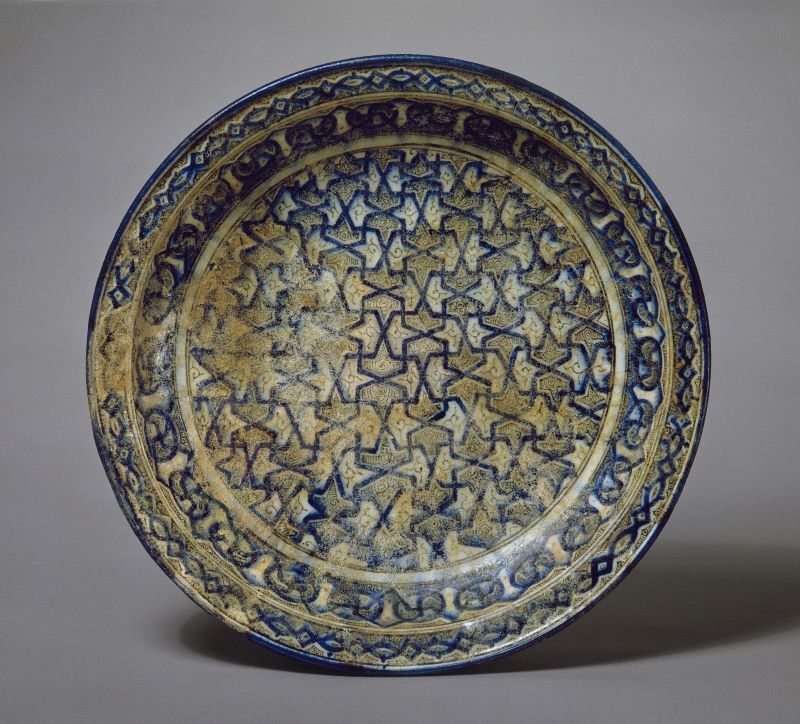
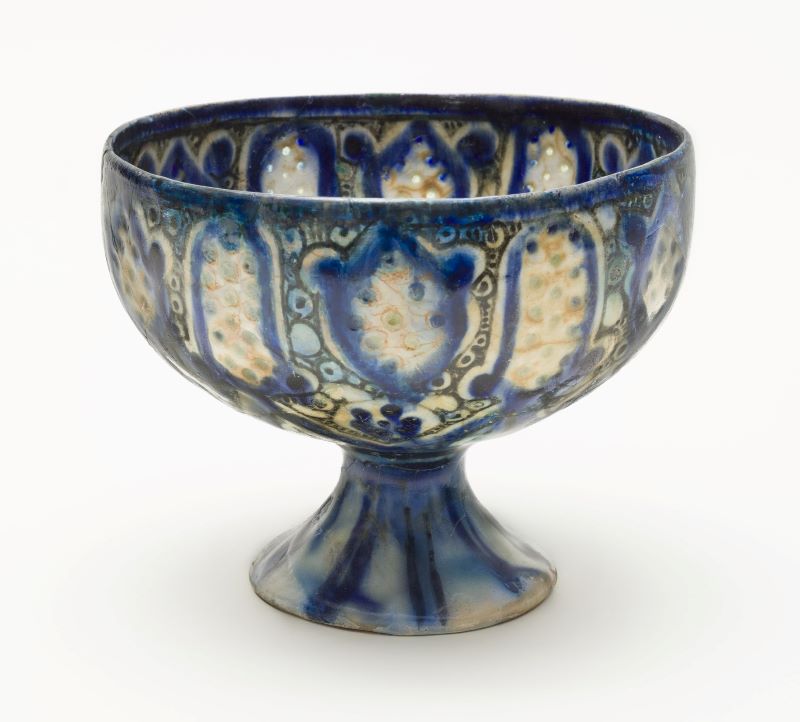
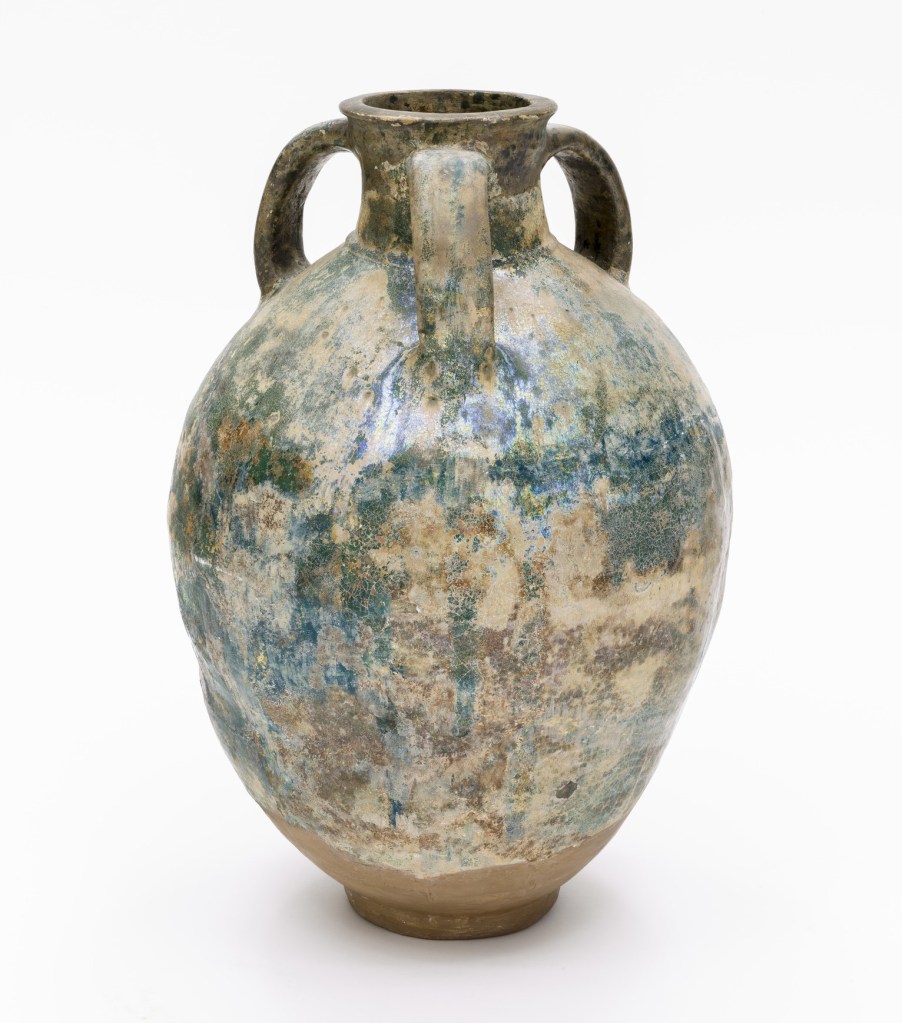
As a first pass, I used the museum’s collection search tool to explore some Islamic ceramics, several of which are embedded in this article.
Plate, Iran or Central Asia, 14th century, Fritware, underglaze-painted. http://www.lacma.orgGoblet, Iran, 14th century, Fritware, pierced and underglaze-painted. http://www.lacma.org
Note: when using the search tool, specific words can make a big difference, so play around a bit. I searched for “pottery; Peru” and got 2 results. Then I searched for “ceramic; Peru” and got 104 results. Generally, “ceramic” tends to yield more results than “pottery” from my quick testing (e.g., “ceramic; united states” gives you 483 results, “pottery; united states” gives you 135 results (filtered for results with images)).
Once you find a general area of interest, scroll through the images and then refine your search. For example, I tried a few general search terms (e.g., “ceramic; united states”) and then switched to use more precise searches (e.g., “dedham pottery”).
Bowl with epigraphic and vegetal decoration, Iran, Nishapur or Uzbekistan, Samarqand, 10th century, Earthenware with white slip covering and decoration in pigments under a transparent glaze. http://www.lacma.orgTile, Iraq, Baghdad, mid-13th century, Brick. http://www.lacma.org
On a separate note, LACMA has teamed up with California State University to offer internship opportunities to students interested in items in the museum’s collection. In the Fall of 2020, two archaeology students completed internships and wrote articles about ceramic pieces in the LACMA collection.
Katherine Gendron, student at CSU-Dominguez Hills, completed a project entitled “Art of the Ancient Ones – A look at Hohokam Pottery at LACMA.” Katherine’s online exhibition dives into the history of Hohokam pottery and provides excellent visual examples of several ceramic vessels. Katherine also provides a search link into LACMA’s Hohokam pottery collection.
Fernanda Hernandez wrote an article on the Museum’s Unframed online magazine entitled “Examining Tlatilco Figurines” where she describes her internship experiences using photogrammetry technology in a museum setting.
Fernanda’s 3D model is of a “Dog Lady” figurine. Both students posted their 3D models on SketchFab, an online hosting platform I described in an earlier post.
I like that the LACMA is engaging students as interns to research, explore and “distribute” information and visualizations of ceramics in the museum’s collection. It’s especially heartening to see the LACMA do this during the Covid pandemic. Bravo!
Storage jar, Syria, 12th century, Fritware, glazed turquoise. http://www.lacma.org
Maggie Curtis produces a variety of architectural ceramics, including custom-built ridge tiles, capitals, garden sculpture, embossed tiles and friezes.
Maggie started off as an art teacher with a side business as a studio potter. She was first exposed to architectural ceramics in 2000, when she needed to replace roof tiles on her own home. Her builder, knowing she did ceramics, suggested she make some of her own replacement tiles.
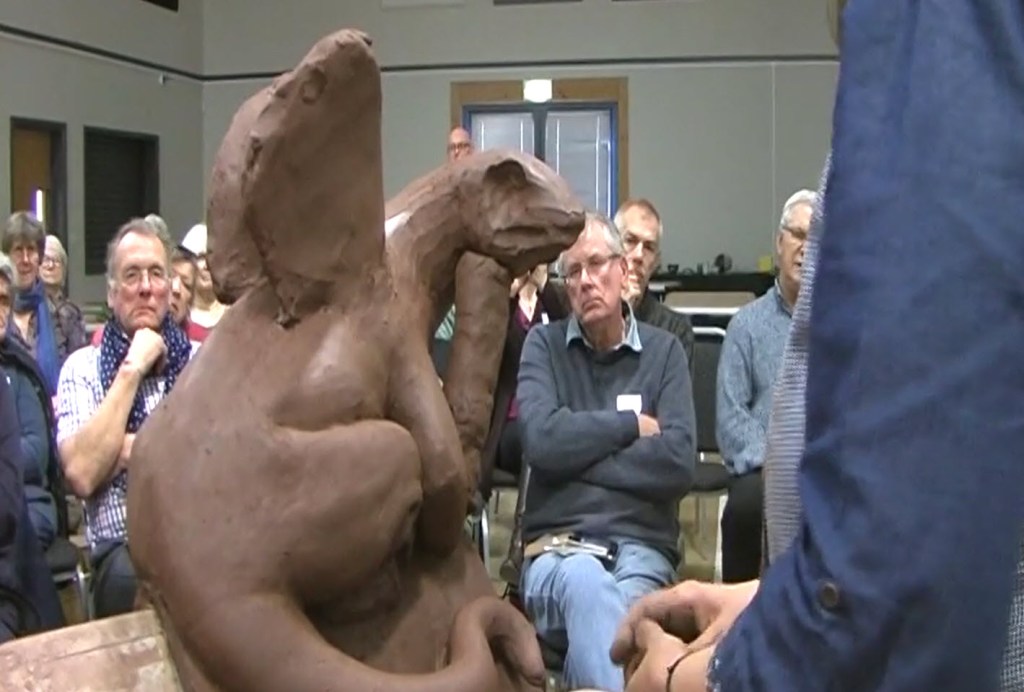
Some of Maggie’s work includes of ceramic “ridge tiles” – decorative sculptures that sit atop a tile bridging the two sloping angles of a building roof. Maggie sent me a video showing how she builds these ceramic pieces. In the video, Maggie creates a dragon sitting atop a rooftop ridge tile. Her process is confident and effortless – clearly the result of years of experience. First, Maggie forms a rooftop tile foundation by laying a thick clay slab across a wooden frame. Using coils of clay, she starts building the shape of a dragon perched upon the ridge tile.
Maggie builds expands and builds up the form using similar methods, roughing in the basic shape of the dragon.
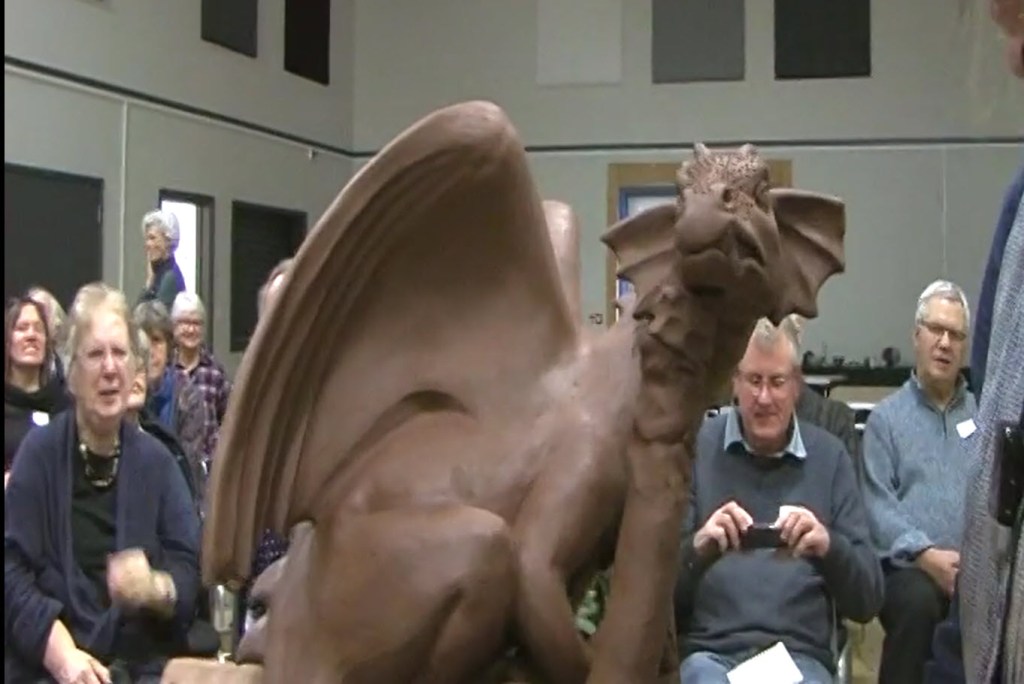
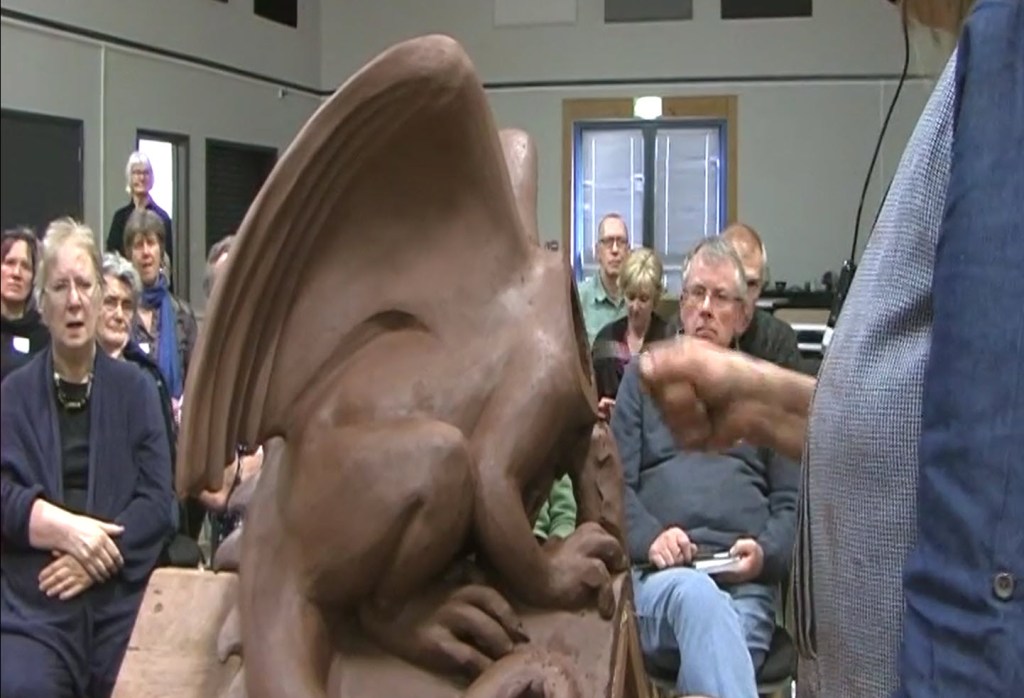
Once the basic shapes are defined, Maggie then adds detail, starting with the face but working out to wings & feet.
When the sculpture is complete, Maggie carves it into sections, evens out the thickness of the clay walls, and then reassembles the sculpture before drying and firing.
Here are a few images from Maggie’s website of rooftop ridge tiles that she’s completed for clients. They are wonderful, imaginative and playful architectural details custom-built to the specifications of her customers. I absolutely love these things!
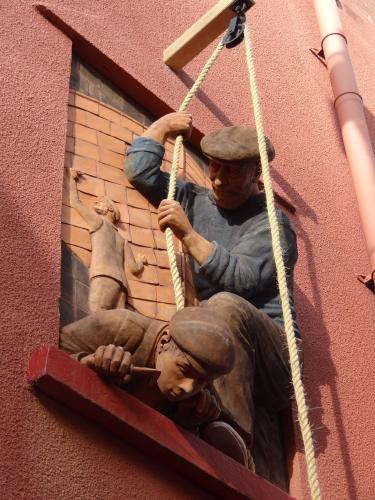
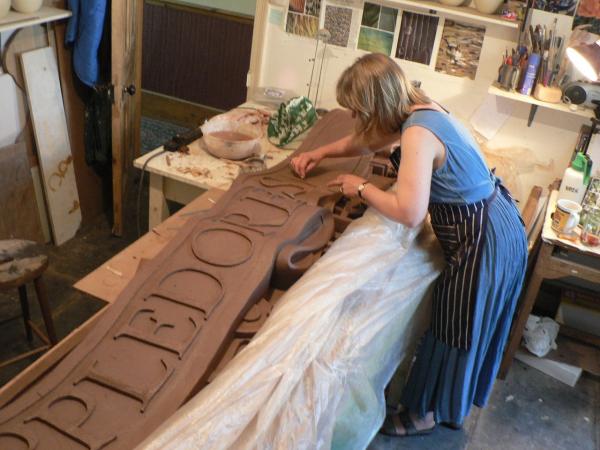
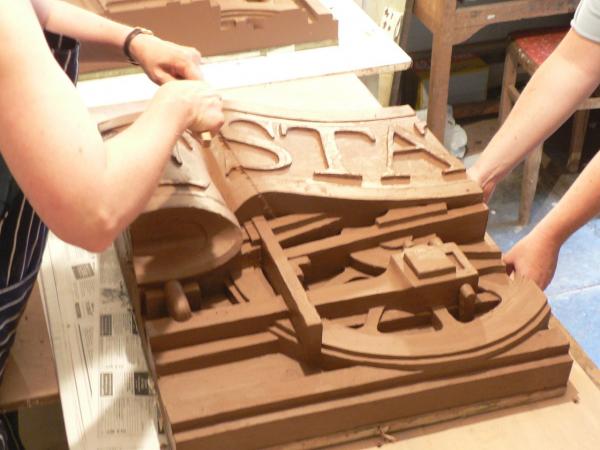
Maggie has also created different types of architectural ceramics. For example, she created a commemorative plaque for a the Appledore Rail Station in England.
These photographs illustrate Maggie’s creative process in building the Appledore Rail Station plaque. You’ll see that after designing and building the large piece, she cut it into smaller pieces for firing, reassembling those fired pieces on-site.
What’s not evident is the research she conducted for this plaque. Maggie told me that she worked closely with historians and railroad enthusiasts to research the specific locomotive details for the type of trains that ran on this particular rail line.
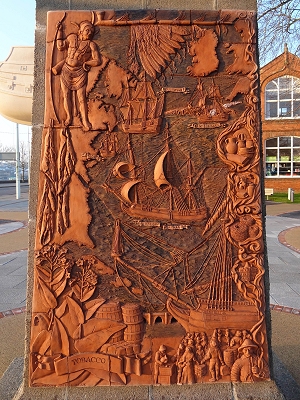
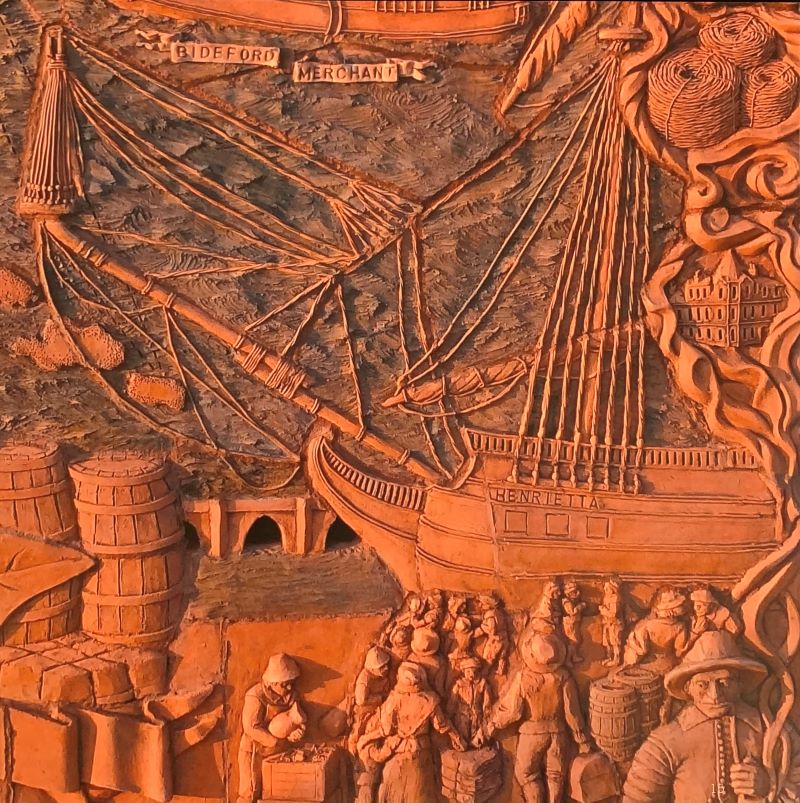
Maggie was also commissioned to produce several terracotta “Trade Maps” for a commemorative monument in the port of Bideford, England. She again conducted extensive research on the 16th and 17th century maritime trade centered in Bideford for the final Trade Map plaques.
Maggie sculpted stories of people, cargo and ships in the terracotta clay for this commission.
The port of Bideford was a major English shipbuilding and trading center during the American colonial period. Products transported in and out of Bideford include tobacco; salt cod; sugar; rum and timber in exchange for essential supplies such as woollen cloth, rope and tools; craftsmen; shipwrights; emigrants; convicts and indentured servants. Interestingly, local Bideford pottery was also a big export to the Americas. Six potteries were needed to supply domestic and decorated slipware, and examples of Bideford pottery have been excavated in Virginia, New England and Newfoundland.
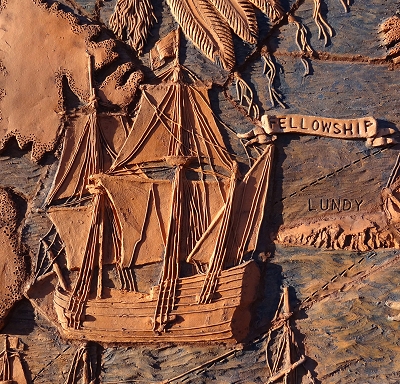
Detail on the Trade Map plaques is impressive, again reflecting Maggie’s work with local historians. The Fellowship, for example, was Bideford-built in 1630, jointly owned by George Shurt and John Strange, who were sending ships to Newfoundland, and later established trading links with colonies in Virginia and New England. Cargo included earthenware pottery sent to the American colonies.
Maggie subsequently published a book that describes some of the ships and cargos memorialized in the Trade Map plaques. It’s fascinating, and adds interesting color to a somewhat sanitized view of colonial America taught to US students. Take Maggie’s description of the ship “Henrietta,” as an example:
Owned by Philip Greenslade, the “Henrietta” [is shown] shipping earthenware to Virginia, Maryland and Barbados. Also part of the outgoing cargoes were emigrants, indentured servants and convicts. Craftsmen were in great demand, not least ship builders. Bedfordian John Smith built at least two 200-ton ships in 1696 on the Chester river, Chesapeake Bay: the “Entrepot” and the “John.”
From 1708 to 1714, emigrants from wealthy families were attracted by the prospect of increasing their trade and acquiring land, and their servants were encouraged to join them by having their passage paid. The Transportation Act was intended to deter criminal activities by sentencing those convicted of even petty crimes to transportation to the colonies, where they would provide free labour to the colonists. Shipping merchants received 5 Pounds for each convict taken. Bideford was a favoured port where George Buck alone took 16 shiploads of convicts [to the American colonies] between 1726 and 1743.
Maggie posts additional information and resources related to the Trade Maps on her website.
The Everson Museum of Art has an extensive ceramics collection. How can a member of the public best access that collection? An earlier post described the Everson’s blog and how users can leverage that blog to access parts of the collection.
This post covers three additional online resources offered by the Everson: Object Study Sessions, a newly-announced “Salt and Pepper” zoom series, and virtual exhibitions.
Object Study Sessions
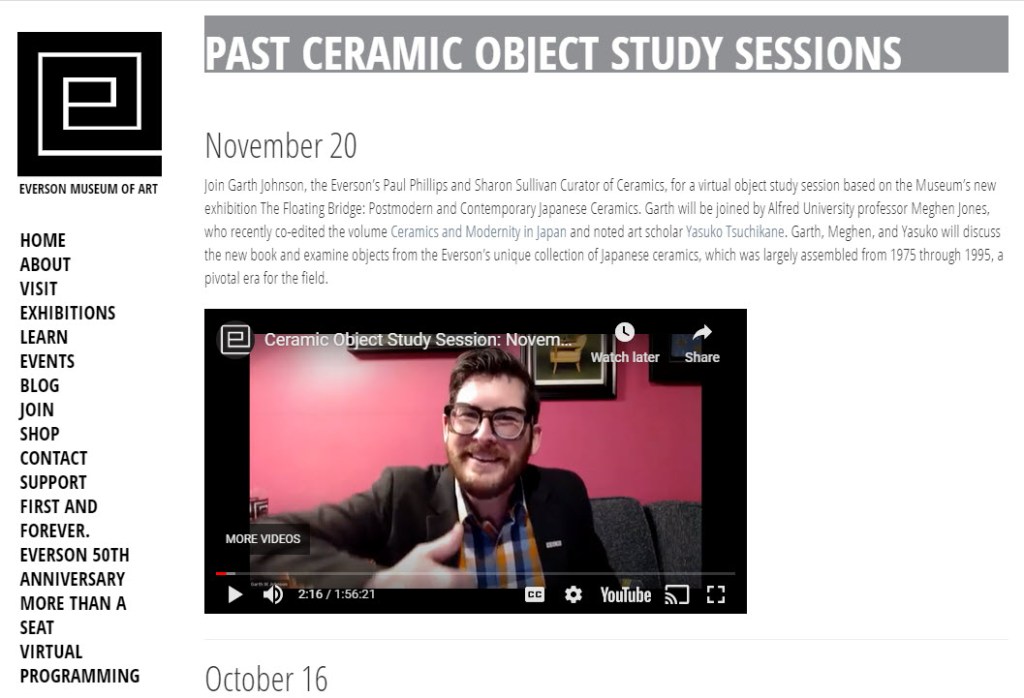
Garth Johnson, the Everson’s Curator of Ceramics, recorded 23 “virtual study sessions” on ceramics. These recorded video discussions take a deep dive into a wide variety of topics such as:
The Floating Bridge: Postmodern and Contemporary Japanese Ceramics exhibit
Adelaide Robineau’s early porcelain work
A conversation with Rebecca Sive. about her collection of American women’s ceramics and the role that women played in the studio ceramics movement
A conversation about “Kitsch” with artist Ryan Wilson Kelly
An interview with Janet Koplos, former editor of Art in America, about her book, “What Makes a Potter: Functional Pottery in America Today”
All recorded Object Study Sessions are listed on the web page shown below (click here or on the image below go directly to the Museum’s site for recorded study sessions).
Salt And Pepper Art/Food Series
The Everson recently announced a partnership with Salt City Market to bring people Salt & Pepper, a new art/food series via zoom. The sessions will consist of Museum-sponsored conversations between artists in their studios and chefs in their Salt City Market kitchens about culture, history, and technique. Pre-registration is required for each event. The first three Salt and Pepper events are:
The Everson has a number of virtual exhibitions hosted on their website. These feature more than the Everson ceramics collection, but there are these specific virtual tours of portions of the Everson ceramics collection (some on YouTube, others 3D visualizations)
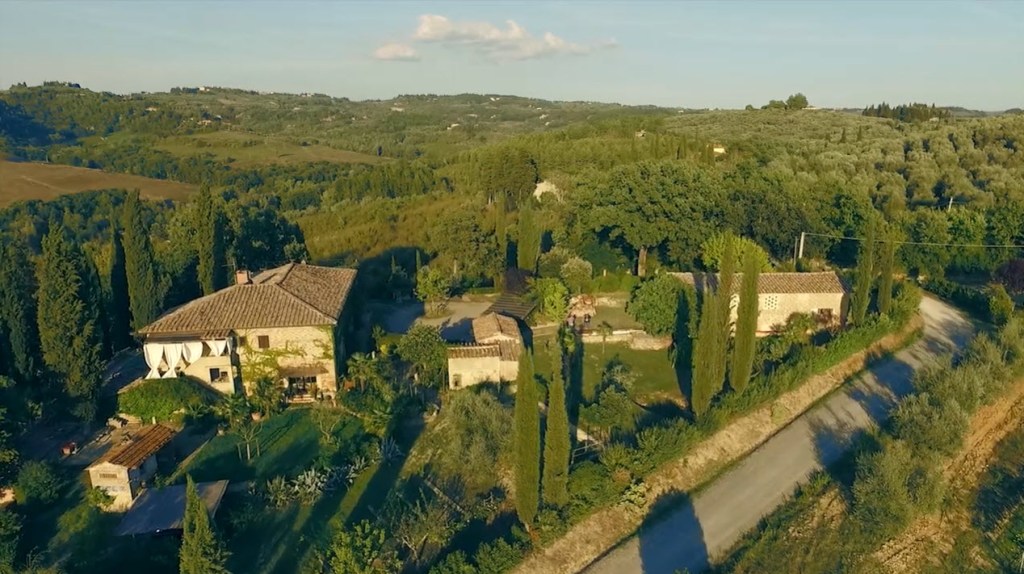
Set in the rolling hills of Tuscany, La Meridiana International School of Ceramics offers a full range of ceramics courses and residency programs for students at all levels. La Meridiana is open, and studios have been adapted to meet up-to-date COVID safety standards.
La Meridiana currently has 28 different courses & programs listed for 2021, beginning in April and ending in October. Courses are generally 1 week or 2 weeks long. (One 3-month residency program is already underway and a 2nd, 2-month residency program runs from October through December.) A list of 2021 classes can be found here.
The facility has 3 on-site apartments, ranging in cost from EUR200 – 400 per week (apx. $240 – $480 per week). In addition, students rent studio space at EUR200 per week (another $240). A week consists of 6 days (arrive Sunday after 3:00PM, depart on Saturday by 11:00AM). Students purchase clay and pay for firings (splitting costs of any firings). More cost information can be found on La Meridiana’s website.
In an effort to penetrate beyond marketing materials, I asked three people (Ursula McGivern & John Davidson who both attended as students, and Sandy Lockwood, who has taught multiple courses at La Meridiana) for their impressions of the La Meridiana experience. Here is what they told me:
JW: What are reasonable expectations for 1-week, 2-week and longer programs? Do students primarily observe and learn techniques with the idea of taking those ideas home to practice & put into use? Or do they make & fire vessels?
Ursula (Student): My partner and I attended a two week course in La Meridiana on two occasions once in 2014 an again in 2017. Both were with Will and Kate Jacobson for Naked Raku Mica Infusion. On both occasions we had demonstrations of the techniques involved at each stage of the process followed by hands on throwing, glazing and firing of completed pieces. We were able to take home any finished work
John (Student): Mine was a two week course and for the most part it was hands on. The instructors would give a demo for and hour or so in the morning and after lunch and the rest of the day we would work on our pieces. The studio was open after hours as well. The instruction would evoke as our progress on the technique would progress. By the time the course ended we all had completed several pieces. La Meridiana arranged the shipping of any pieces that we wish shipped back. This was of course at our expense.
Sandy (Instructor): At my studio I offer intensive courses for three or four days. They are full on making and development courses. Generally there are a couple of demos each day and students make intensively. Students generally apply themselves and make sound progress during the course. They also develop an understanding of what they need to do after the course to maintain their momentum. Students at my workshops may leave work for bisquing and they can come back for a glazing day and then I’ll fire the work and they come back to collect when they are ready.
As for Meridiana, I think it depends on the teacher and teaching style. There are many teaching styles and many learning styles and things go best when these mesh well. My style is more a coaching approach that takes each student from where they are and guides them in their development.
Students observe and practice techniques and also develop ideas. So, the workshops form a foundation for further development.
I have run two two-week workshops at La Meridiana and they involved making pots for a week then they were bisqued while participants went on excursions to various interesting ceramics and non-ceramics related places. Then we loaded and fired the wood kiln and after that used the work for an Italian Feast which the in house chef prepared..Meridiana assists the organisation of shipping home any works students wish to repatriate.
The On Centre course that I taught was 3 months long. For that there is certainly an emphasis on developing skills/techniques but this also goes hand in hand with aesthetic development and discussion.
JW: Given the short length of many La Meridiana courses, do teachers focus on inspiring creativity / illustrating possibilities or teaching technique?
Ursula: Usually the course description indicates the Aims & Nature of the course, Teaching method specified and experience required for the particular course. In both experiences the course facilitators have inspired creativity and shown how to exploit creative and technical possibilities.
John: The techniques were presented A to Z and also many choices to enhance the creativity of the process.
Sandy: It depends on the approach of the teacher. I think generally these things are not mutually exclusive. Students learn technical aspects, and given the environment away from their usual life tend to feel more free to experiment. They also encourage and support each other.
JW: In your experience, do most students come to La Meridiana to learn new techniques or to improve techniques that they already employ?
Ursula: I would say to do both. In our case we were already working as studio potters specialising in Raku and went on the first occasion to learn the technique of mica infusion which is unique to the Jacobsons. On the second occasion we went back to the same course as we enjoyed the friendly ambience of La Meridiana and also to have the opportunity to work with renowned ceramic artists at the top of their game.
John: In our case everyone was new to the technique of Naked Raku but almost all had experience at different levels of ceramics. I know of two of our group who returned the next year to repeat the course.
Sandy: Both. See my comments above.
JW: a Meridiana is set in the Tuscan countryside and offers good food, wine, beautiful surroundings, etc. Do some (or many) students attend workshops primarily for the cultural experience vs. intensive ceramics training?
Ursula: I think the answer here again is both. We certainly went back the second time to meet up with the artists again and to enjoy the sunny ambience, good food, many cultural trips organised by La Meridiana as part of the course. We had visits to Certaldo Alto, the Etruscan Museum, San Gimignano and free days when the work was drying to visit Siena or Florence independently.
John: In our case everyone came for the intensive training but most either came before or were staying after for a holiday. It makes sense to combine the two in such a beautiful part of the world.
Sandy: I think it’s a mixture. Each student has their own balance of motives. In my experience there is a range of motivations including intensive ceramics learning, cultural experience, getting away from established routines, getting away from hassles of life and probably more.
JW: How do instructors balance different student expectations and skill levels?
Ursula: The class sizes are limited and tuition is 6-8 hours per day, the studio is open 12 hours per day. This gives time for instructors to get round all participants. The course will always state the level of experience necessary, so booking a class suitable for “all” you have to expect that very basic skills will be taught as well as more advanced techniques. We found the facilitators and all the staff at La Meridian very generous with their time and very willing to answer all queries.
John: In our case only two people had little to no ceramic experience and the instructors helped them produce more basic work and they seemed to enjoy the whole experience. As there is a lot of time each day to work, everyone has the time to work at their own pace and level.
Sandy: I cannot speak for others. I approach things from a coaching style as mentioned above. This means adapting exercises and objectives to suit where the student is at. Good communication here is vital. I prepare my course offerings with this in mind.
JW: Do many spouses or partners accompany students? If so, what should those people expect?
Ursula: Spouses can accompany course participants and will pay a reduced fee to cover accommodation in a Tuscan Farm house along with their spouse. They are not permitted to attend the course of have the lunch provided. I would recommend that an accompanying spouse would be advised to hire a car as La Meridiana is located in the Tuscan countryside with no amenities within easy reach.
John: In our case there was one spouse who accompanied their partner. They had rented a car and we were only a stone’s throw away from several places to visit. That person joined in on the meals and certainly felt like one of the group. Given we were together for two weeks there is certainly a strong social dynamic to the experience. Also you are staying in a house with a group of people so evenings are spent together.
Sandy: Sometimes spouses attend. My husband has come a couple of times. Spouses are made to feel most welcome. Spouses can join the gourmet lunches served and mix with the students. There are opportunities for spouses to explore the area and attend excursions with the group. One year my husband and the husband of a student rented motor scooters and spent time having exploration adventures around Tuscany.
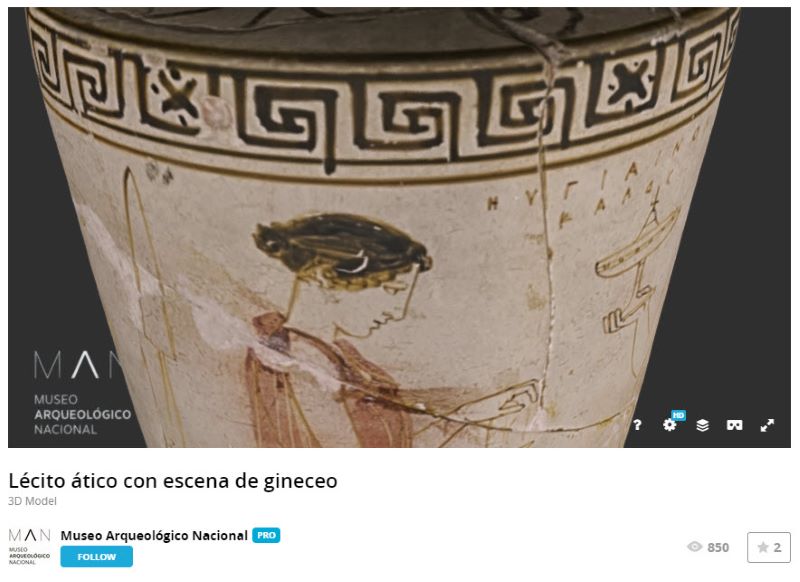
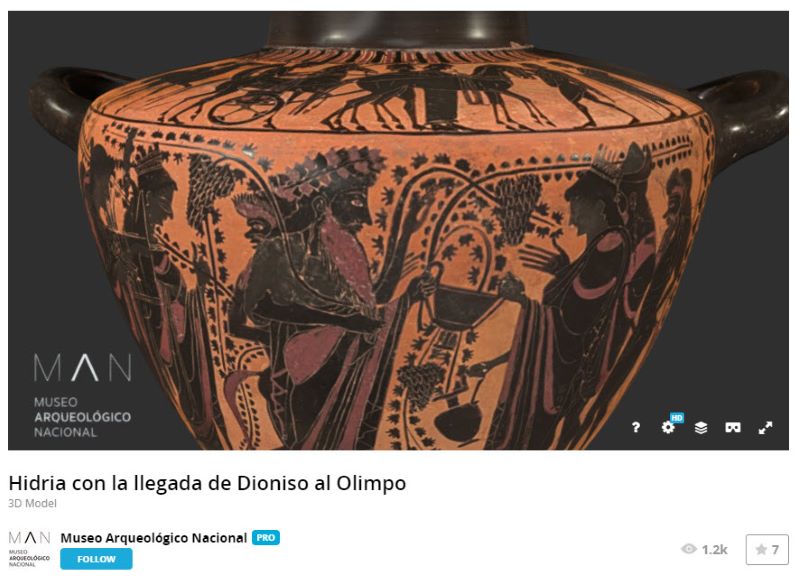
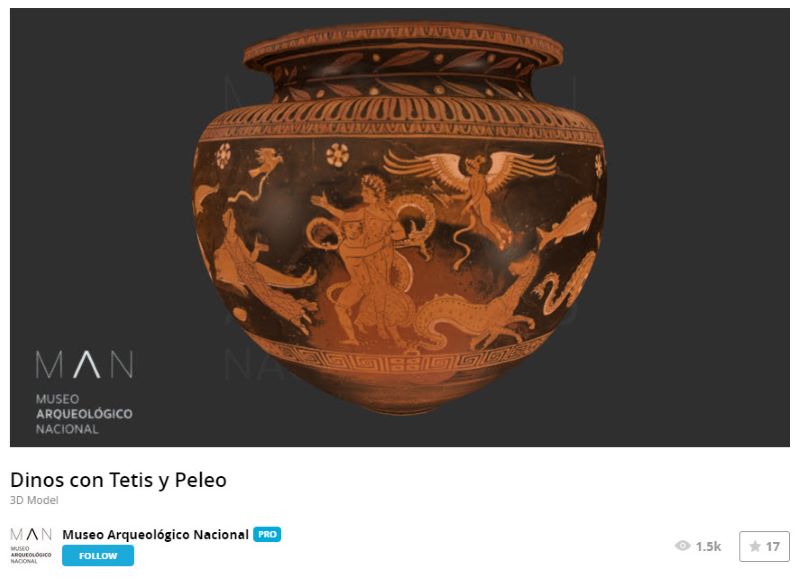
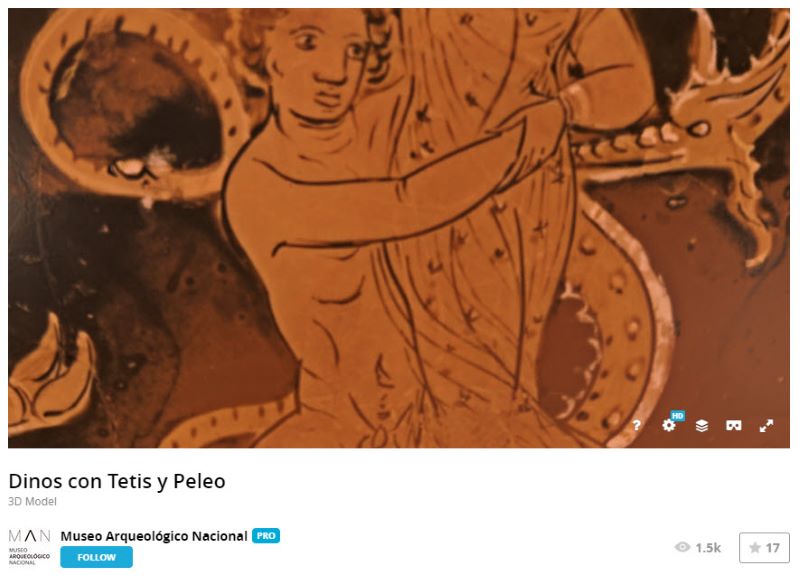
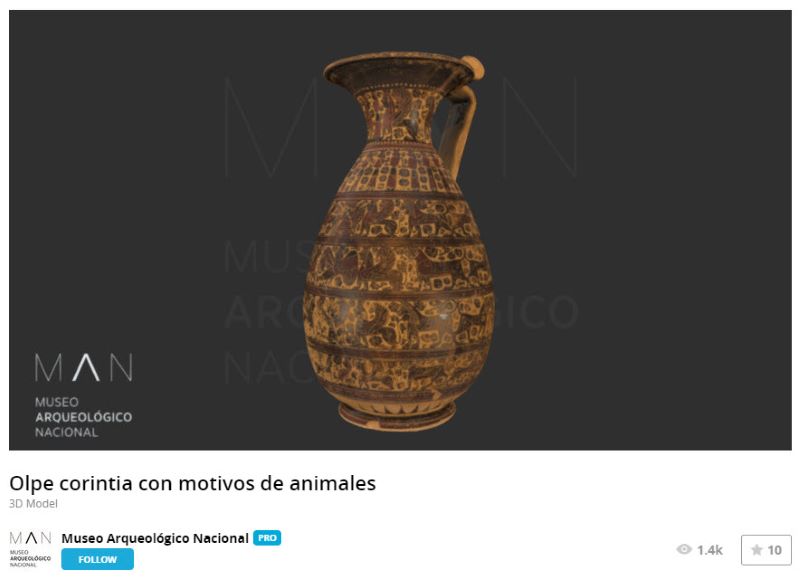
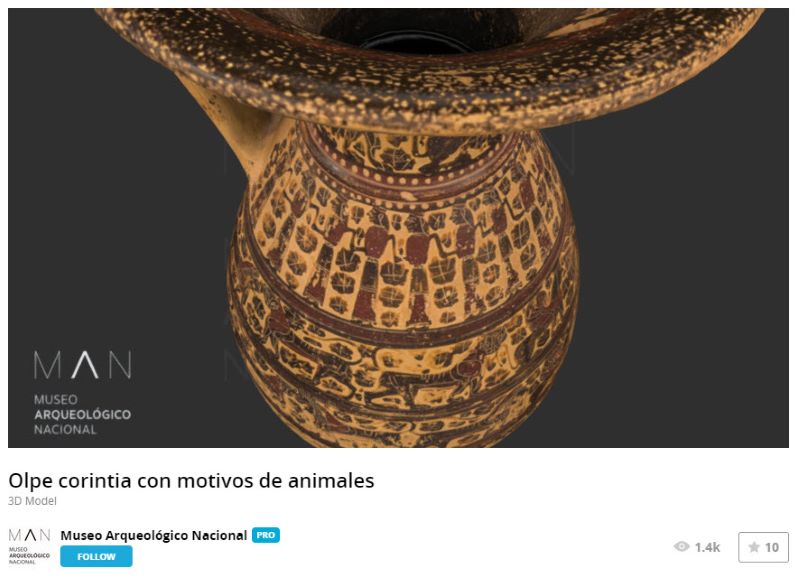
As a follow up to an earlier post on technologies being used to create 3D models and visualizations of ceramics, I found 30 models of ancient Greek pottery created for the Museo Arqeologico Nacional in Madrid, Spain.
The quality of the 3D models is outstanding. Here are a few static screenshots indicative of the detail available:
Below are a links to several 3D models of different Greek vessels, which link into a 3rd party visualization hosting service called sketchfab.com:
Ben Carter produces the podcast “Tales of a Red Clay Rambler,” in which he interviews ceramic artists from around the world. Ben is now up to episode 360, so he’s amassed a rich treasure of conversations with different potters doing different things.
I asked Ben about the origin of his podcast, what intrigues him about these conversations, special moments he remembers, and his plans for the future.
Ben was living in Shanghai, China, when he launched these interviews in 2012. He originally started a blog, not a podcast. He told me started asking artists to write for the blog about their work or inspiration, but that was difficult for many ceramic artists. It was easier for artists to discuss their work in a conversation rather than through writing. So Ben adjusted his approach and adopted podcasting.
For the first 18 months of the podcast, Ben was living and working in Shanghai. He interviewed potters on route to Jingdezhen in Southern China, center of Chinese porcelain production. “Potters would stop over and spend a day or two in our studio in Shanghai, recovering from jet lag and travel fatigue,” Ben said. “While they were there, I’d interview them for the podcast.”
Later, Ben moved to Denmark for a 6 week residency program, where he continued “Tales of a Red Clay Rambler” by interviewing a different type of artist – those not necessarily working with porcelain. He then moved back to the States and lived with his wife in California, Montana and now New Jersey. “Until 2020 when the pandemic hit, I would always interview artists live and in person,” Ben explained. “Covid was a real game changer. Now I’m doing my interviews through Zoom. I can talk to a lot more people, but it doesn’t have the same intimacy as sitting in someone’s studio and talking about work that’s literally sitting on tables around us. Video has actually been helpful, because now my interviews aren’t limited to where I’m travelling. I can literally talk to anyone, anywhere.”
“I’ve had really, really interesting conversations – it’s hard to pick out highlights,” Ben said. When I pressed him a bit he pointed me to two interviews he still remembers fondly. “In 2017 I interviewed Wallace Higgins, who at the time was 92 years old. He had taught at Alfred University and was a prominent ceramic designer. He had also served as a Tuskegee Airman during WWII, and we discussed his experiences as a black man from rural New York going to the deep South.
It was fascinating to hear the human-to-human experience of what’s it’s like for a person to experience racism for the first time. After the military Wally went on to have a decades long teaching career and became a sought after international ceramic consultant.
Ben also told me about his interview with Linda Christianson, a Minnesota wood-fire potter, who has a vibrant personality and yet creates very quiet ceramic pieces. “We were talking in general about how she deals with her own mind, in terms of self-doubt,” Ben recalls.
“She had this very funny, quick-witted way to tell herself, ‘Thanks for sharing, but I’m going to ignore you now’. I thought that was such a poignant thing for an artist because self-doubt can be at the core of any creative practice.” (PODCAST 122, Oct 22, 2016).
“I’ve found most people working with clay to be very open and welcoming,” Ben says. “This is true regardless of fame or position in the art world. We all share a strong desire to connect with one another, especially during COVID. Working with clay can be a very isolated existence. While you can say that my conversations are about ceramics and art, I find I gravitate toward discussions of ‘what has your experience been like?’ and ‘what are the things that make you most excited?’. I can point to many, many podcasts that start with a conversation about clay but end up being a discussion about the human condition and living a creative life.”
I asked Ben whether there is an overall theme or pattern to his podcasts. He told me he has typically divided his podcasts into “seasons,” and within a season he may have 3-4 podcasts along a particular theme, perhaps along a geographic area such as “Irish potters” or “New Zealand potters.” Sometimes he explores a more esoteric topic such as “intuition” and the role of intuition in someone’s work. More recently, he’s started to focus on some topics more relevant to our times, such as how the clay community is dealing with race and class.
We discussed Ben’s plans for the future. “I’m interested in helping other artists develop podcasts for themselves,” he said, “where I’ll step into more of an executive producer or editor role.” Ben continued, “There’s so many people to talk to, there’s so much out there in terms of the art world, that, well, I’m limited by my own intellectual capacity. But if you expand out to having multiple hosts working on multiple podcasts, then something really special can happen.”
“Let’s fast forward 200 years from now. I don’t want people in that era to look back at our time and think, ‘There must not have been many potters working, because there are no books about them, there are no stories about them.’ One of the things that pains me is that some of the best potters that have lived through time are anonymous. We’re never going to know who they were. We can see their pots, there are museums filled with amazing pots, but we don’t know the sound of their voice, we don’t know what they were stressed about or what they were thinking about while they were making, we just know those objects. I want to find out as much about the person as I can. I want to record that person talking about their own work in their own voice – to me that’s really special and important.”
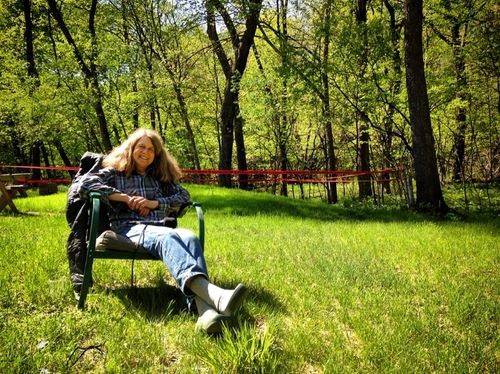
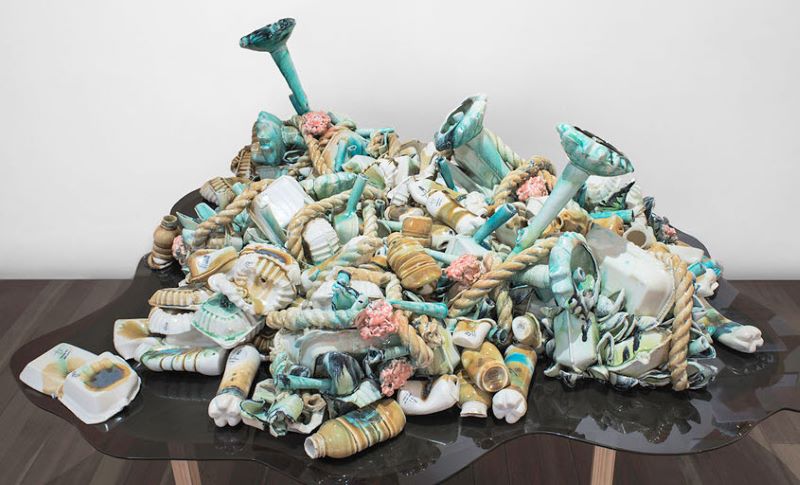
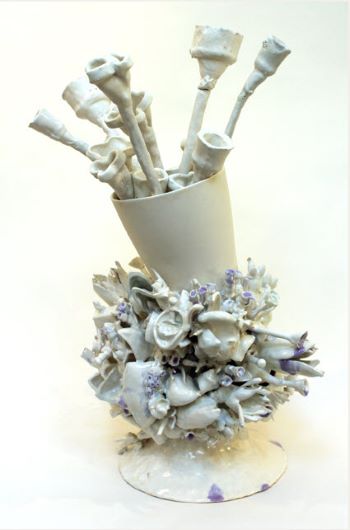
Susan Beiner has been a Professor of Ceramics at Arizona State University since 2006. She is also an active studio artist, working primarily as a ceramic sculptor.
Susan has exhibited her work widely, both domestically and internationally. Her work was exhibited at The Mint Museum of Craft and Design, the Houston Center for Contemporary Craft, the Clayarch Gimhae Museum in Korea, the San Francisco Museum of Fine Arts, and at Princessehof Keramiekmuseum in the Netherlands, to name several.
Susan has exhibited her work widely, both domestically and internationally. Her work was exhibited at The Mint Museum of Craft and Design, the Houston Center for Contemporary Craft, the Clayarch Gimhae Museum in Korea, the San Francisco Museum of Fine Arts, and at Princessehof Keramiekmuseum in the Netherlands, to name several.
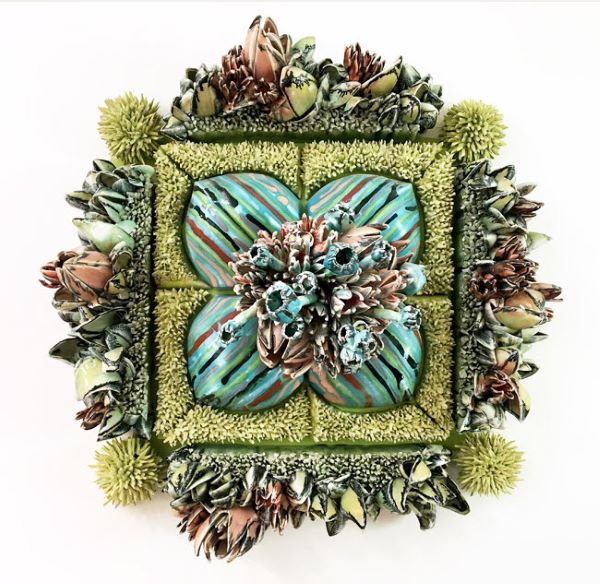
Susan describes her work process in the Virtual Studio Tour video below. As she walks through her studio, she shows several work examples (both in process and complete), plus some of the many molds she uses in her work. Susan’s video tour is one of the more interesting I’ve seen. In the first 10 minutes, as she moves quickly through her studio space, you get a real sense of how she uses molds to create the components of her large-scale pieces, and then you see some of the finished components that she will assemble into finished works. She also shows her studio in the context of her garden – an important part of her ceramic pieces and her lifestyle.
In the subsequent 5 minutes (10-15 min), she discusses how she finds inspiration in her garden amidst growing, thriving plants. “I’m outside doing something almost every day,” Susan says, “and I watch things as they grow. As I watch things, I do little drawings as notes for forms. Those [drawings] then become parts of the shapes I make out of clay. I then start repeating them to create bigger forms.”
JW: You have an intense interest in the botanical world – even a “microscopic” view of the botanical world. Have you always had a strong attraction to plants, gardens and organic forms?
SB: Yes, I have always enjoyed the landscape and all that goes with it, color, shapes and texture. I watch plants grow and change until they produce, whether that be offspring, seeds, flowers, fruit or vegetables. I meticulously tend to my garden and fruit trees as well as nurture all the plants. I watch and take part, I feel connected, its an integral part of my art practice and my life. Gardening makes me feel grounded, literally, and often when thinking about units for my work, I investigate many historical palace gardens, they are visionary. Plants are important in our civilization, they are a part of our history, and they present in curiosity and wonder.
One of my favorite things in my travels to different countries, is to look for indigenous plants in various areas and search out untended fields only to discover inspiring growth.
JW: Is there a progression in your work? (Things like color to monotone, modular to single unit, individual pieces to wall units to environmental (entire room) experiences, for example.)
SB: I have always wanted the viewer to be able to immerse themselves, maybe a feeling of being overwhelmed.
Most of my work is modular so I can work at a larger scale with smaller sections that are more manageable, and I can conform them to various walls or floor spaces. Many of my wall pieces, though they are single pieces, are still composed of several sections that fit together.
You may not notice the things that have changed, for instance, the scale of the encrusted forms are much larger than they have been in the past, which may seem like its less detail, but field of color is taking shape. I design and compose sculptures, a single object to experiment and experience new ideas, like sketching with form or just play with form. Sometimes I use remnants of pieces I am working on to think about that specific piece before it goes in the recycle bin. There is something interesting about the cast off/cut off piece that I find filled with intention, so I go off on a tangent and start something else…I especially do this after working on a big project, where I need to work small for a while, to get a piece completed in less than a year or more.
In my practice I think the idea of “play” is important for me, I try a lot of different things, many of which no one sees but me.
I consider my work to evolve around project ideas, as environmental issues are in the forefront of my mind of late.
I use color as a tool to shape ideas, trying to arrive at the essence of form. The rendering of various glazes to create the perception of foliage now has changed. Now I am interested in using color as a way to unify forms without being specific about the organic-ness of plants. You will see this in my most recent installation, Bounded Fragility, a floor piece based on the idea of a carpet, covering earth, all one glaze. It hasn’t been revealed yet, but soon.
I think that I learn something from every piece and that moves into another piece. Some of the wall work was figuring out various hanging devices, however, ultimately it all takes so much time so perhaps I take small steps?
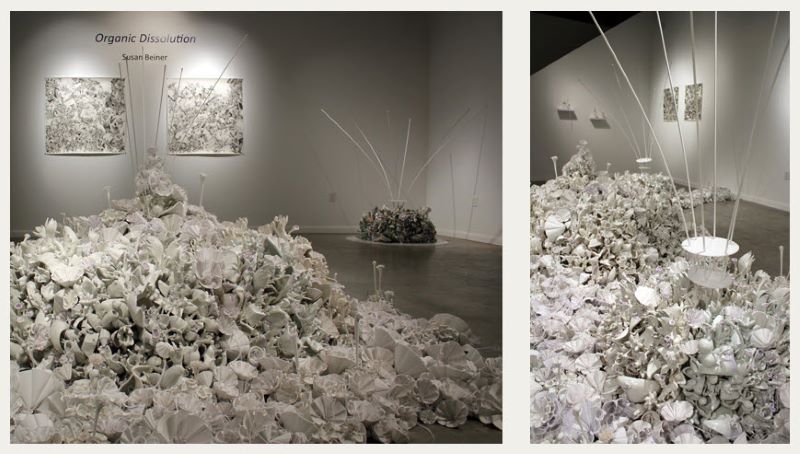
JW: I do sense a more recent interest in synthetic vs. organic themes (for example in Organic Dissolution and Non-Biodegradable). Maybe I’m reading too much into this, but do these pieces reflect some form of disappointment or disillusion on a larger scale?
SB: I would call it concern. I wonder what will be left of our planet and what troubles we will be consumed by in the future. Our resources are being used up and we will get used to swimming in an ocean of plastic… It’s similar to responses to the pandemic, we have to act in unison to make a change, it’s a serious commitment and an understanding of treating our planet better. Unless corporations stop producing single use plastic…it will never end, but we will.
JW: Some (much) of your work is very large-scale. What keeps you inspired through what must be very long periods of time it takes to create these pieces?
SB: Scale keeps me engaged, and time is an element in space. As I work with a plan, I commit to the activity and timeline and once I start to see progress I feel like the presence of the piece associates with what I want to viewer to feel… overwhelmed. I want the work to be something you can dive into and feel.
Small work is over too fast, the feeling goes away too fast, I much prefer larger work.
JW: You seem to sketch quite a bit. Are your ceramic pieces usually sketched out and carefully planned in advance? Or do they “come together” as you are working on them?
SB: I do plan them in advance, but there are usually some changes once I start the making process. There is still room for intuition even with a plan.
I have to make an entire set of molds since I slipcast and assemble all the parts from my molds. Making the prototypes of the parts comes first and takes up a chunk of time before I proceed to making. Many times I need to make duplicates of some of the shapes because I cast them so many times, they get worn out.
JW: Where to from here? Do you have plans for upcoming work that you can share?
SB: Yes, as I said in above question, my newest piece Bounded Fragility which will be out very soon, is still very new in my mind, all one glaze color it feels very powerful to me. Since I am at the end of this project, I can finally see the direction that awaits and eager to move forward. However, as I mentioned prior, I am ready for some smaller individual works to experiment with, sort of give me a rest so I think more. Additionally, I will be working on some large format drawings.
I am excited for you to see this piece, I would enjoy the feedback. I have never made such a large format piece as one intensely active field.
Louise Rosenfield has amassed an outstanding collection of contemporary American functional ceramics. She has posted images from a large portion of her collection online (almost 3,300 pieces featuring the work of 791 ceramic artists).
Ben Carter interviewed Louise Rosenfield in a 2017 Podcast – part of his “Tales of a Red Clay Rambler” podcast series. In that interview, Louise describes how her experiences making ceramics informs the way she collects ceramics. Rather than rehash what inspired her to collect ceramics, I encourage you to listen to Ben’s interview with Louise.
When I spoke with Louise, we focused more on what motivated her to open her private collection to the world, albeit virtually. We also discussed how to best access the online collection. Finally, we spoke about Louise’s plans for her collection of functional ceramics.
The Online Rosenfield Collection
Louise is remarkably candid about her collection and objectives. It’s refreshing and energizing to speak with someone so enthusiastic about her activities.
Louise told me she has always been interested in sharing her utilitarian ceramics with other people. “The whole purpose of utilitarian ware is usage – people need to use plates and cups and bowls, not just look at them,” she says. “It’s wonderful that artists also add beauty and creativity to a functional piece. But ultimately, beautiful pieces in my collection should be held in one’s hand and enjoyed physically, intimately, through use. Utilitarian pieces that aren’t used are dead. There’s nothing like drinking coffee from your own, special mug, feeling the fit of the handle and the warmth of the liquid inside as you cuddle the mug in the palm of your hand.”
“One of my goals has been to educate the Dallas community where I live about the possibilities of ceramics,” Louise told me. “Many people believe the finest ceramics you can get are from local craft fairs. There are fine ceramics at craft fairs, but people don’t necessarily know that there are artists who display ceramic pieces in art galleries and even museums. There are amazing ceramics and most people simply aren’t aware they exist and don’t know where to find them if they are aware they exist. I’m very interested in educating people on how to find outstanding ceramics and the artists who produce them.”
Louise continued, “All along I’ve had students interested in the pieces that I’ve collected. My collection is a resource for students. But that resource has been limited to students who live in the Dallas area. Not everyone can come to Dallas and look at my collection. So I put my collection online to share it with a wider community.”
Tips on Accessing Images in the Online Collection
The Rosenfield Collection website has filters on the top right that allow users to find works of individual artists (listed alphabetically), by forms (e.g., bowls, cups, jars, etc), by firing method (e.g., high fire oxidation), and by technique (handbuilt, slipcast, wheelthrown, and wheelthrown and altered).
Typically, when you filter for forms, firing method and/or technique and select an individual piece to view, you will also see a link on the top right stating “View more objects by [artist name].” Go ahead, click that little link. Be brave.
Items you view online have been numbered by type of work and sequence of addition to to the collection. Louise told me she employs the following indexing scheme:
B = bowl (although I’ve found some bowls listed as SW (service ware))
C = cup
CP&S = cup & saucer set
C&S = cream & sugar set
E = ewer
J = jar
P = plate
PV = pouring vessel
OT = other
SW = service ware
T = teapot
V = vase
When Louise first purchases an item, she brings it home and uses it for personal use. (Yes, she actually uses these items!) After some time, she will add the item to the collection, referencing it numerically. For example, if Louise transitions a plate from home use into her collection, she’ll label it “P” plus the next sequential number under “P.” If the previous plate is labelled P885 then the new plate is added to the collection as P886.
The Essence is Variety
I asked Louise if there are any particular pieces that she would like me to highlight. “Not really,” she responded. After we spoke for a bit, I realized the essential beauty of her collection is its variety. Spend a few minutes scrolling through her collection and you can’t help but be amazed at the sprawl and scope of artistic innovation. It’s like a Texas of contemporary functional ceramics.
What’s In Store for the Future?
Louise told me a fantasy. “When I thought about what I would do with the ceramics I’ve collected, my fantasy was to donate the entire collection to a restaurant. The restaurant patrons could then use the pieces when they dined. When they break, they break. At least they will be used.”
Louise tells me that her fantasy is coming true. The Everson Museum has decided to build a museum cafe and she will be donating her collection for use in that cafe. In her imagination museum patrons will enter the cafe, view interesting cups and plates displayed along a wall, select their cup from the shelf and fill it with a beverage to enjoy in a cozy cafe setting. Louise wants people to use the collection.








































 JTW Ceramics