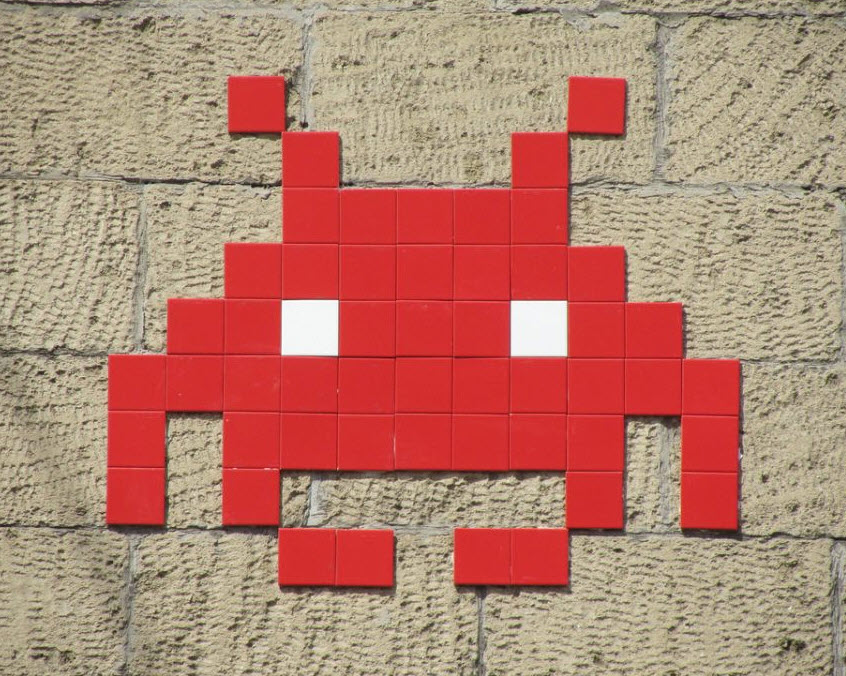
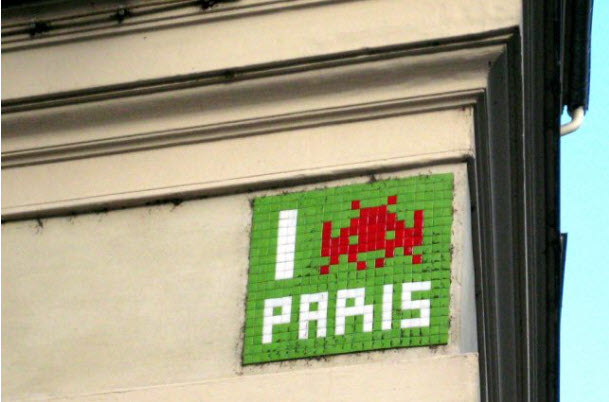
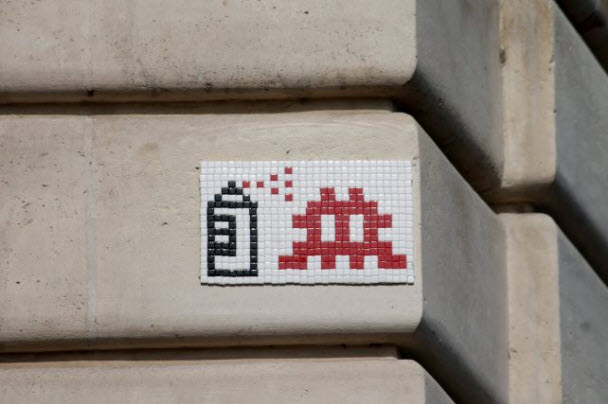
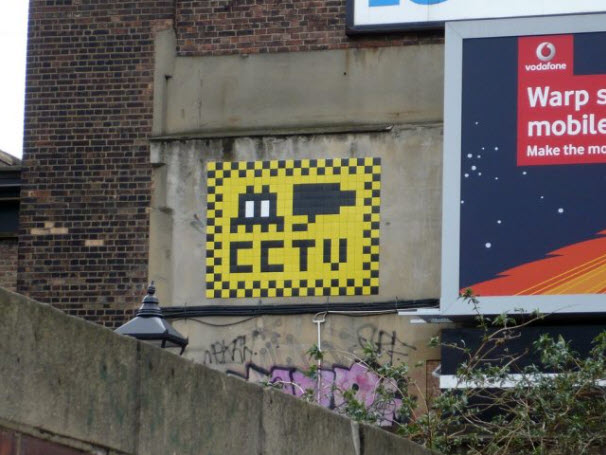
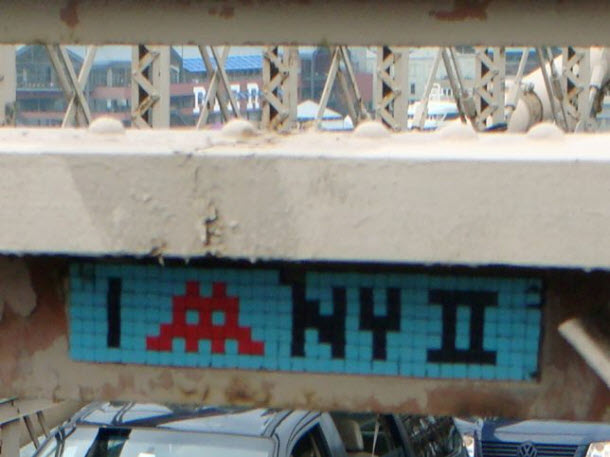
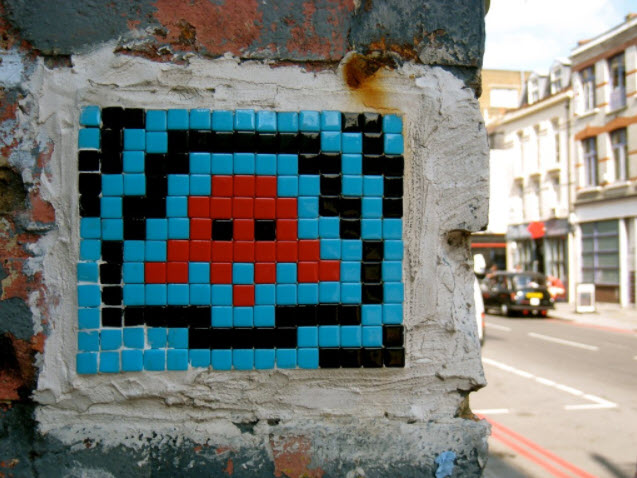
Invader is the nom de guerre of a ceramic graffiti artist who has been installing ceramic tiles with pixilated designs on the walls of cities around the world since the 1990s.
According to Wikipedia, “Invader sees himself as a ‘hacker’ of public space spreading a mosaic ‘virus’. He believes that museums and galleries are not accessible to everyone, and so installs his work at street level for ordinary people to enjoy…”
Invader originally targeted the walls of Paris, then moved on to other French cities, and from there he launched “invasions” of other cities: New York, Hong Kong, Los Angeles, and others. A “FlashInvaders” app maps the location of Invader’s installations. App users are encouraged to search out and photograph the ceramic installations, which are tucked away in nooks and crannies or non-descript building walls. At the time of writing, there are 3,997 invaders in 79 cities, mostly in Europe.
Invader tile installations have become valuable collector items, with pieces selling in galleries for $250,000 or more.
Ben Carter recently recorded a Tales of a Red Clay Rambler podcast interview with Paul Greenhalgh entitled “How Ceramics Shaped Civilization.”
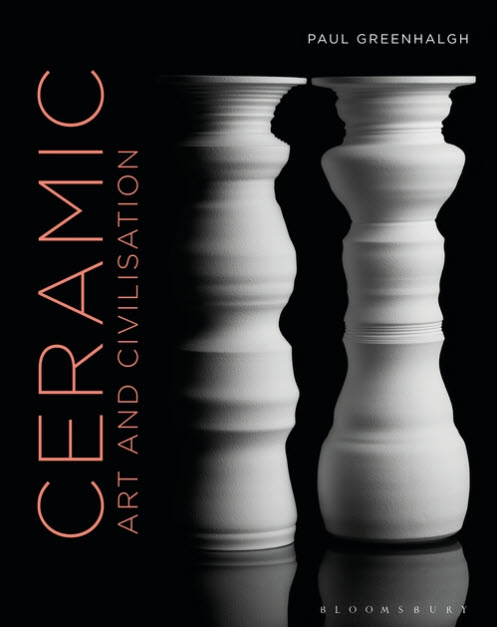
I was so impressed with the discussion I purchased Paul Greenhalgh’s book “Ceramic Art and Civilization,” available online at Bloomsbury and Amazon. It is a meaty tome the size of a college 101-course textbook. I’m about 100 pages in and am finding the book extremely interesting and thought-provoking. I recommend the book.
Paul Greenhalgh is currently Executive Director at the Sainsbury Centre for Visual Arts in Norwich, UK, part of the University of East Anglia, where he is also a professor of art history and museum studies. He formerly worked at the Victoria & Albert Museum in London as head of ceramics research. He has written several books and delivered lectures around the world, many of which he has posted on his website.
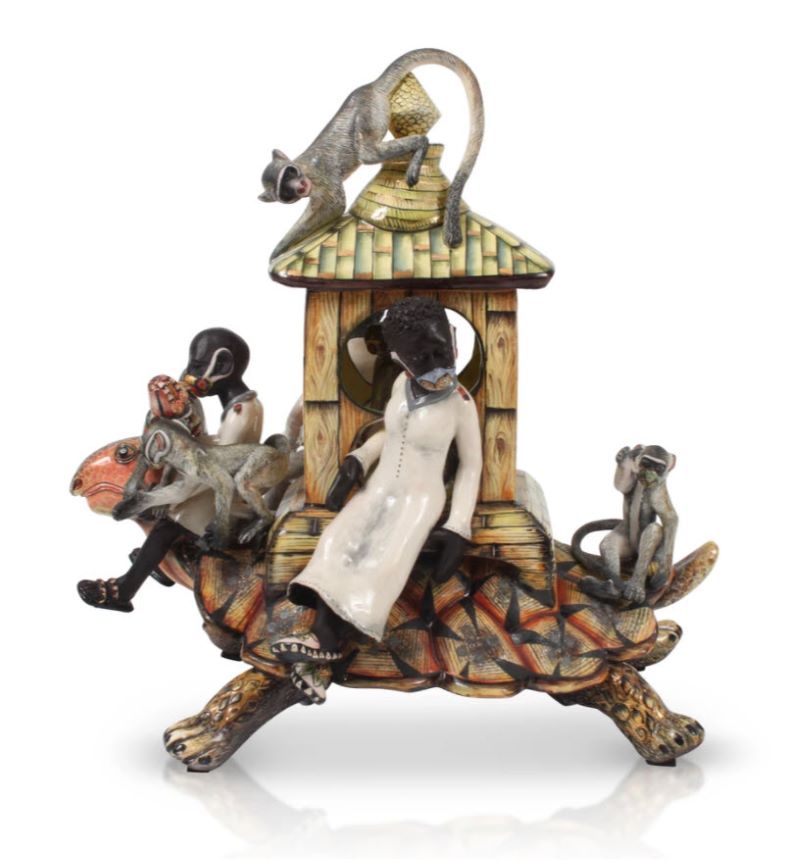
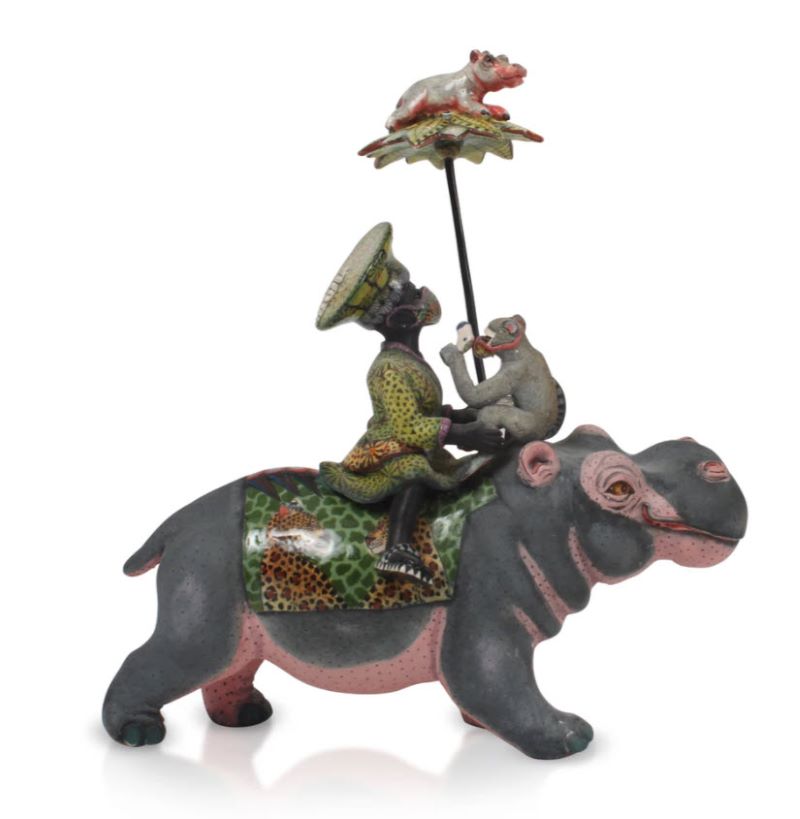
I’ve been struck by how much more collaborative creating ceramics can be than what is typically practiced in the United States. In the U.S., individual artists execute the entire production process (from sourcing clay, turning or handbuilding clay into forms, decorating those forms, glazing and firing the final piece(s)). In many parts of the world that work is divided up between several people. Ardmore Design, based in South Africa, provides an example.
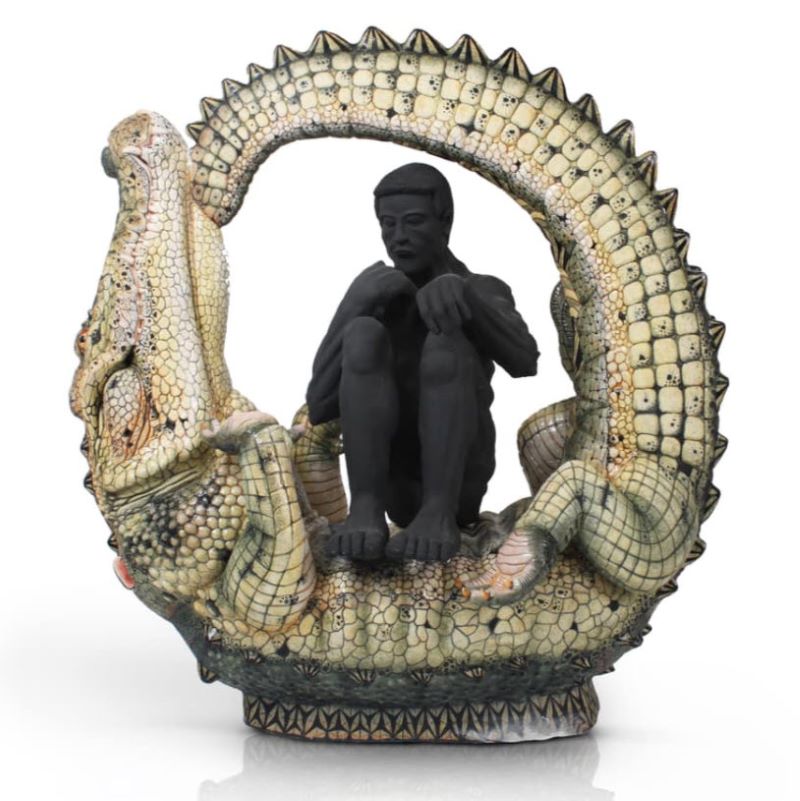
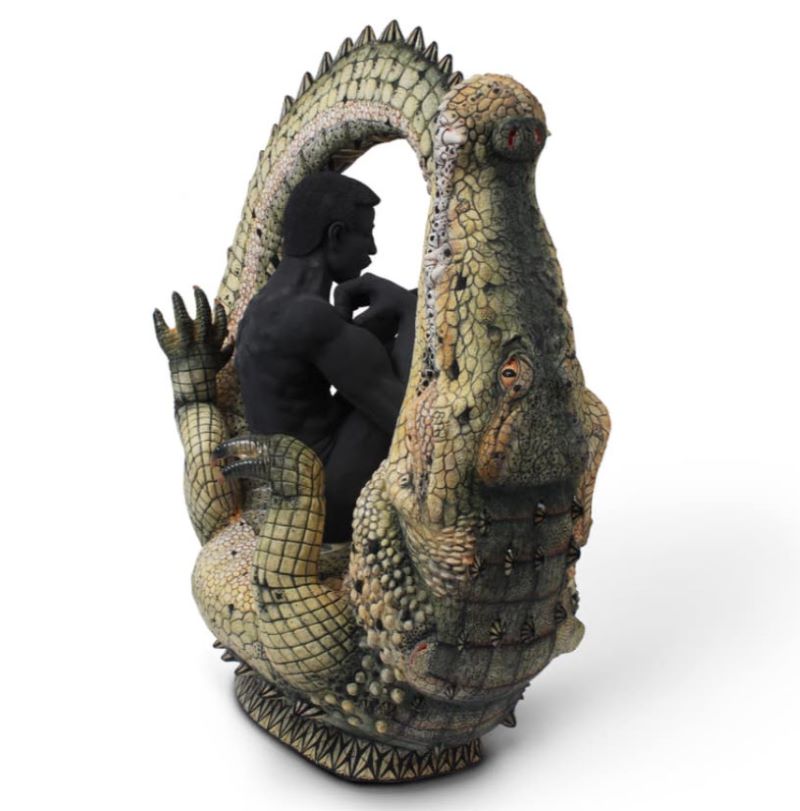
Crocodile Equilibrium Sculpture by Teboho Ndlovu (sculptor) and Wiseman Ndlovu (painter)
Fee Halsted, founder of Ardmore Design, grew up in Zimbabwe and studied painting at university in South Africa. She also worked in ceramics. After school, Fee was teaching art in Durban and lost her job. “I was angry,” she recalls, “I want to teach people, and if I can’t teach privileged white people then I’m going to help people who don’t have opportunity.”
Fee started a ceramics studio in 1985 and shortly thereafter started working with Bonnie Nshalinshali, her maid’s 18-year old daughter, who joined the studio as a ceramics apprentice. That collaboration ultimately led to founding Ardmore Design, a full-fledged ceramics studio in South Africa that has blossomed into an international business venture.
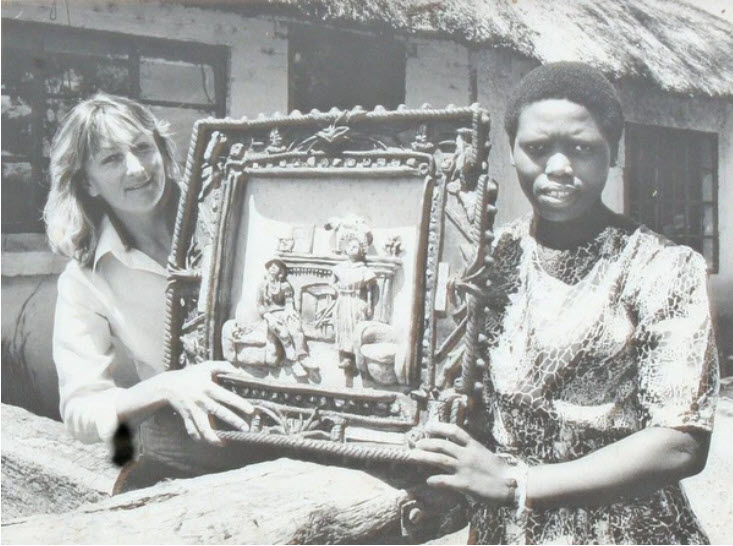
Fee Halsted and Bonnie Nshalinshali, displaying the Standard Bank Young Artist Award in 1990
I found this “transformational story” fascinating, on both an individual and social level. Individually, Fee transformed her activities from those of an art teacher and individual ceramicist to the creative director of a large-scale production operation. Fee has provided job and creative opportunities to 80+ workers, each of whom has transformed from an inexperienced student into a highly skilled person doing one or more parts of the the overall ceramic production of Ardmore Design’s offerings.
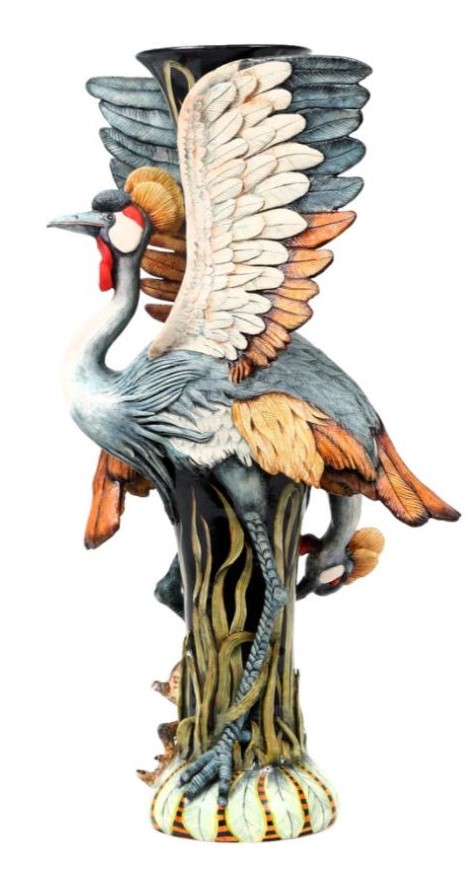
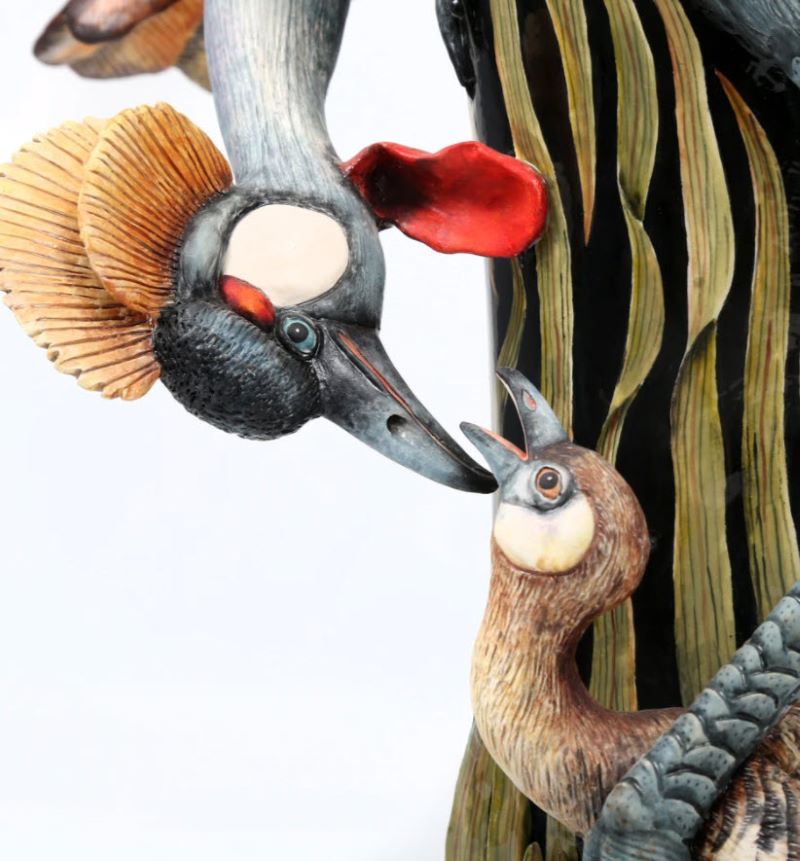
Crane Vase, thrown by George Manyathela, sculpted by Victor Ntshali, and painted by Mthulisi Ncube
I contacted Fee Halsted and her son Jon Berning about the origins and transformation of Ardmore Design. Here is a summary of our exchange.
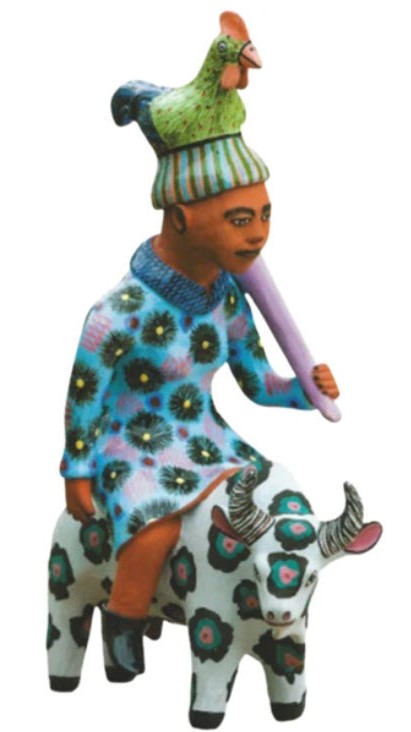
Work by Bonnie Nshalinshali
JW: How did Fee and Bonnie Nshalinshali originally collaborate on ceramics produced at the studio?
FH: I would come up with the concept and story of subject matter, and Bonnie would execute the theme as per her own idea on that theme. Fee would encourage her own naïve interpretation of the idea and express it in her own way.
JW: As additional women joined Ardmore studio, how did work styles evolve?
FH: Everyone creatively interprets the same subject matter. Our blue print is never a one fits all, each piece is unique. In the beginning the new artists followed Bonnie’s style but not wanting them to execute poor versions of Bonnies’ work I encouraged them to hand coil functional works and have some creative freedom in which they could express their talent.
JW: Did each woman do her own ceramic work or did the women collaborate on pieces?
FH: In the earlier days we started with makers and painters, and each women chose if they preferred to mould a work in clay and some preferred to paint with underglazes, which resulted in more works becoming glazed. Women creating work together meant, we could produce works quicker and more efficiently.
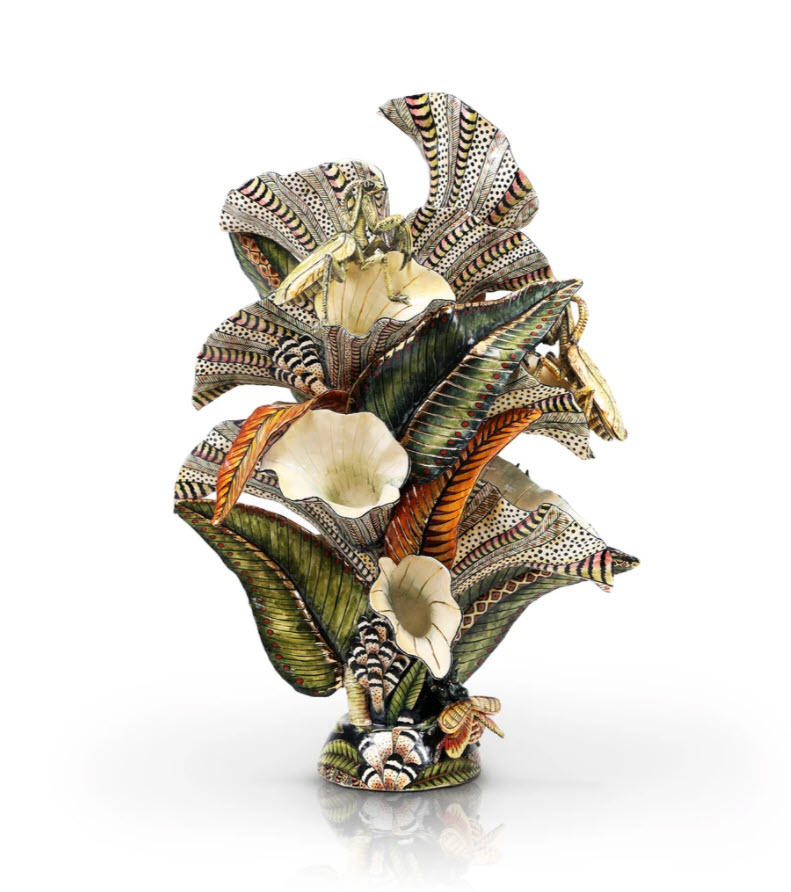
Gilded Lily Vase, Made by: Qiniso Mungwe and Painted by: Mandla Ngwenya
Highly skilled, talented artists have always created the story-telling works.
Sculptures and art pieces of the smaller sizes and from our newer painters make up the bread and butter for more of our functional and popular items.
70 % of Ardmore’s’ income is made up of smaller hand crafted items and this income enables the opportunity for the larger fine art works that take longer to create. These Masterworks are harder to sell yet they give Ardmore clout and fine art status.
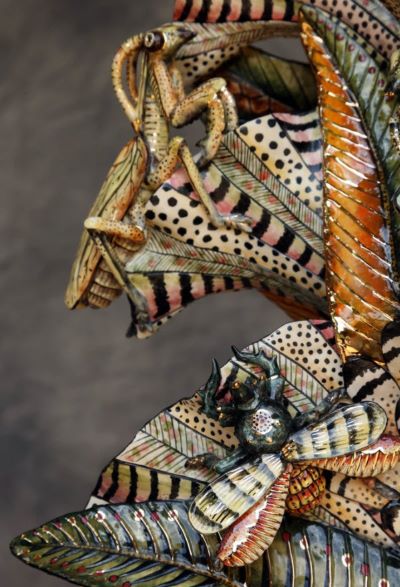
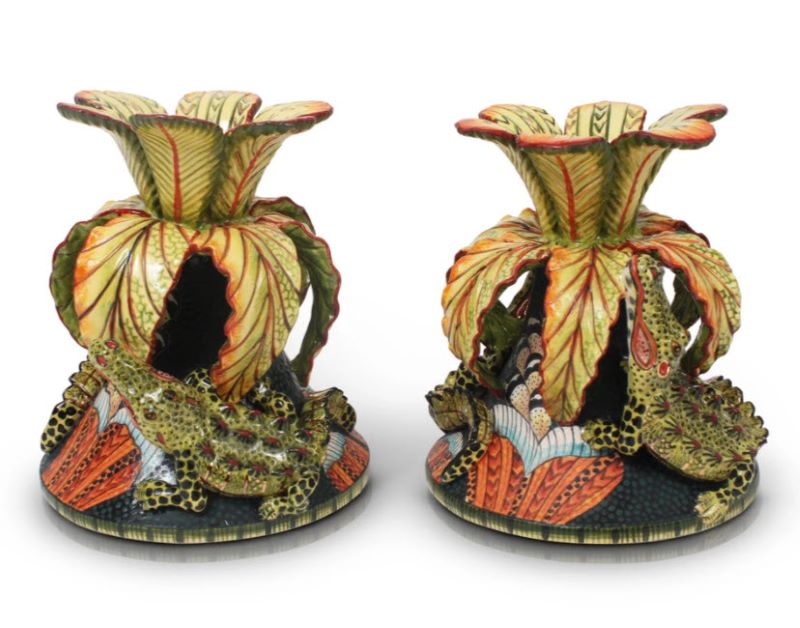
Crocodile Candle Holders, Made by: Sbusiso Ndaba and Painted by: Nondumiso Mfuphi
JW: Fundamentally, how did Ardmore studio originally function? Did Fee train and bring together various ceramic artists and allow each of them to pursue their own, independent artistic direction?
FH: Correct. In the beginning women from Bonnie’s family and friends joined the studio, but as the years went by artists joined from Lesotho, Zimbabwe and Malawi which gave a myriad of culture to our artworks too. I have always given ideas to the artists to work with and in turn they also come up with their own interpretations off an original idea. They are also often inspired by another artists work in the studio. We are a collective of artists that share Ideas and skills, we bounce off one another.
Baboon and Aloe Vase, Thrown by Lovemore Sithole, additional sculpted detail by Moshe Sell, and painted by Mthulisi Ncube
JW: Was Fee’s role more tilted toward the business & marketing side of running a commercial studio?
FH: I am still overseeing the running off the business but I have handed over the reins to my son Jonathan and daughter Megan. My eldest daughter Catherine is involved in marketing and design work. My main job role is creative director. I like to think I am the creative energy behind the artists and I aim to excite and stimulate the artists and encourage them.I crit art and design daily and keep the creative spirit up. It is all about caring feeding that creating energy.
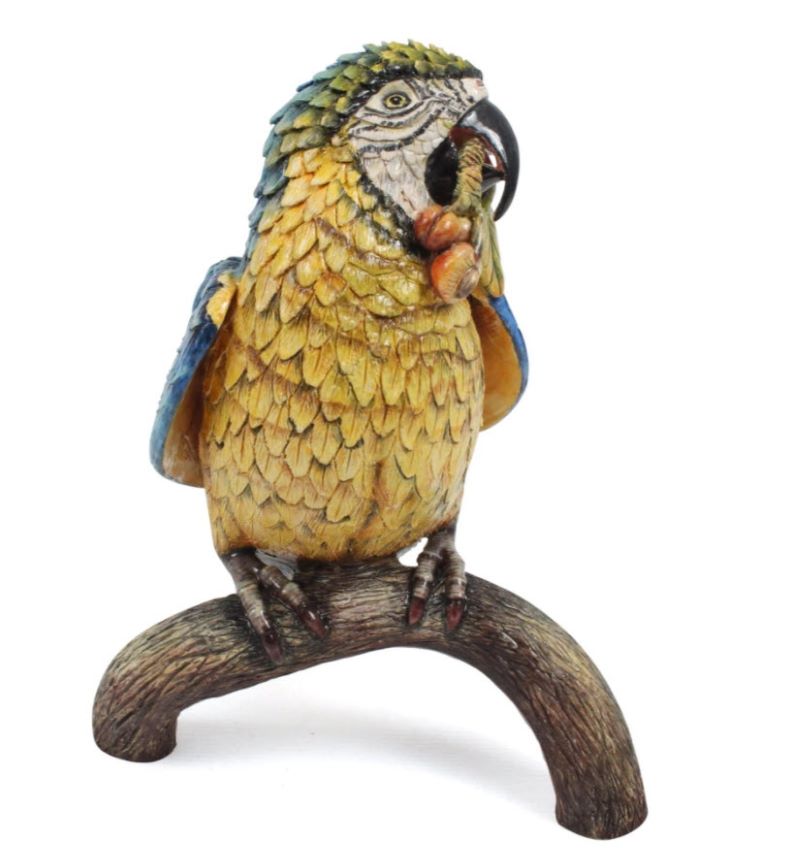
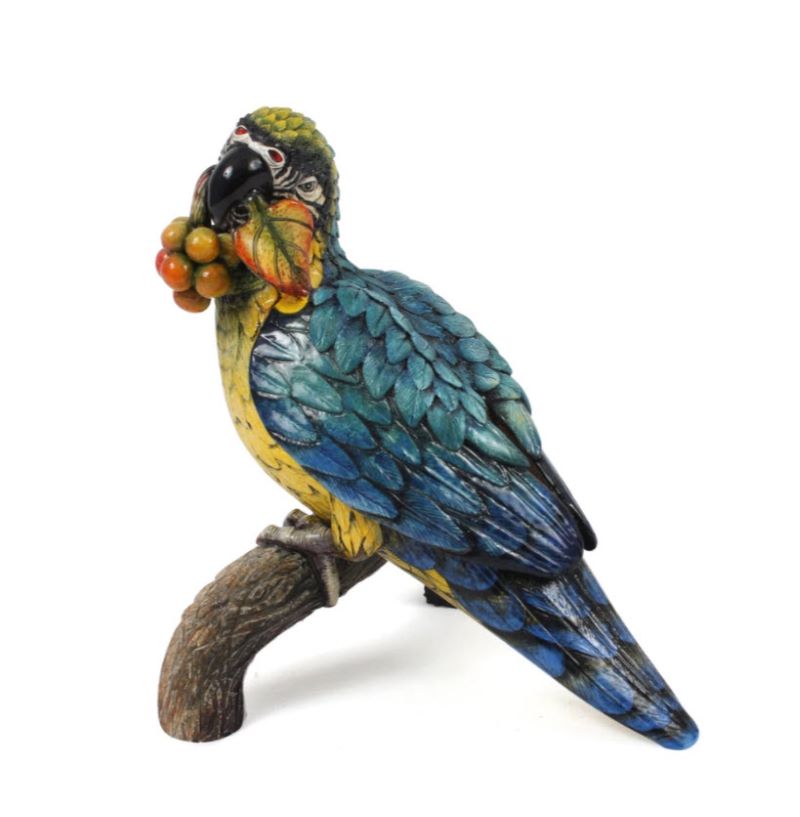
Pair of Parrot Sculptures, Sculpted by Betty Ntshingila and Painted by Mthulisi Ncube
JW: Did that change over time?
JB: Not really. I just had to give up my own art as finding ideas best suited for 80 artists is a full time job. I research images and try to develop recognizable styles best suited for each individual’s talent.
JW: Looking at the history of work produced at Ardmore studio, I detect a transition from original “naive” tone to more “refined and sophisticated” products beginning in the early- to mid-2000s. Can you tell me more about that transition?
JB:
This is an accurate observation. In the early days the women were untrained in their clay hand craft and as most had had little education. It was because of this that their work was naïve, but as the artists became more proficient with clay their art developed and became more realistic. In sculpting the work became more refined and realistic as men joined the studio. Additionally artists from other parts of Lesotho and Zimbabwe joined and they came skilled and trained in art and clay work and this set off a higher standard of art excellence. One should always aim for excellence!
JW: Around 2013, Ardmore started expanding into other design areas such as textiles & furnishings. What prompted that development?
FH: I had always been interested in the British art craft movement of de Morgan and Morris and had my own exhibition titled with De Morgan in Mind. This took place back in the 80’s at the Elisabeth Gordon gallery in Durban. I was teaching at the Durban Teck at the time.
After my son Jonathan completed University in Stellenbosch, I asked him if he would like to join me in starting a new business, and we started the journey together. In 2010 We were awarded the Share Growth Challenge grant, and this sparked Jon and I to start Ardmore Design which was the homeware side of the business. This part of the business has continued to be a success and is ever growing.
JW: As these new product lines developed, resulting in commercial success, has the organization and functioning of the studio changed? (The “look” of Ardmore products looks quite coordinated – as a brand and a “look.” I’m interested in how things have changed and evolved over the years.)
JB:
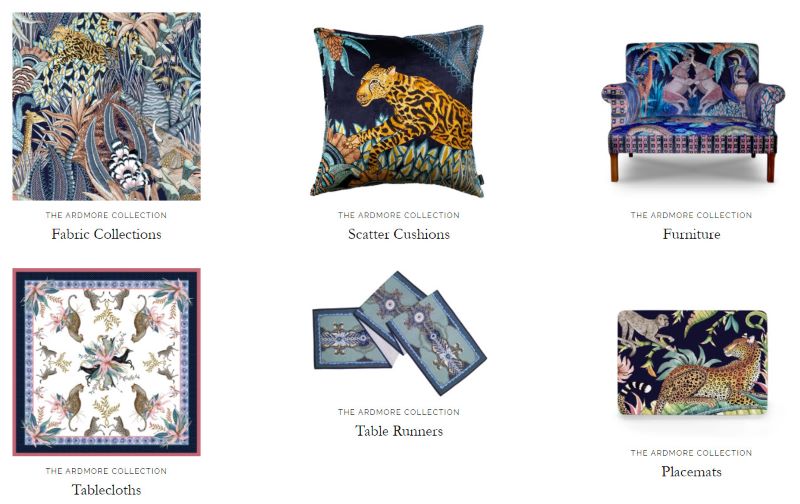
Ardmore ceramics and design has always been about the art and keeping thing fresh and in tune with current times. The ceramics and design of Ardmore are close in style because the designs originate off the one of kind ceramics and are always unique. They are hand drawn by our artists and then scanned and worked into step and repeat designs for fabric and then sent abroad. Our marketing and launches are all interlinked by theme so therefore results in a co-ordinated look.
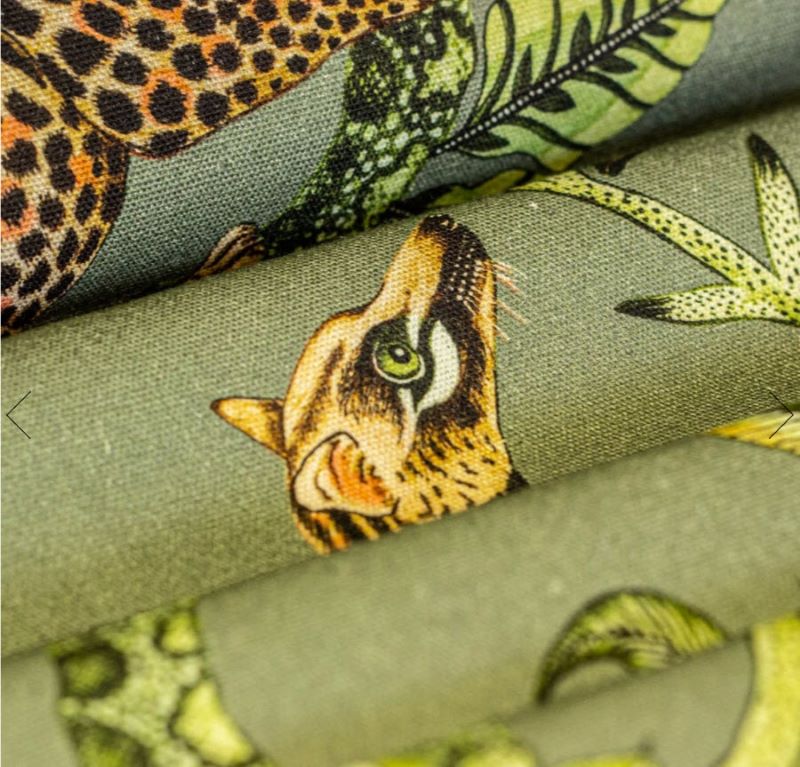
We are the Ardmore group and have amalgamated the ceramics and home items under the Ardmore umbrella name. It is our African designs with animal and plant motifs and glorious colours that make us recognizably Ardmore in style.
JW: Looking at several of the “Collectors Items” on your website, it seems that there is quite a bit of collaboration going on. One artist may create the form, for example, and another will paint that form. Is this work still done at Ardmore in a collaborative studio setting, or do various artists work from their own home and coordinate their own collaboration?
JB: Yes, we see ourselves as a team, Ceramics and graphic design involve many processes and each step takes more than one person’s involvement. Our motto is “we are because of others” and we value each and every one of our artists. This also pertains to the skillful kiln operators who do the glazing, as well as our international printers and CMT (cut, make, trim) team. Our sales team are also artists themselves as well as our packing team. The success of any business is the passionate leaders who keep the flags flying and carry huge responsibility.
JW: What are your plans for the future?
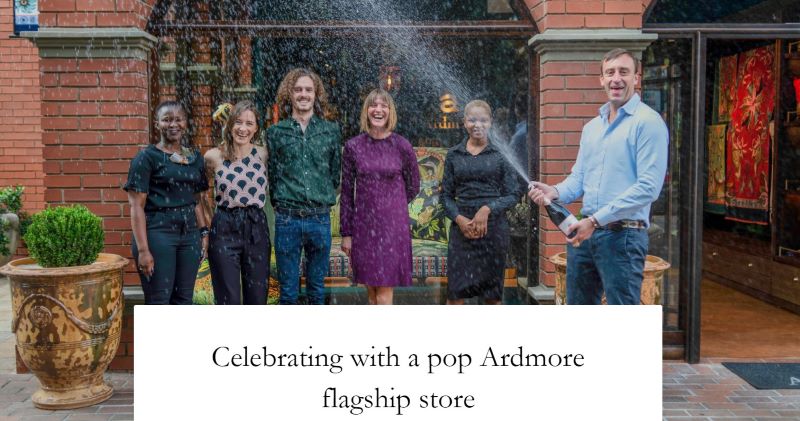
JB: Our main focus for Ardmore is to build the company into a luxury South African business that celebrates our artists and designers. We want to have stores within stores around South Africa, and we have recently opened two beautiful Ardmore flagship stores. These being in Caversham KZN Midlands as well as in Dunkeld in Johannesburg. A new Ardmore wall paper collection will be launching shortly with UK company Cole & Son, and this winter we will launch a new outdoor fabric range. For this range we are also collaborating with another South African family business Melville and Moon.
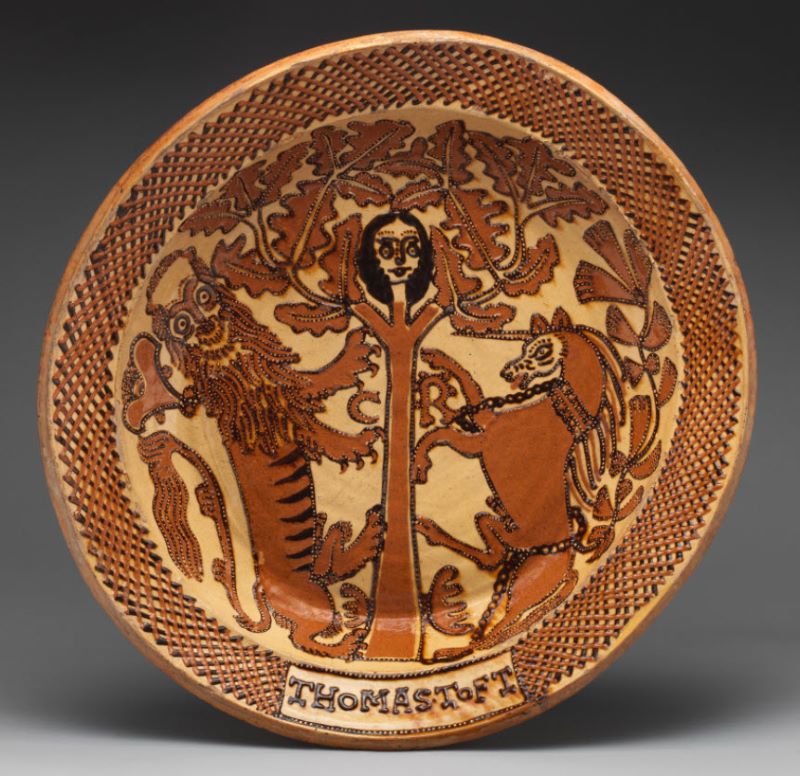
Previously, I posted an article about Early English Slipware. Two prominent producers of this style were Thomas Toft and Ralph Toft — so influential, in fact, that early English slipware style is sometimes referred to as “Toft ware” regardless of who produced the piece. Thomas and Ralph Toft created large slipware plates and platters, boldly decorated with trailed slip, and are highly prized pieces held in museums around the world.
Plate by Thomas Toft, Metropolitan Museum of Art
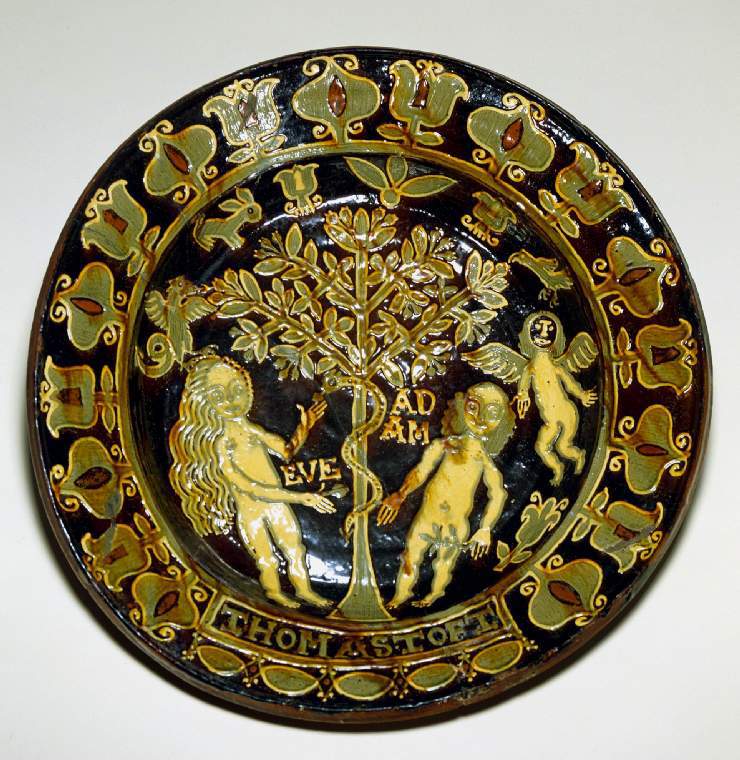
Thomas Toft worked in northern Staffordshire, England, in the mid- to late-1600s. He is known to have died in 1698. Thomas Toft, like other English slipware potters, first coated earthenware clay “base” with a uniform coat of slip, which is essentially clay mixed with water, to form a smooth, even foundation for his decoration. Toft then used “trailings” of liquid clay of a different color atop a the slip foundation. Typically Toft used darker red slip trailings atop a cream-colored pale slip foundation, but in one example below he used black and green slips. Slipware potters like Toft used a lead oxide glaze which gave the pieces a warm amber tone.
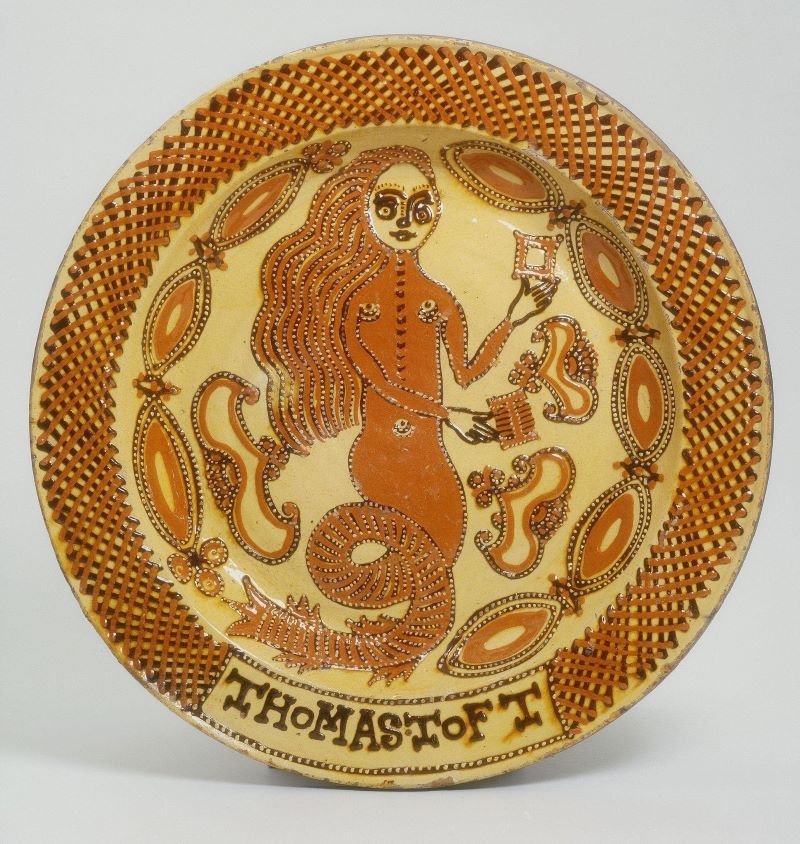
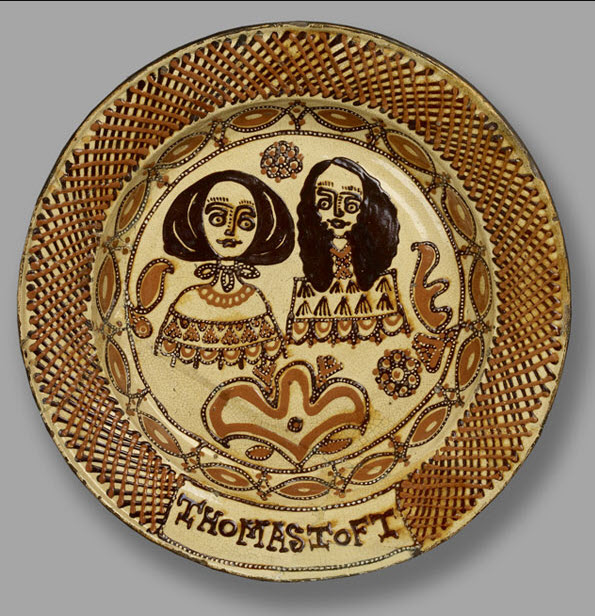
About 30 pieces attributed to Thomas Toft remain in various collections around the world. As can be seen in the few samples provided here, Thomas Toft employed a variety of decorative motifs (heraldic animals, mermaids, portraits, vegetative forms, and biblical themes). The slip drawing on all pieces is simple, casual and naive, suitable to a type of ware sold to ordinary citizens as opposed to the aristocracy.
The Victoria & Albert Museum holds several examples of Thomas Toft pieces, one called “The Mermaid Dish.” The V&A has extensive notes about this piece on its website here. Quoting from this source:
“…whereas functional cups and posset pots were probably sold at fairs and taken in wicker panniers on horseback to distant parts of the country, these huge dishes emblasoned with the name of their maker seem to have been made as local advertisements for the (widely varying) skills of their creators. Despite the many surviving examples, they were apparently completely ignored in Staffordshire until Enoch Wood acquired two specimens for his factory museum, which opened about 1816…
“Although such wares were recognised as interesting examples of folk pottery by the time that the South Kensington Museum acquired this piece in 1869, it was only in the 1920s that the writings of the art critic Herbert Read helped to raise them to the level of English Primitive Art. The striking simple image perfectly adapted to its ‘frame’ on the dish was much admired by early studio potters such as Bernard Leach (1887-1979).“
“The Mermaid Dish,” Victoria & Albert Museum
The Ashmolean Museum at the University of Oxford holds a 3rd Thomas Toft dish, this one believed to show a portrait of the royal couple.
Because of the scale and preservation of these works, most scholars believe they were used primarily as decoration rather than cooking ware or dining ware.
Ashmolean Museum, Oxford University
I did find one multi-color piece by Thomas Toft, located in the Fitzwilliam Museum at Cambridge University, shown below. (The Fitzwilliam Museum holds the single largest collection of English slipware that I found. Access their online collection here.) Notes on the museum’s website state: “The Temptation or Fall was a popular subject for the decoration of seventeenth-century slipware and delftware dishes. This one is unusual in having a dark brown slip ground. The angel, wyvern [winged dragon], and rabbit symbolize good, evil, and lust or fecundity respectively.”
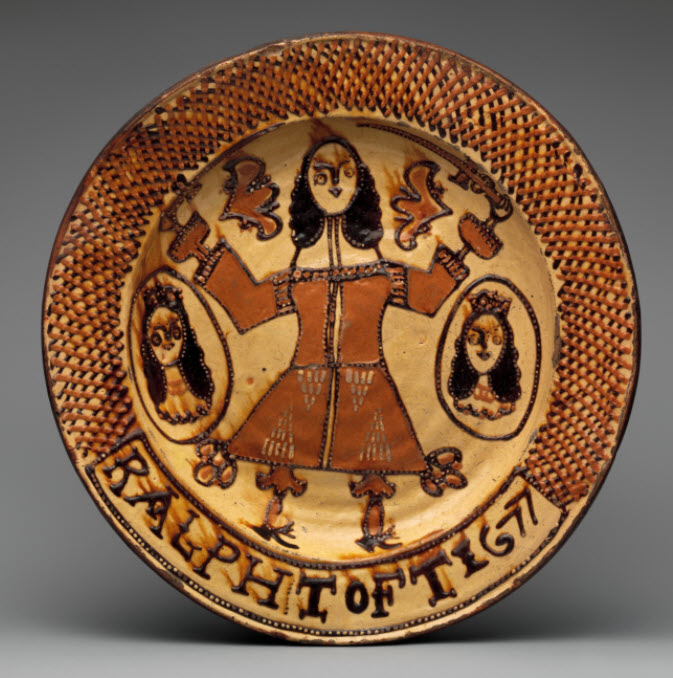
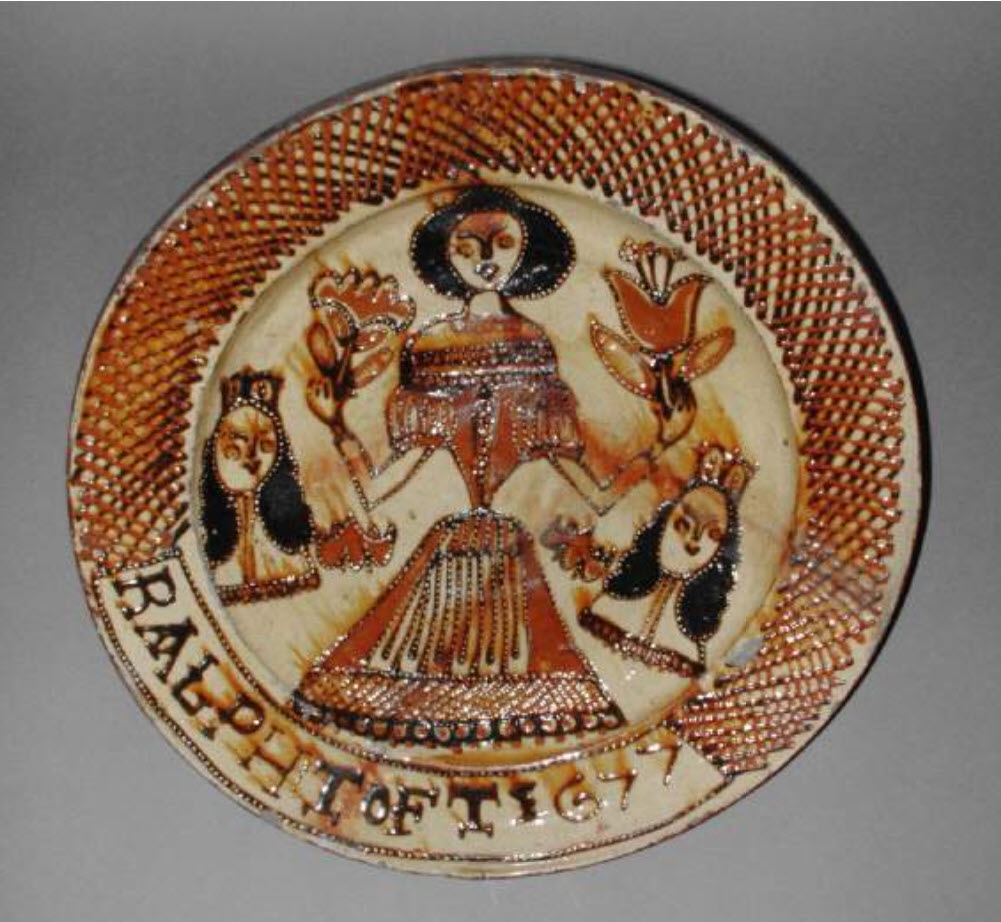
Ralph Toft was believed to be Thomas’ brother, but could have been Thomas’ son. Ralph, too, created slipware pottery (as did a Cornelius Toft and a James Toft). An example of Ralph Toft’s work from the Metropolitan Museum of Art is shown below. Once again the artist employs a cream-colored slip foundation and dark clay slip trailings for decoration:
Plate by Ralph Toft, Metropolitan Museum of Art
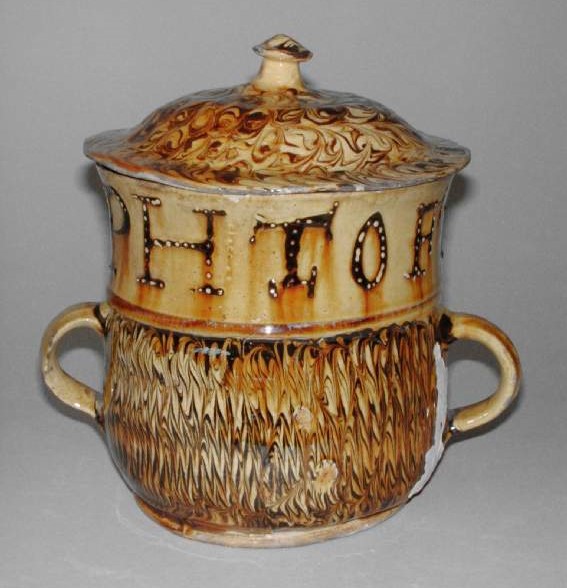
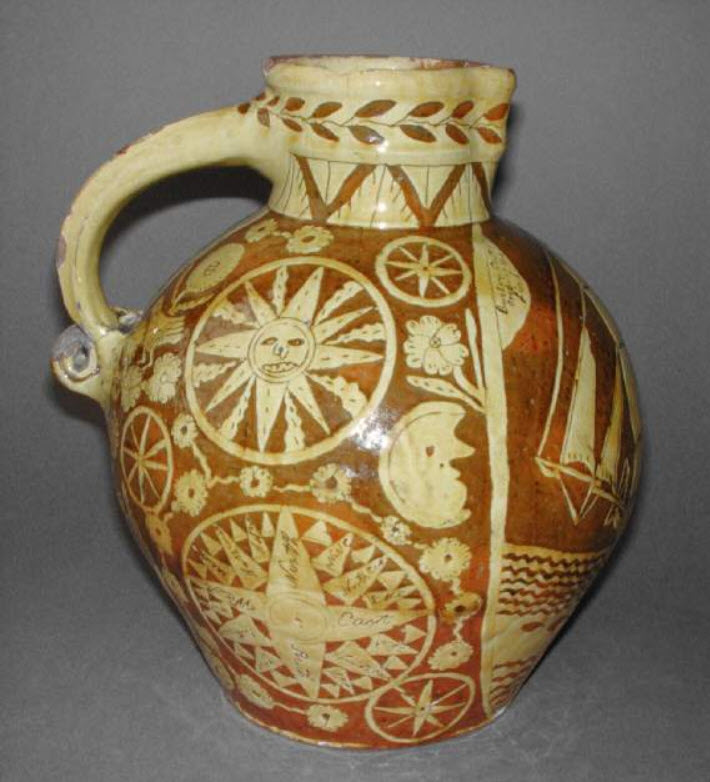
The Fitzwilliam Museum at Cambridge University has 5 items from Ralph Toft, including these two vessels. The first shows an example of “feathered” designs on the top and bottom, probably created by blending wet slip trailings into wet base colored slip with a feather.
Slipware was first produced in what is now the Netherlands and northeastern France in the 16th century. The product was successfully traded throughout continental Europe and found its way to England, where the imports inspired English potters to create local versions.
George Ward, Inscribed ‘GEORGE WARD MADE THIS CVP AN\D SO NO MORE BUT GOD BLESS THE QUEEN AND ALL HER PARLEME’, The Fitzwilliam Museum (2020) “Posset pot” Web page available at: https://collection.beta.fitz.ms/id/object/73745
The English potters had previously used slip when making medieval tiles, and had also employed slip to decorate pottery jugs, but imported functional wares seemed to spark a large increase in slipware production in England the late 1500s, first in Somerset and later in north Devon.
Slip is essentially just clay mixed with water. Potters would apply an even coat of this liquified clay across the vessel to decorate. Early on, English potters would carve away portions of the slip coating to reveal the color of the underlying earthenware clay, a technique known as Sgrafitto.
Potters developed other techniques to blend together different colored slips into interesting, swirling surface patterns. English potters applied slip onto earthenware ceramic vessels with a quill, or through “slip trailers” made out of cow horn or pottery. Potters applied the slip “trails” directly onto the earthenware clay, frequently after first appling a light, uniform coating of slip over the earthenware surface. These “trailed” designs became quite elaborate and playful.
I love English slipware for its simplicity – almost naïve quality. It is lyrical and fun. Warm and engaging.
I am preparing a separate blog post about two of the more prominent English slipware potters: Thomas and Ralph Toft. I encountered several other interesting slipware potters when doing my research on the Toft family, including Henry Ifield, John Eaglestone, John Finley, Samuel Malkin, William Simpson, John Phillips Hoyle and George Ward. I’ve attached an example of several of these artists below (all from the Fitzwilliam Museum):
An interesting booklet on English Slipware, by David Barker, is available from Shire Books. Unfortunately, the illustrations are all B&W.
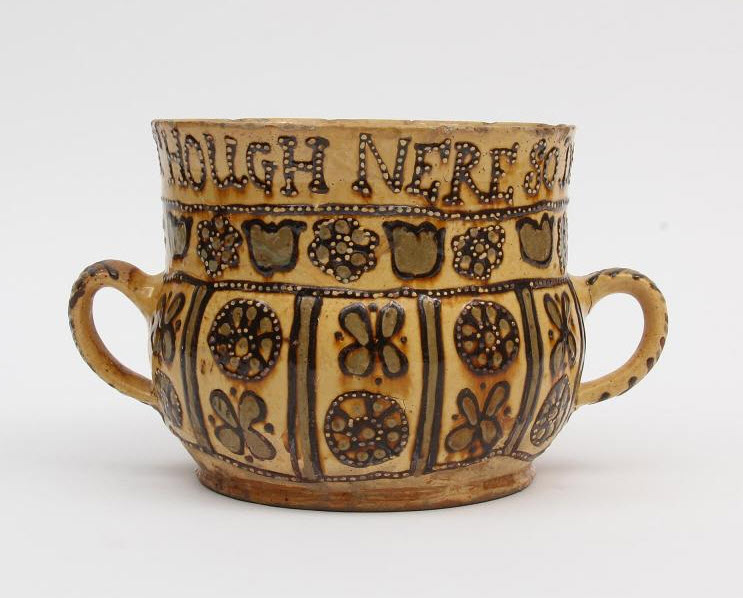
The Gardiner Museum has a small online collection of English slipware. Two delightful examples are shown below – the first a cup with the script “THOUGH NERE SO DEEP – YOU’L IN ME PEEP” encircling the rim, the second a “charger” or decorative plate.
Deighton is a ceramic artist and educator, currently teaching courses as the Artist-in-Residence at The Ceramics Program at Harvard University. He has also taught ceramics at Lesley University, Clemson University, Winthrop University, and Greenville Technical College.
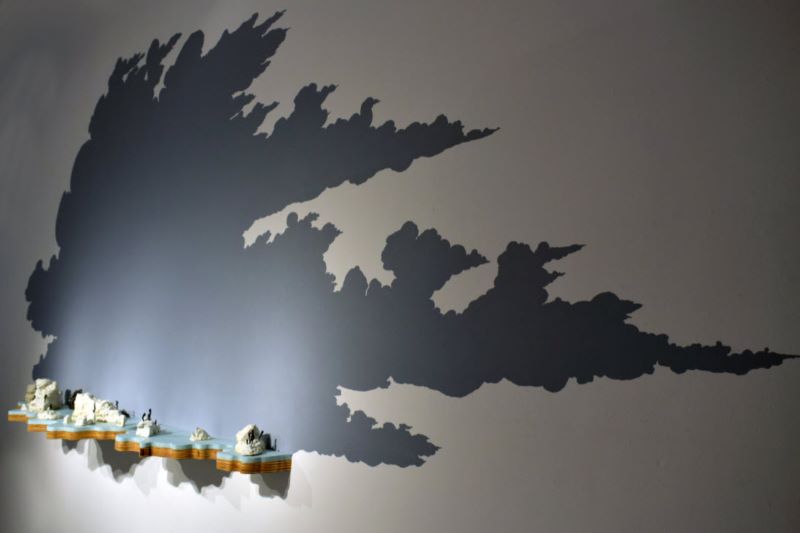
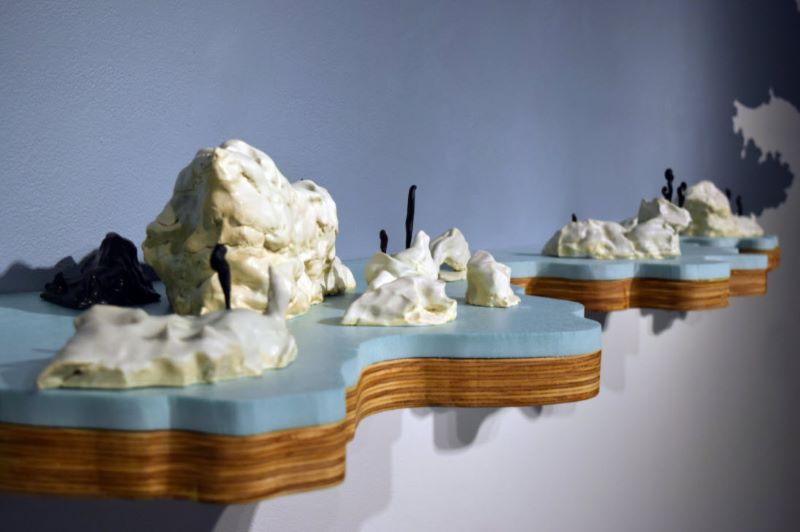
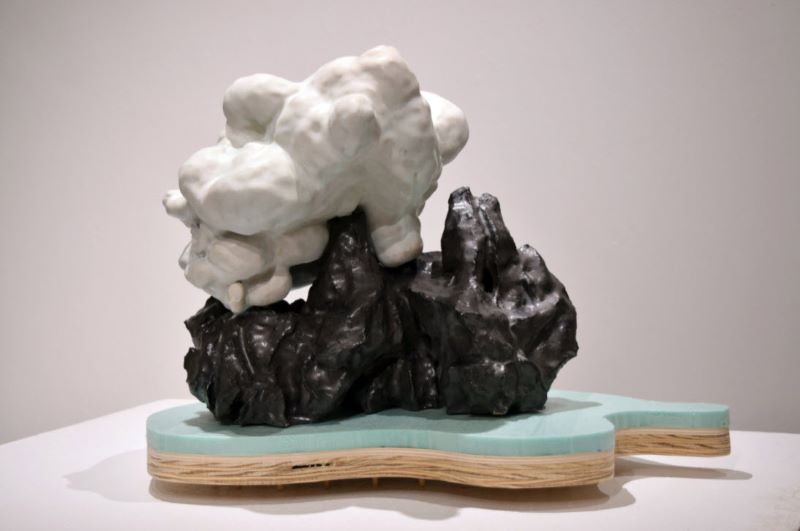
Deighton grew up in Alaska, and has fused that experience with sculpture. Deighton’s work explores connections between humans, the creative process, and the physical landscape — with a particular focus on environmental stress and climate change.
JW: You do both sculptural work and functional work. Any preference? What does one offer that the other does not?
DA: For me, it’s hard to choose between which of the two are my preference since they offer different creative outlets and processes for me. I tend to call myself a sculptor and never a potter since I’ve never worked exclusively making functional work. Sculpting allows me pretty wide berths in terms of creative freedom as I’m not tied into any sort of explicit craft dogma (typically no one is consuming food from my sculptures) so I can make the call most times on what is acceptable in terms of things like glaze “flaws” and fissures in the clay.
Functional work, however, keeps my craft edge sharp as I try to make work that fits into more traditionally acceptable ceramic standards. A cup that doesn’t hold water is more clearly a failure than a sculpture with a similar crack. Much of my maintaining balance between wheel throwing and handbuilding (whether it’s functional or sculptural) comes from my teaching practice and ensuring my students can learn any number of skills from my lessons and not feel underserved.
JW: You started as a printmaker. What prompted your transition to ceramics?
DA: I started my full time undergraduate studies after almost a decade of working in retail and foodservice and I’d persistently called myself an artist in spite of not making much work. I’d always illustrated and drawn things from life but my undergrad program introduced me to the process heavy medium of printmaking. I really enjoyed carving blocks and working in a fairly old, traditional medium that had a heavy reliance on craft. My program required that I take ceramics as a foundations course and I saved it for the very end of my program as I really didn’t want to do anything with 3D work. I’d never touched clay in my life (other than playdough as a child) and had no interest. The first project was a simple pinch pot and I struggled with it so much that my wife actually finished it for me. The next project was a coil pot and something clicked with me and that process. My instructors John Jensen and Mac McCusker were very supportive and I ended up becoming a studio tech the following semester. Something about the vibrant, open community of clay really attracted me and I felt able to translate my drawing skills directly into sculpting from life. Haven’t been without clay ever since.
JW: It looks like your recent (2020) sculptural work is of fairly small scale, while some earlier pieces you did were larger. Is there a reason for that change of scale?
DA: My wife and I moved to the Boston area in late 2019 for her work and I started working at the Ceramics Program for the Office of the Arts at Harvard University as a work study intern and academic assistant to the director Kathy King. I didn’t have a dedicated space for my own work other than small shelves and my apartment was incredibly small with little storage.
This forced me in some ways to work on a very small scale but I’d also been a bit exhausted physically and mentally from making and moving large works. Aside from these practical concerns, I was beginning to think about how to make impactful work that didn’t rely on massive scale to operate and I’d also become hyper aware of my material consumption and this was a minor way to mitigate that. My space during the pandemic was also very limited and I didn’t have access to kilns or firing for the first time. It was incredibly difficult to find motivation to continue working on my own work and I’d transitioned to teaching ceramics fully remotely and the challenges of online learning consumed much of my time. For a few months, I’d actually begun making tiny daily sculptures inspired by Japanese netsuke at the suggestion of my wife.
JW: You’re very focused on environmental changes – but certainly the pandemic has had large-scale impact on societies around the world. Has COVID wiggled its way into your work in any way?
DA: I’m still dedicated to my research on climate change and material ethics through my art but the relative isolation of the pandemic in our new urban home gave me time to think about some of the root causes of disaster and human nature. I’ve started to think more intensely about living in different regions, whether urban or rural, coastal or inland, and so on change our levels of consumption.
I haven’t gone on to making things like caricatures of viruses, toilet paper, and kn95 masks, but the pandemic has certainly changed my view of the planet and the people in it. If anything, my concerns are even more outward facing with my work and I now have an even greater interest in how social and mental health affect our views on climate change and its perception within political theater.
JW: What specific steps have you taken as a ceramic sculptor and maker to mitigate your environmental impact?
DA: Most steps I take to mitigate my impact as an artist are through offsetting my consumption in other areas of my life. I drive as little as possible and walk or take public transit, something easy to do in my new urban home. I also try to limit the amount of meat I consume as there’s plenty of evidence to suggest that factory farm processes have a severe impact on the environment. Within my work itself, I constantly try to reconfigure older work or pieces that didn’t feel ready to exhibit when I made them and combine them in new ways that feel fresh. I tend not to cull too much of my sculptural work and hold onto them until I find a use for them. Most of the time my demo pieces from workshops or teaching serve as experiments for combining forms, such is the case with my piece Nilohuki/Molohuki which combined a demo coil pot and two sculptures that didn’t make it into my final thesis show.
JW: Are you satisfied with what you can do as a ceramic artist to alleviate your concerns about ecological catastrophes?
DA: Overall, it’s hard not to be a bit cynical about my impact as a ceramic artist. Much of what I discuss surrounding my work feels hypocritical as I convert raw earth that has taken millions of years to develop and then convert it into permanent ceramic which will then take perhaps the same amount of time to decompose. Compound that with the knowledge of the sometimes vast distances these materials travel and the often irresponsible mining practices that procure them as well as using fossil fuels to finish them off, the negative aspects of consumption seem very dire. I understand, however, that you can trace much of these same processes to any part of our daily life and the scale of my ceramic consumption often pales in comparison. I think much of my thoughts surrounding consumption stem from the closeness and abstract kinship I feel to clay and all of its stages. These thoughts often freeze me up in the studio but I also think about how much more mindful I’ve become with my work and that drives me forward to continue making, even if the pace is sometimes painfully slow. I’ve never wanted my work to be about making people feel awful about consuming anything, least of all clay, but an awareness of the materials we use and the means we take to acquire them I believe can make us more mindful and perhaps more imaginative when it comes to the future and how we move forward.
JW: On your functional work, I’m picking up several surface decoration themes (skulls/skeletons, eye symbols, & landscape elements). Can you tell me more about the origin and repeated use of those elements?
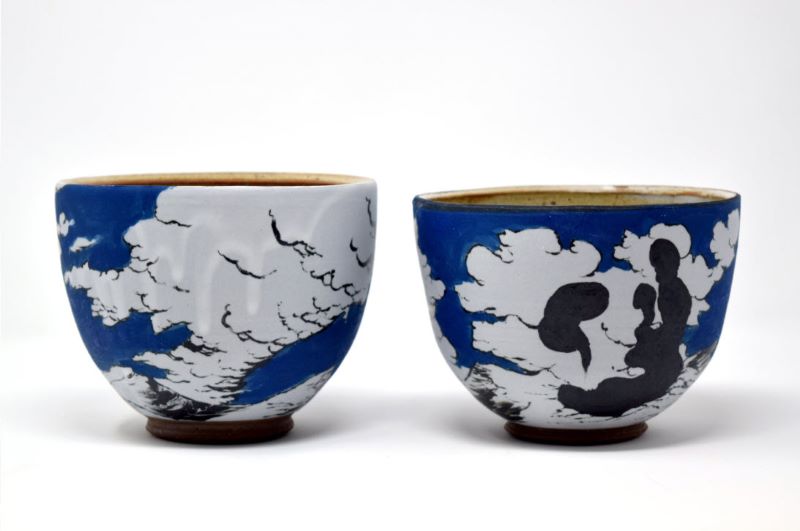
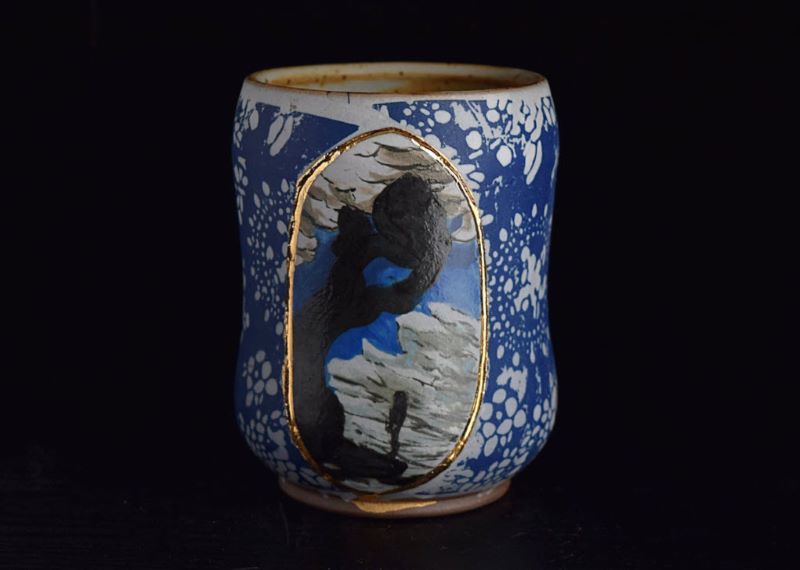
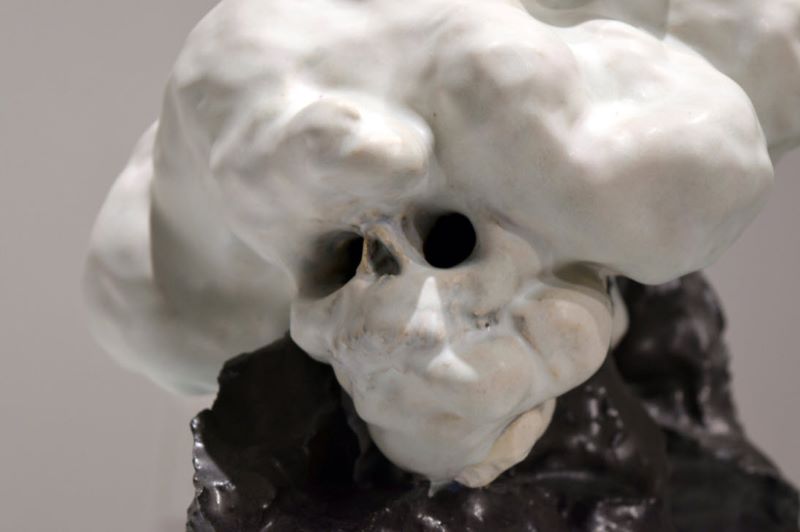
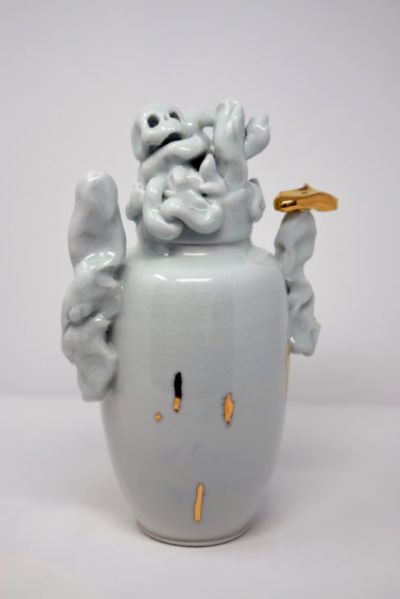
DA: In many ways, the illustrations of my functional work are continuations and extensions of my printmaking work. There’s something special about drawing on clay, especially porcelain, that drives me to think about how I divide and fill the space. Skeletons are usually my way of striking a sense of memento mori, a reminder of death, but I try not to make them overly morbid and try to make them slightly humorous when I can. Eyes and clouds have been my default patterns and void fillers, there’s something about both motifs that enable me to work quickly and imbue a sense of the ethereal with them, something I haven’t really pinned down conceptually.
My landscapes are almost always fully imagined and drawn directly on my surfaces with little to no planning. My father grew up in Jackson Hole, WY, and my mother grew up right outside the west gate of Yellowstone in Gardiner, MT; in combination with my experiences growing up in Alaska, I’ve always had a deep connection to vast, open landscapes. I also love the atmospheric paintings of Chinese artists like Fan Kuan, the Romantic Era paintings of European and American artists like Caspar David Friedrich and Thomas Cole, as well as Japanese manga artists like Katsuhiro Otomo. These influences among many others drive me to make functional work that is labour intensive, atmospheric, and accessible.
JW: What would you like people to know about your sculptural work?
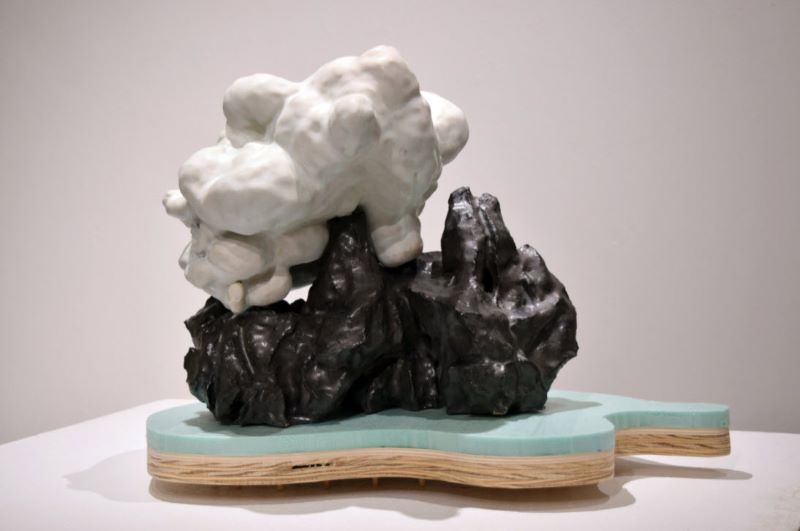
DA: My sculptural work is driven by my need to express myself and viewpoints in deeply conceptual ways. Every part of them has some degree of meaning, especially the materials I choose to support them like salvaged, untreated wood and polystyrene insulation foam, the latter began as a pun with my thesis work titled Winter Kept Us Warm, a nod to a line in T.S. Eliot’s poem “The Wasteland”, and the view I was trying to express that we often “insulate” ourselves from knowledge that conflicts with our conceptions of reality.
Even though I attempt to imbue every single component of my sculpture with meaning and/or symbolism, I think they are mostly meant as emotional conduits for the viewers. Generally I hope there’s enough ambiguity within them for people to interact with them on their own terms without needing all of the baggage of meaning I construct for them.
JW: Where to from here? Any major projects or plans on the horizon?
DA: My focus since graduate school has largely been on teaching both on the community and academic level. Teaching is one of my greatest joys in life and I love developing students’ desire to create thoughtfully, both for themselves and the world around them. I’m currently teaching courses as the Artist in Residence for Harvard Ceramics as well as ceramics courses at Lesley University. I’m looking forward to developing new sculpture classes for both as well as completing a new body of sculptural and functional work. I’m working towards a new shop update for my functional work on my website and making sculpture for my solo show here at Harvard sometime in 2022.
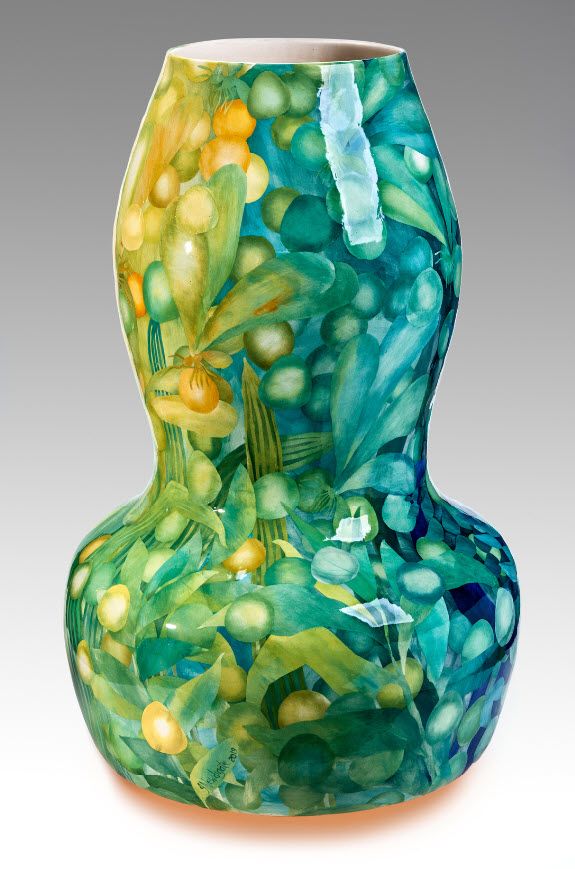
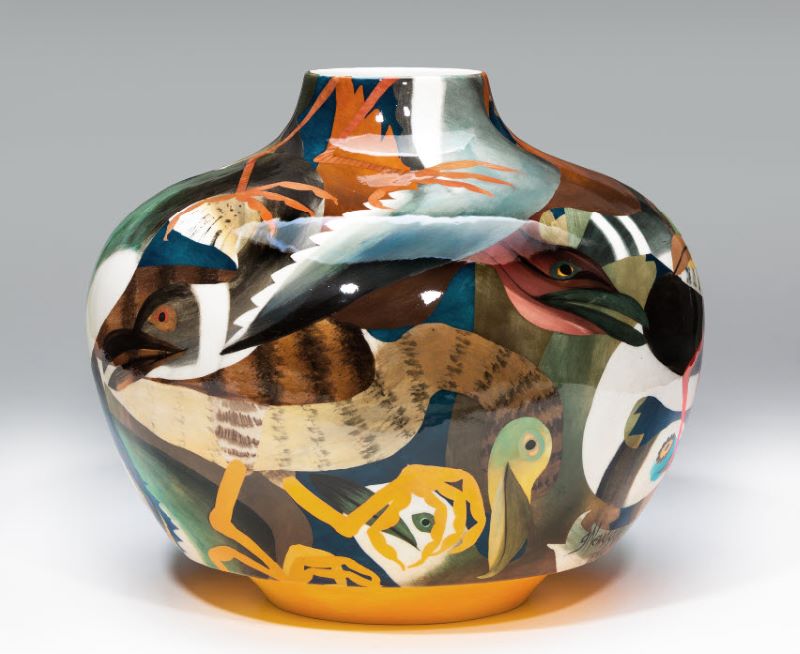
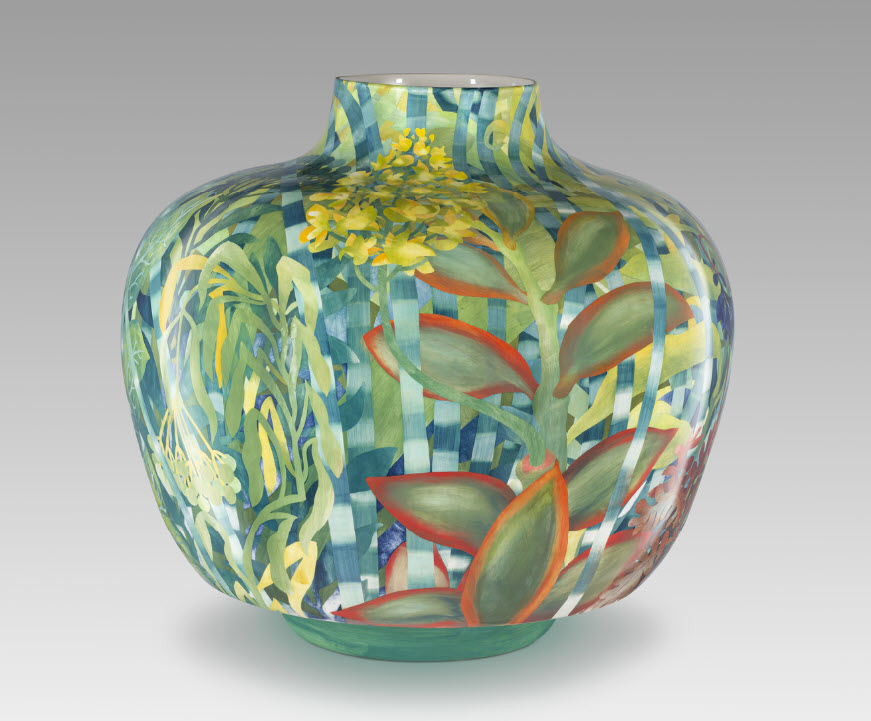
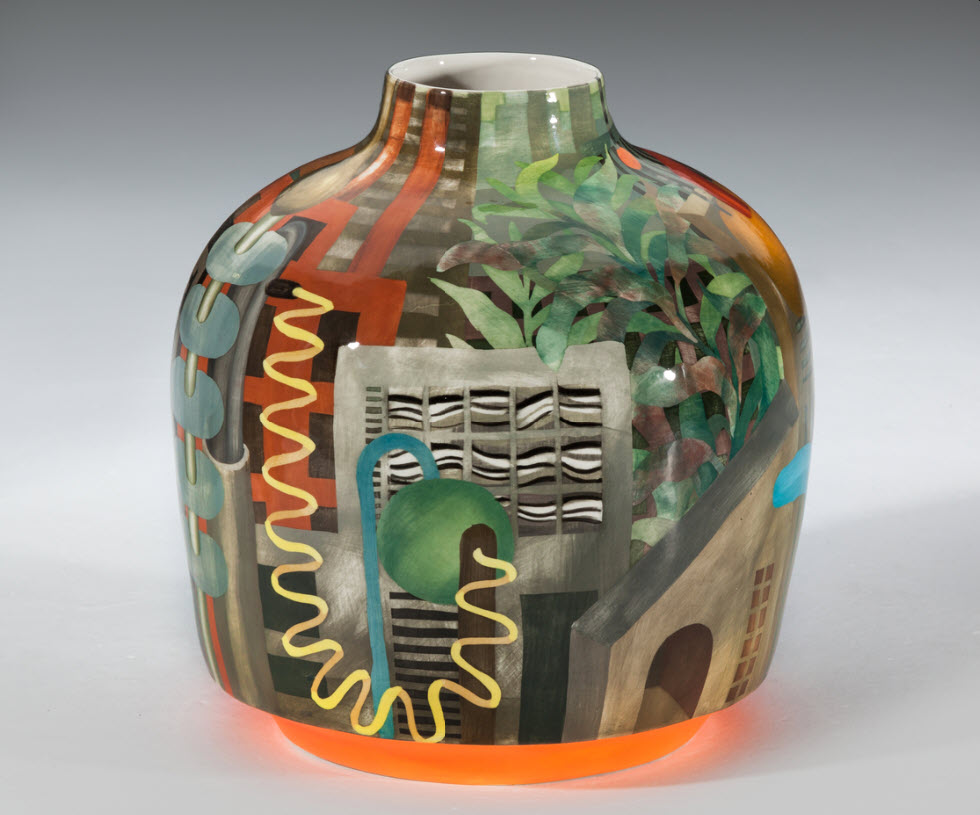
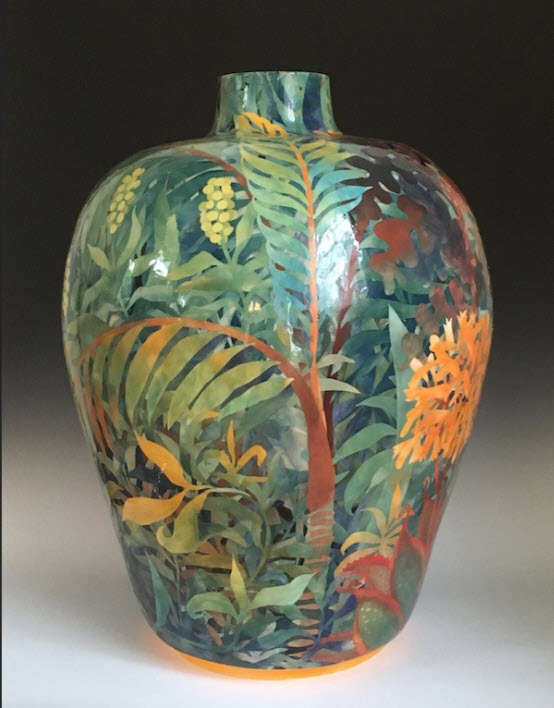
John Newdigate is a South African artist who produces magnificent pots, churning with the vegetative forms and animals that surround him in his mountainside home. Vibrant colors distinguish his ceramic pieces. Large scale forms are also characteristic of John’s work, although he creates vessels in various sizes.
JW: Will you tell me something about your collaboration with Ian Garrett? (I think he throws the pots and then you take over with painting and glazing).
JN: Ian Garrett and I have shared our lives for over twenty years. We were both professional ceramists when we met, but our approaches could not have been more different. Where Ian has a MAFA degree, I have informal training. Ian works in low fired, burnished earthenware and I work in underglaze painted porcelain. Ian makes few pieces that he puts a lot of time into, whereas I saw myself as a studio potter, making multiple versions of functional wares. For many years we kept our professional lives separate as we both had clear directions for our own creative journies. However, over time we did start to influence each other. I learnt from Ian’s more disciplined approach, to take my work seriously and to devote more time to making fewer pieces.
I am a competent hand builder in my own right, and for many years made my own vessels, but Ian is widely acknowledged as a master hand-builder, creating vessels that are as symmetrical as if thrown on a wheel but his forms have the warmth and generosity of hand-built forms. Ian actively maintains his solo career, so is happy to play a secondary, supportive role in our collaboration, choosing not to do more than the making of blanc vessels for me to paint. As my painting can be exuberant, I appreciate that his forms do not compete for attention, rather adding a quiet sophistication that compliments the end result hugely. The aim for a successful collaboration should be for the the sum to be greater than the parts, I feel that we have achieved this.
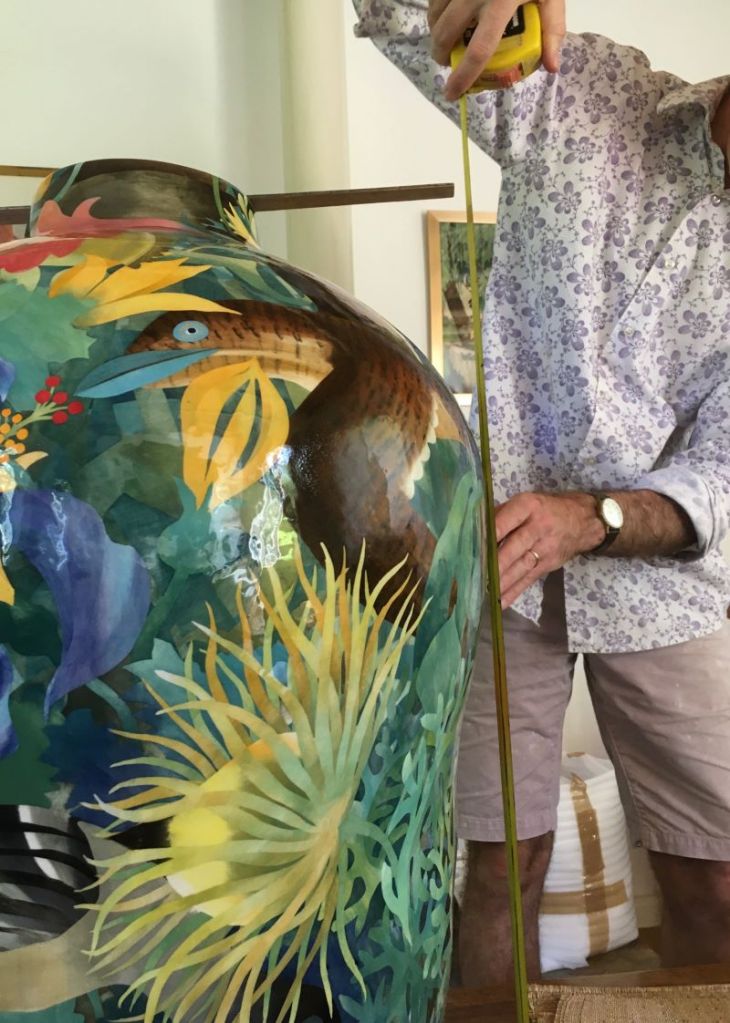
JW: One thing wasn’t evident until I looked at your Instagram account: the scale of your work. These pieces are huge!
JN: The work varies in size, from 15cm – 110cm tall, with most being around 30-50 cm in height, so they’re not all huge!
JW: How do you achieve such intensity of color in your work? (I believe you use underglaze topped with a clear glaze. It’s really remarkable.)
JN: When underglaze pigments first became widely accessible they were immediately taken up by amateurs painting pre-made slip-cast bisque ware which resulted in the medium not being taken seriously by the established ceramics world. After years of working in carved porcelain, glazed in reduction fired celadon, I started yearning for colour and started experimenting to find a technique to express my ideas more fully. After each failed attempt I would retreat back to the safety of the carved celadon. But there was just enough of an inkling of a new and exciting possibility that made me persevere. Eventually I realised that mixing colours by overlaying thin layers and reserving areas with wax-resist I could create images that combined control with freshness and spontaneity, allowing me to share the images that had previously lived in my imagination only.
JW: Will you tell me a bit about your background? Were you always interested in ceramics? If not, what attracted you to ceramics?
JN: I grew up in a coastal village/suburb called Kalk Bay on the outskirts of Cape Town, in one of the very few places in South Africa at the time that was not (fully) racially segregated. The close-knit community consisted of people from a wide variety of socio-economic, ethnic and cultural backgrounds, which was highly unusual for South Africa at the time. Many of our family friends were artists and I was especially lucky to get informal training in childhood from two women, Peggy North for painting and drawing, and Barbara Bruce for ceramics. When I completed schooling and started studying Art at a tertiary level I didn’t thrive and left after six months. I was conscripted into the South African Military for two years, against my will and principles. On completion I worked in the Art department of a screen printing factory for a year. The following year I visited Europe on a working holiday. My return to South Africa coincided with the Rainbow Nation of a post-Apartheid South Africa, creating a current of great optimism and goodwill. In this spirit I started making objects out of various materials, but ceramics was always my favourite.
JW: I see a lot of vegetative themes in your work, plus of course fauna. Can you tell me about the sources you tap into for your painting?
JN: I like my art to be autobiographical, and honest. For me this means depicting the physical world in my immediate surroundings, melding it with my thoughts and observations of the wider world. I don’t aim to judge, influence, praise or blame, rather to depict concepts visually that I find difficult to articulate with words (as I’m struggling to do right now!), as a means to understand them better myself. While Nature is profoundly beautiful, I do not see it as cute and fluffy.
From the level of unicellular organisms to large mammals its a case of eat or be eaten. We humans have done a half-convincing job of concealing our animal instincts, whereas the natural world is straight forward which is why I do not sentimentalise it.
JW: I also detect an “industrial” theme in some pieces. Where does this come from? How DO you decide on a theme? Is this driven by your inspiration at the moment or are you preparing work to satisfy demand for your products?
JN: I know for example that a smartphone does work, but like most people I have no idea *how* it works, let alone anything about the processes that created it. How does one go from raw materials mined from from the earth to the iPhone in your hand? How can technology play such a huge role in my life without me knowing much about it?
In these pieces I am depicting my basic understanding of how these structures and processes work, and that I appreciate how much I do not know about them. To be honest I don’t know where my ideas come from, but often they come to me when I’m in a state halfway between being awake and asleep.
JW: Will you tell me more about your creative process? I found this on your Instagram account but honestly I don’t understand all the references
JN: While painting foliage on a vessel one day, I looked up and noticed that the scenery outside my studio windows was filled with the same subject matter. It occurred to me that it would be good to record the moment and what my studio looks like. The main reason that I like to paint on vessels is that all the imagery cannot be seen from one viewpoint. Time is required to reveal the images as the viewer moves around the vessel. This creates a static animation, or single frame animation.
On one side of this vessel I have the unpainted pots as given to me by Ian Garrett, in various stages of drying. Outside, viewed through the windows, is the natural world that inspires me and which I then paint onto the pots. Further along there are pots in varying degrees of completion. In-between I’ve depicted some of the equipment and materials that I use.
JW: I’ve got to ask: what is the story about “(The Attempted) Suppression of the Kikuyu Uprising”? (It seems like one of just a few “social commentary” pieces I’ve seen. I’m personally interested in this because of all the turmoil we’re experiencing in my country (USA).)
JN: There is a species of grass called kikuyu, named after the Kikuyu people, as it grows naturally in the region of east Africa where they live. The grass is also tough and resilient, like the Kikuyu people, and to get it to conform into a lawn requires constant attention. In the past, colonial authorities imposed their will on the locals using brutal methods, but it did not have a lasting effect, the people recovered and continued their resistance, eventually defeating them. I see Kikuyu grass as a metaphor for the human spirit that never gives up the struggle against tyranny, and the futility of imposing rules over unwilling subjects.
JW: What would you like people to know about yourself and your work?
JN: Ideally, I’d like people to view my work without presumption, maybe the less they know about me the more likely that would be!
I would like people to know that I put a lot of thought and time into each piece, and that I leave space for the viewer to have their own interpretation of what the work is about, so that there is a three way conversation between the maker, the vessel and the viewer.
In closing, here’s a short video about John’s work in his own words.
Courtesy Die Neue Sammlung – The Design Museum, Photo: Hannes Rohrer.
In July 2017, Franz, Duke of Bavaria donated his collection of African ceramics to the Die Neue Sammlung – The Design Museum, based in Munich, Germany. Franz, Duke of Bavaria had been accumulating his collection since the 1970s. In September 2019 the museum held an exhibit of over 250 works from the collection, which ran from Sept 2019 – April 2020, and included information on the forms and function of each ceramic piece, plus the context of their creation.
Unfortunately, we all missed that.
Die Neue Sammlung – The Design Museum, did, however, give me permission to share photos of some pieces that were included in the exhibition. I’ve supplemented these images with tidbits about the artists and ceramic traditions that I’ve been able to find online. (I don’t have access to the museum’s information on each piece. I also have no background in African ceramics or African cultures.)
These ceramic pieces stand on their own, with or without exhibition information. They possess raw vitality and energy. It would be fantastic to view the objects first-hand, to experience the physical properties so central to that vitality. I thank Die Neue Sammlung – The Design Museum for allowing me to share photographs.
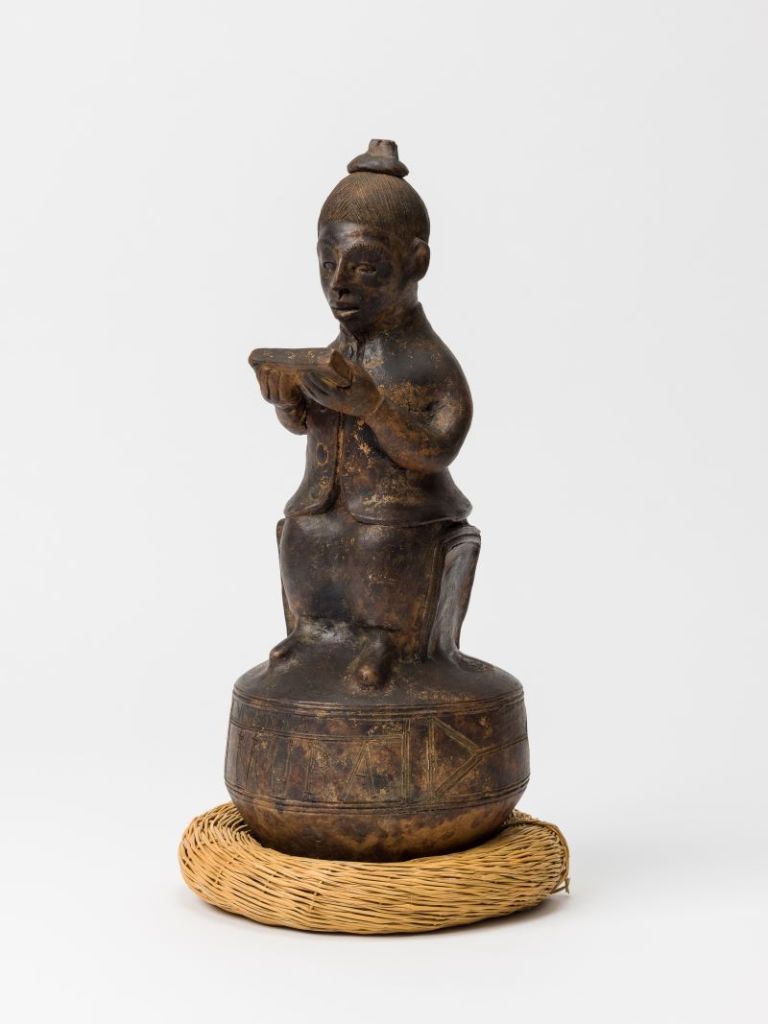
Voania of Muba (? – ca. 1928), Figurative vessel, Woyo culture, Muba, Democratic Republic Kongo, end of 19th century until ca. 1928. Courtesy Die Neue Sammlung – The Design Museum, Photo: Hannes Rohrer.
The figurative vessel above was created by the self-taught Voania of Muba, a Woyo chief who worked in the early 1900s. Voania created ceramics for a European clientele. He is fairly unique because the Woyo people do not have a strong pottery tradition. I found multiple images of Voania of Muba’s work online, and individual examples of this artist’s work at the Semanek-Munster museum, the Smithsonian Museum and the British Museum.
Bottle, Tutsi Culture, Rwanda, Burundi, Late 19th – mid 20th c., Black terracotta, white pigment, H 42 D 30.5, Inv.# 1868/2019, Die Neue Sammlung – The Design Museum, Munich, permanent loan from Franz, Duke of Bavaria (Inv.# FVB0551) Courtesy Die Neue Sammlung – The Design Museum, Photo: Hannes Rohrer.
Pots such as this example, above, were used to carry water in rural communities. Made of local clay, the patterns are rich and bold.
Tutsi people are believed to have arrived into what is now Rwanda in the 1400s, setting up a feudal system with a king. Local Hutu farmers ultimately came to lease their farmland from the Tutsi immigrants, and racial tensions sharpened after European colonists arrived. Ultimately, the situation erupted into extreme violence in the 1990s with the Rwandan genocide, where apx. 1 million Tutsi people were massacred with local tools and machetes. See background information here.
Magdalene Odundo (born 1950), Asymmetrical Series, Kenya/Great Britain, 2017. Courtesy Die Neue Sammlung – The Design Museum, Photo: Hannes Rohrer.
Dame Magdalene Odundo was born in Kenya and now works as a studio potter in Surrey, England. She is best known for her hand built, asymmetrical pieces that are highly burnished, covered with slip, and then reburnished.
I found this video interview with Ms. Odundo, who describes her training and background, plus some insight into process and motivations.
Ritual Vessel for Shango Yoruba Culture, Oyo, Nigeria, Late 19th – mid 20th c., Brown terracotta, H 43 D 40.6, Inv.# 1581/2019, Die Neue Sammlung – The Design Museum, Munich, permanent loan from Franz, Duke of Bavaria (Inv.# FVB0295). Courtesy Die Neue Sammlung – The Design Museum, Photo: Hannes Rohrer.
I found an article about Shango cult practices online. It notes that, “In Nigeria, Shango, god of thunder, is the only deity worshipped in the Shango cult… Clay pots and jars containing water are ubiquitous in the Shango centers of Trinidad as they are in cult houses in southern Nigeria (Talbot 1926: 11: 20). On entering a Shango center in Trinidad during a nonceremonial period, a prominent devotee goes to each of the exterior shrines and pours a small quantity of water from the jar found on the “stool.” Water is poured from clay pots at various times during a ceremony.” (See The Shango Cult in Nigeria and Trinidad.)
Courtesy Die Neue Sammlung – The Design Museum, Photo: Hannes Rohrer.
Courtesy Die Neue Sammlung – The Design Museum, Photo: Hannes Rohrer.
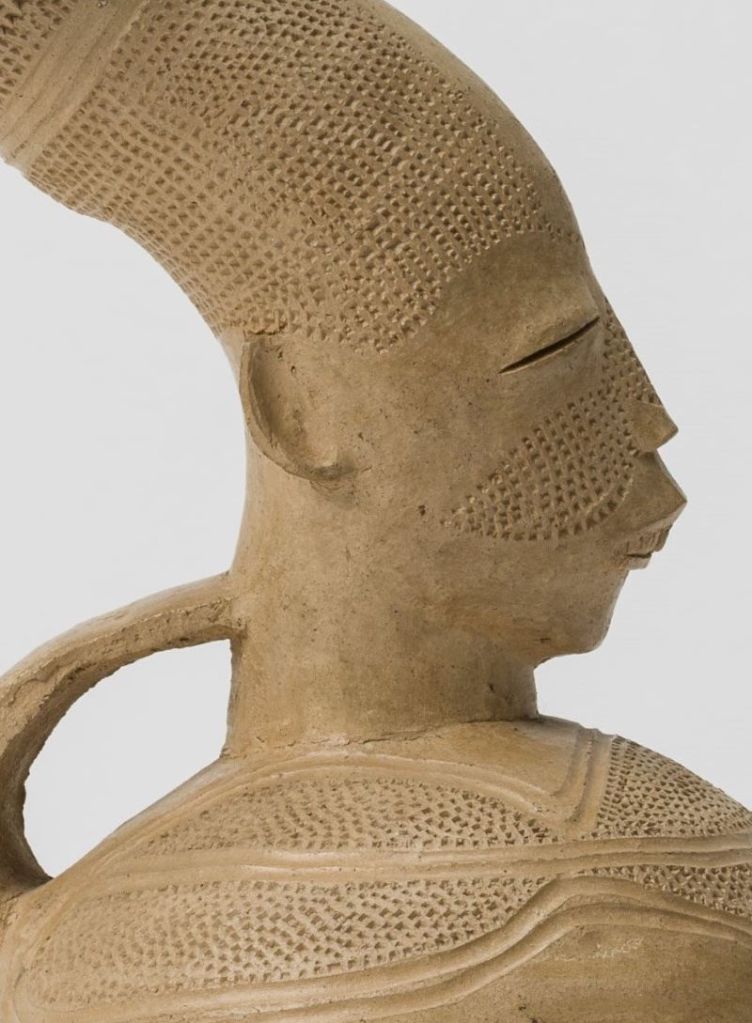
People of the Mangbetu tribes are known for their elongated heads. Newborn babies have their heads wrapped with cloth to shape it into an elongated shape.
Patterns carved into Mangbetu pots are typically thin, shallow lines that wind around the pot surface.
Additional examples can be found by searching for “Mangbetu” on the Met’s website.
Spirit Vessel, Mafa or Matakam Culture, Cameroon, Nigeria, Late 19th – mid 20th c. Gray terracotta, white stones, H 47 D 40, Inv.# 1591/2019, 2019 Die Neue Sammlung – The Design Museum, Munich, permanent loan from Franz, Duke of Bavaria (Inv.# FVB0311). Courtesy Die Neue Sammlung – The Design Museum, Photo: Hannes Rohrer.
I could find very little about the Matakam culture online. Nevertheless, I like this “Spirit Vessel”, above. A lot.
Initiation Mask, Makonde Culture, Mozambique, 1950 – 1980, Dark brown terracotta, H 27 B/W 22 T/D 18, Inv.# 1877/2019, 2019 Die Neue Sammlung – The Design Museum, permanent loan from Franz, Duke of Bavaria (Inv.# FVB0581). Courtesy Die Neue Sammlung – The Design Museum, Photo: Hannes Rohrer.
I found an interesting article entitled “Rituals, Beliefs and Sculptures in Makonde Culture” saying: “Two types of masks can be used during Mapiko ritual dances: a “máscara facial”, covering the face, or a “máscara capacete”, covering the whole head. Both masks are made from wood and their shape is usually heightened and bizarre, with hair and bright colour decorations.”
Of course, the initiation mask displayed above is terracotta clay, not wood.
Medicinal Figure of a Warthog or Hippopotamus, Zigua Culture, Tanga or Kilimanjaro region, Tanzania, Late 19th – mid 20th c., Brown terracotta, H 13 D 30, Inv.# 1929/2019, 2019 Die Neue Sammlung – The Design Museum, Munich, permanent loan from Franz, Duke of Bavaria (Inv.# FVB0634). Courtesy Die Neue Sammlung – The Design Museum, Photo: Hannes Rohrer. Jug with Handle and Spout, Igbo Culture, Nigeria, c. 1950, Dark gray terracotta, red, white and blue paint, H 35 D 29, Inv.# 1706/2019, 2019 Die Neue Sammlung – The Design Museum, Munich, permanent loan from Franz, Duke of Bavaria (Inv.# FVB1215). Courtesy Die Neue Sammlung – The Design Museum, Photo: Hannes Rohrer.
See this Wikipedia page on Igbo art, including their ceramic traditions. Beautiful object.
Beer Vessel (ukhamba), Azolina MaMncube Ngema, (1936 – 2015 or 2016, South Africa, Zulu Culture, South Africa, Mid 20th c – 2015/16, Black terracotta, burnished, H 32.7 D 38.1, Inv.# 702/2017, Die Neue Sammlung – The Design Museum, Munich, donated by Franz, Duke of Bavaria (Inv.# FVB0529). Courtesy Die Neue Sammlung – The Design Museum, Photo: Hannes Rohrer.
I can’t vouch for the accuracy of observations recorded, but in this article entitled “Indigenous Knowledge Systems (IKS) & Zulu Ceramic Arts: Azolina MaMncube Ngema, One Worman’s Story” the author recounts information about Azolina MaMncube Ngema, whose work is shown above. The author spent several weeks with Ms. MaMncube, observing and discussing her ceramic work. Ms. MaMncube often created pots in the “izinkamba” style, including raised “amasumpa” decorations, blackened with “natural” materials including shoe polish. This style of pottery was traditionally associated with Zulu royalty, but Ms. MaMncube may have worked in this way specifically to appeal to to high-paying patrons – specifically, white scholars and collectors. It is an interesting read.
Another example of Ms. MaMncube’s amasumpa-decorated pots is at the Art Institute of Chicago.
Ritual Vessel in the Shape of a Human Head, Tiv Culture (probably), Nigeria Late 19th – mid 20th c. Brown terracotta, wood, feathers, sacrificial patina, H 15 B/W 17 T/D 10 Inv.# 1584/2019. Courtesy Die Neue Sammlung – The Design Museum, Photo: Hannes Rohrer.
I return to my initial statement about these ceramic pieces – they contain raw vitality and energy. Here is an academic paper on ceramics produced by Tiv women. I prefer to just enjoy the piece on its own.
Finally, here is a .pdf listing all the exhibited works, prepared by Die Neue Sammlung – The Design Museum. The listing is complete, but the images are small.
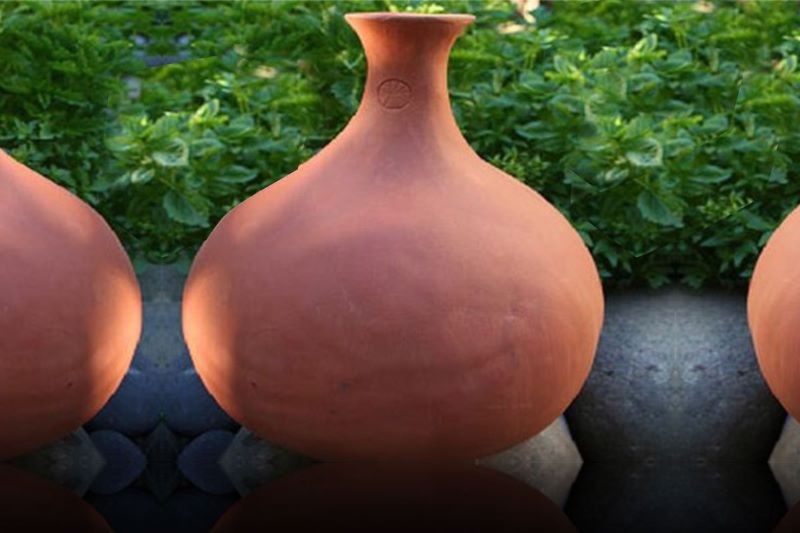
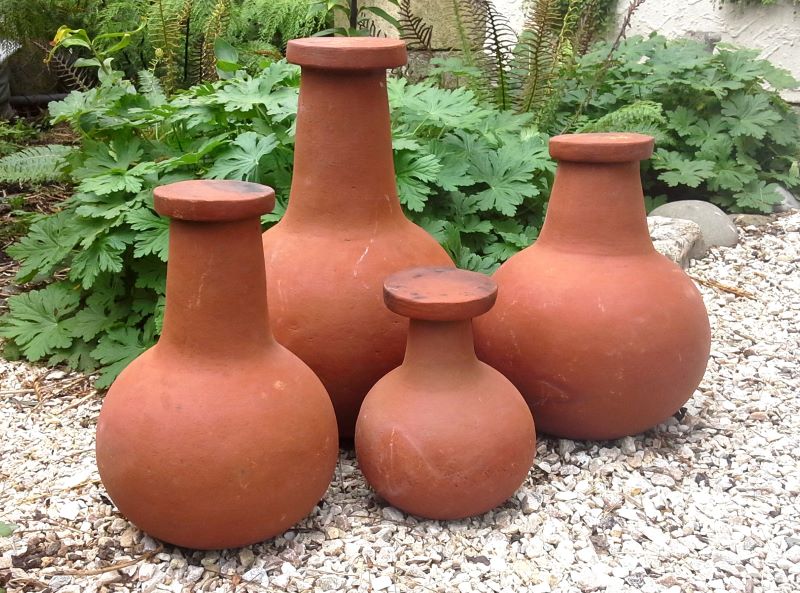
Ceramic ollas (pronounced oh-yahs) have been used for thousands of years as an efficient irrigation system in arid lands agriculture. They are making somewhat of a comeback in small-scale gardens because they are easy to make as DIY projects and they’re effective. In honor of Earth Day 2021, I thought I’d provide some information on this water-saving technique.
Chinese texts that are well over 2,000 years old mention clay pot irrigation. The Romans used ollas. Olla irrigation can be found in the Middle East, India, and Central and South America.
Below are a few instructional videos about ollas, including how ollas work, how to use ollas as small-scale irrigation systems (i.e., garden plots), and instructions on several ways to make ollas out of wet clay (on the wheel, coil building, and slip casting techniques) and how to construct ollas out of commercially available clay garden pots.
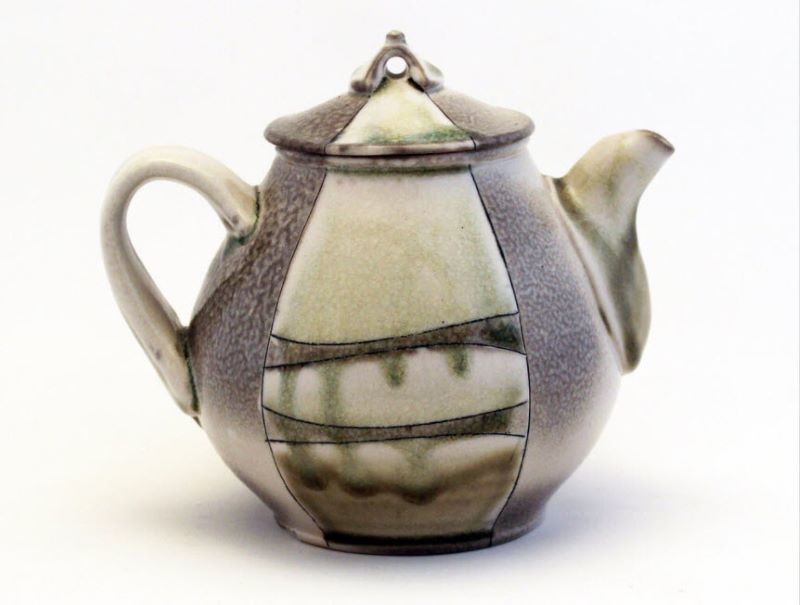
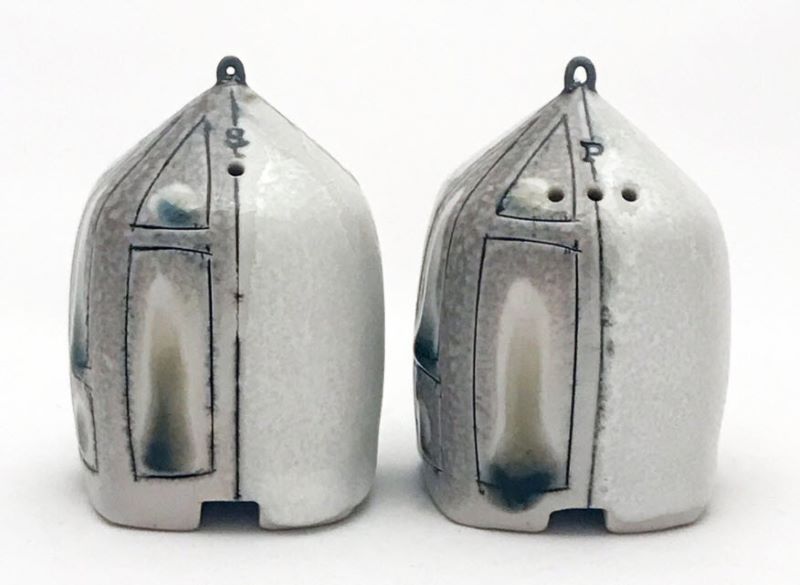
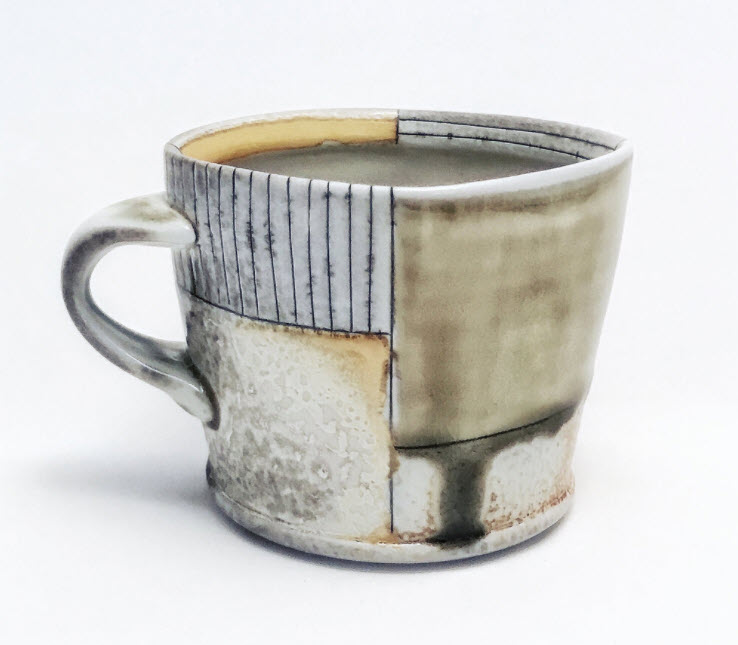
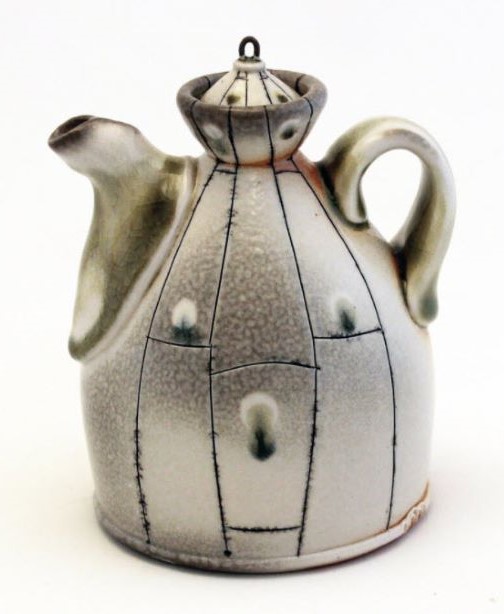
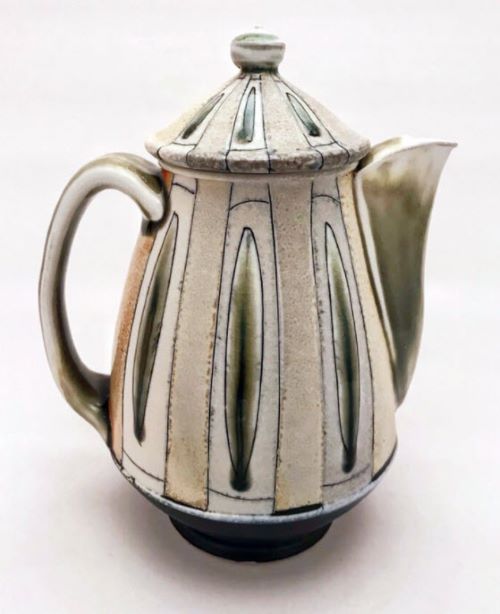
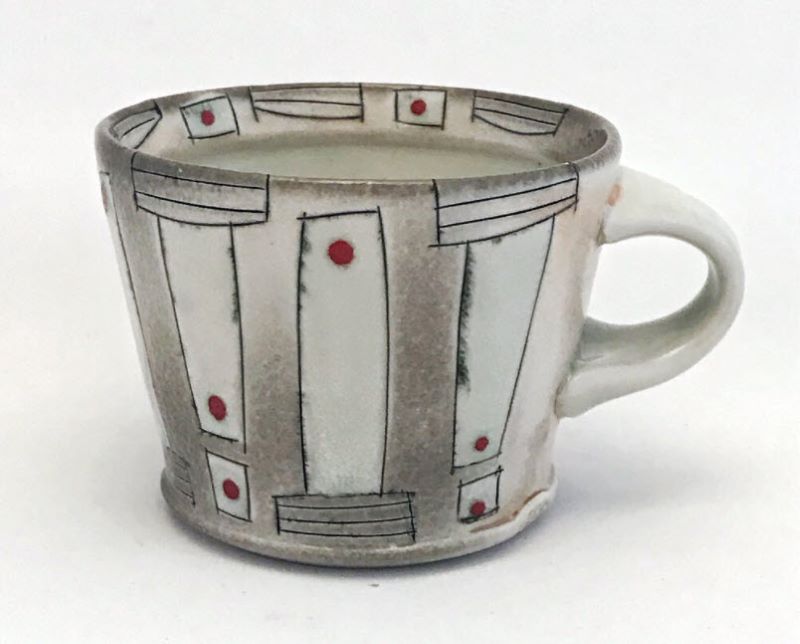
Lorna is a Colorado-based artist who produces soda fired porcelain ware. Her work is intimate, nuanced and subtle. Work to be held in one’s hand and slowly spun around to fully appreciate the gradation of color, the detailed markings, the exquisite texture of object.
Lorna’s stated goal is to integrate the form and surface of her pots, starting with 3D forms that divide space, then drawing on the surface of those 3D forms, and finishing by adding color. “I am drawn to work that is rich in ornamentation, with lavish use of materials – both scarce in a culture of mass production,” she notes on her website.
JW: You work primarily with soda fired porcelain. What attracted you to porcelain and that firing process?
LM: I first started using porcelain, and did my first soda firing in a workshop that Peter Beasecker taught at Anderson Ranch Arts Center in the late 90’s. I was attracted to porcelain for its ease in altering wheel thrown work, and the brightness of the glazes on the clay body. I use soda firing for the directional nature of the firing process. In other words, one side of the pot looks different than the other. The drawing on the surface of my work is often symmetrical, graphic, and very controlled. The soda process is a point of contrast to the predictability of the other processes in my work.
JW: What attracted you to ceramics in the first place?
LM: I started making pots in High School. It’s a little hard to remember what exactly drew me in initially, but I can say that it was the wheel. I think it was just really different than anything else I had done and I was pretty good at it. I loved it right away.
JW: I believe you’ve travelled a lot. Do your travel experiences influence your creative work?
LM: Yes, I like to travel and I am fortunate to have taken quite a few trips. I don’t know how much travel affects my work directly, but I’m sure it has a way of sneaking in some influences into what I am making. I particularly think that is true about my trip to Italy a few years ago. I loved looking at the architecture and the rich colors there.
JW: How has your work changed over the years?
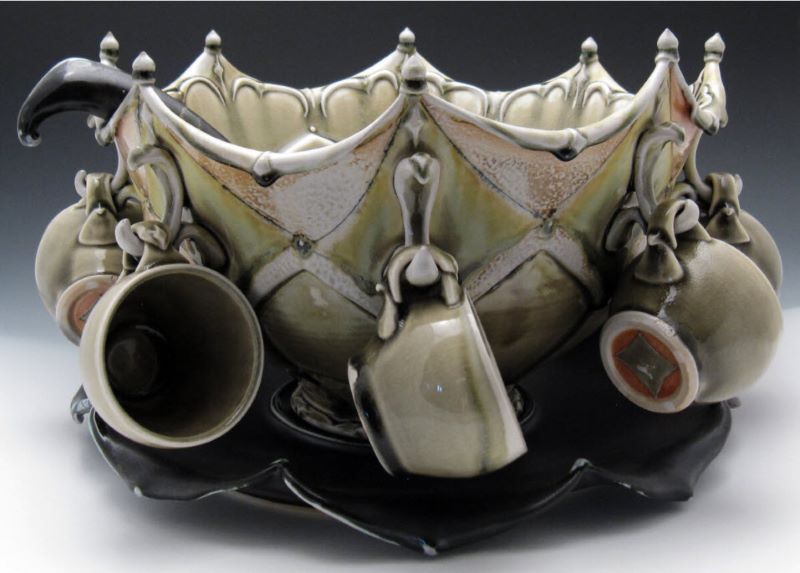
LM: My work has changed very slowly over the years. I’ve been a potter for 33 years now. Initially, my work was very simple – round and dipped in one glaze. Graduate school changed my work, making it more ornamental and decorative. My punch bowls would be the best example of that.
I started spending a lot more time on each piece. In the 15 years since then, I’ve returned to making work that is a little simpler, meant for everyday use. Part of the return to utility was due to the need to make a living. Nowadays I find myself wanting to revisit ideas from the past. I’m currently working toward a solo show in June at Studio & Gallery titled “Tools of Habitation” that will include both some elaborate and decorative work.
JW: You bought into Studio & in early 2020. Apart from changes brought on by Covid, how has that gallery ownership affected you? Have you had more or less time to work on your pottery?
LM: Buying into Studio & Gallery has been great for me. There are 5 of use who own the gallery cooperatively so I only work 1-2 days a week, leaving plenty of time in my studio. I taught adjunct for years, so this has kind of replaced the time I used to spend doing that.
I’m enjoying the connection to other artists and the Durango community that has come from being more involved at the gallery. I expect that will continue to increase as we slowly climb out of this pandemic.
JW: When you first set up your pottery business, your goal was to sell 50% of your work via galleries and the other 50% directly (direct studio sales and sales via your website). Have things worked out that way?
LM: On the topic of selling through galleries, or online, it is continually changing. I still sell through galleries, but I have been moving toward selling more of my own work both online and at Studio &. I just simply have to, in order to make a decent living. I have leaned into online sales during this past year with the pandemic and it has gone quite well. My large Instagram following is a good audience for online sales. I think the new normal after this pandemic is going to give way to a renewed celebration of the brick and mortar. After all, pots are meant to be held…
JW: It looks like you’re doing a fair number of online workshops. As an instructor, do you have any suggestions or recommendations for students to get the most out of online instruction?
LM: I have also been doing a lot of online workshops in this past year. It has gone great. It, of course, has it’s pros and cons. As far as getting the most out of it, I would say, like any workshop, the most important thing you take with you is your ideas. I’ve really enjoyed doing the research for the Powerpoint presentations that I include with my Zoom workshops. I’ve been inspired by both the historical and contemporary work that I’ve found. I hope my workshop participants feel inspired as well!



































 JTW Ceramics