Lindsay Montgomery – Artist Profile

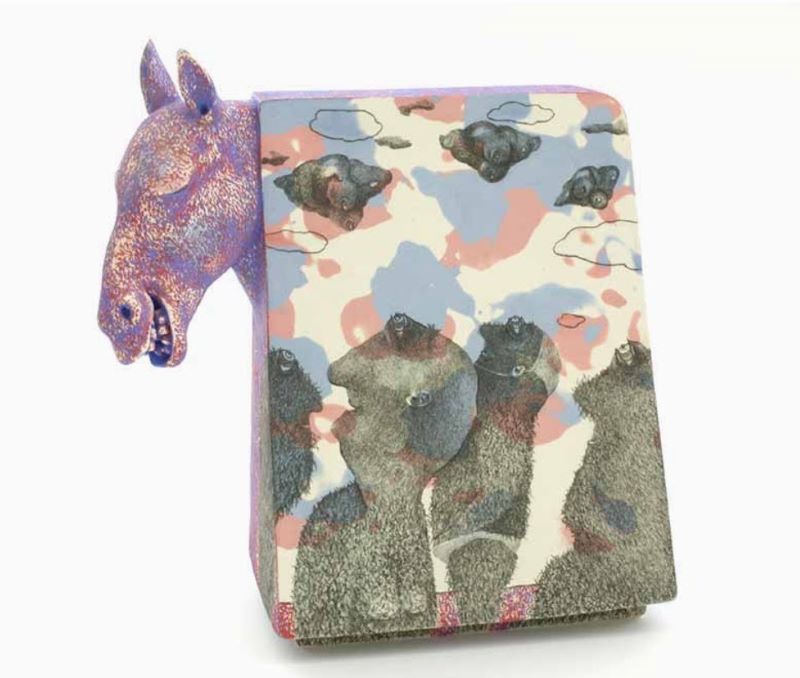
Lindsay Montgomery’s work punches pretty hard, there’s no doubt about it. She decorates her surfaces with narratives that harken back to historical periods and themes. She draws liberally from the past, and reformulates it into a contemporary vision. Her work is fun, vibrant, intriguing, irreverent, and memorable.
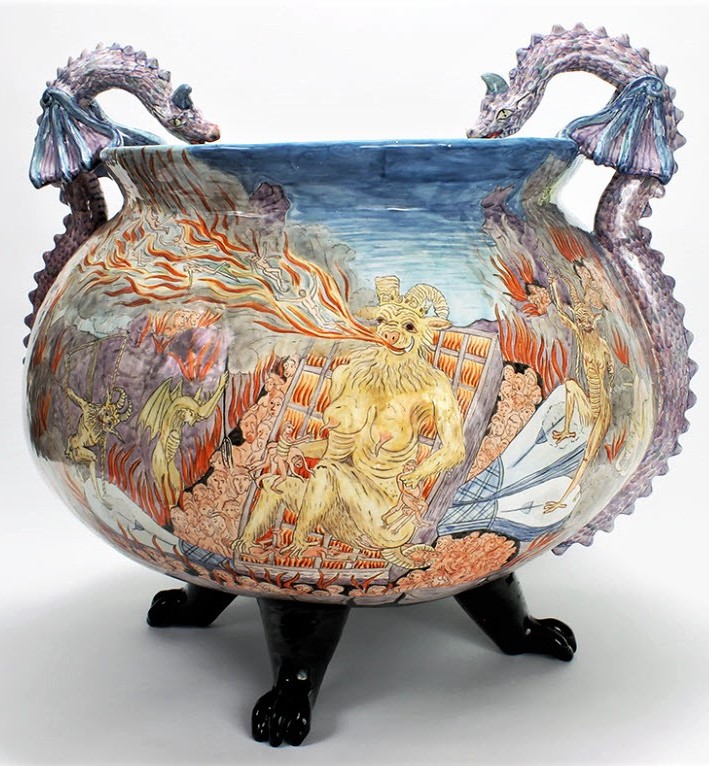
JW: In an earlier interview you describe your work as “neoisotriato” – drawing off 16th century Italian ceramics. Do you replicate techniques of that period in your process? Or do you refer mainly to the type of decoration and forms you employ?

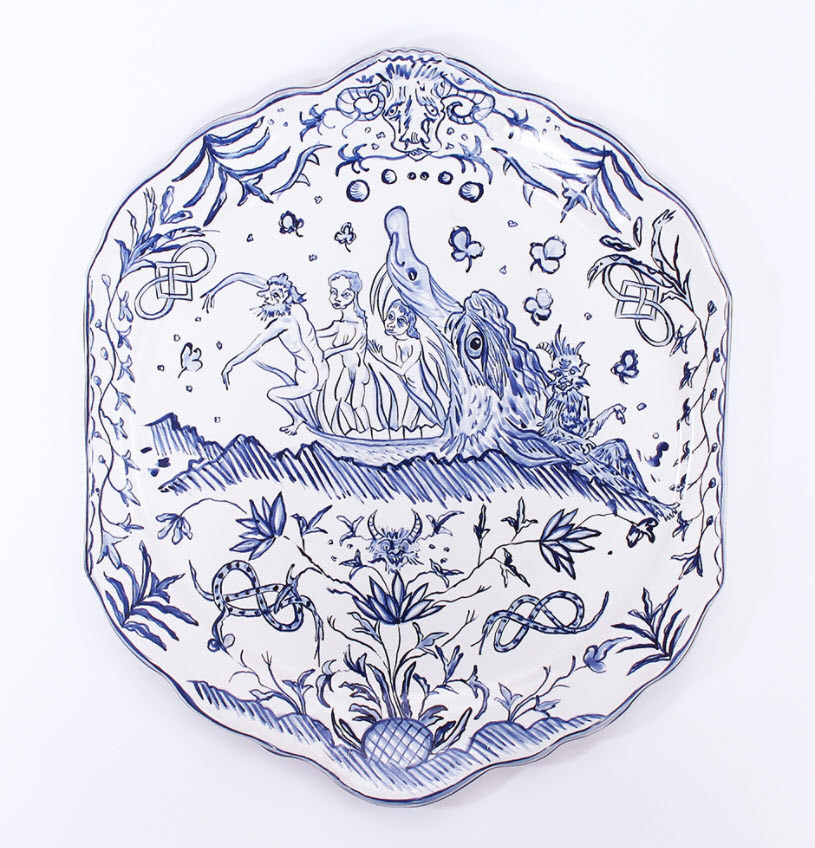
LM: Yes, my neoistoriato works are made just as they were in the renaissance. I love Maiolica because it was invented to be a cheap knockoff of Chinese porcelain. It’s made with humble terra-cotta low-fire clay coated in tin-glaze so it can be painted and look like porcelain. It was sort of the knock off Louis Vitton handbag of its time, and I love that lower-class quality of it because I’m working class.

The historical forms are sumptuous and right for this kind of painting style so I riff on the historical works of not just Istoriato ware from Italy, but also French faience, Dutch delftware and English Staffordshire and other factory pieces. I like when the form and function of a piece adds to the story happening on the surface painting. Right now, I’m making censors with hell and hellmouth imagery, and I love how the smoke billowing out when they are in use adds authenticity and magic to the imagery.
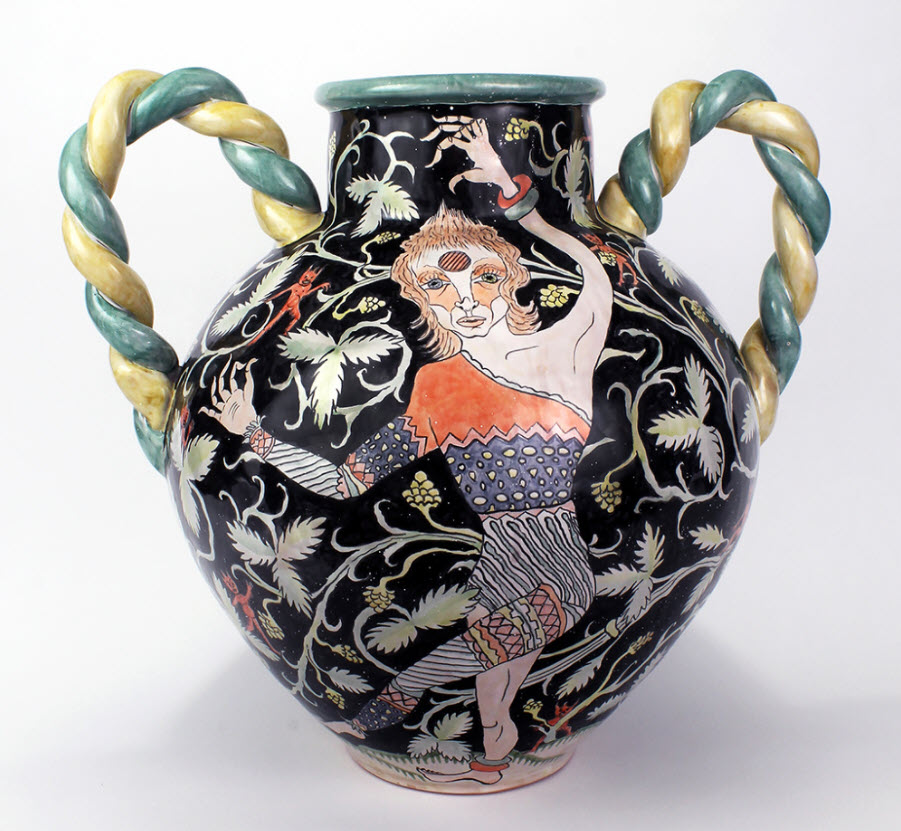
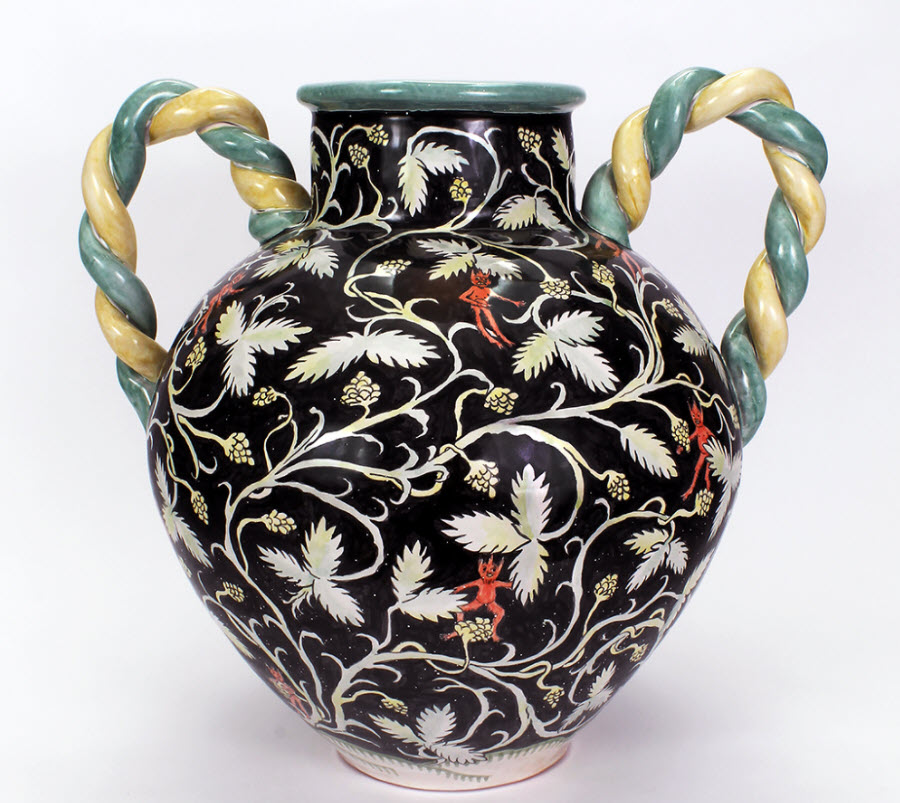
JW: I’m also reminded of Bernard Palissy in some of the handles on your platters. Has he been an influence on your work?

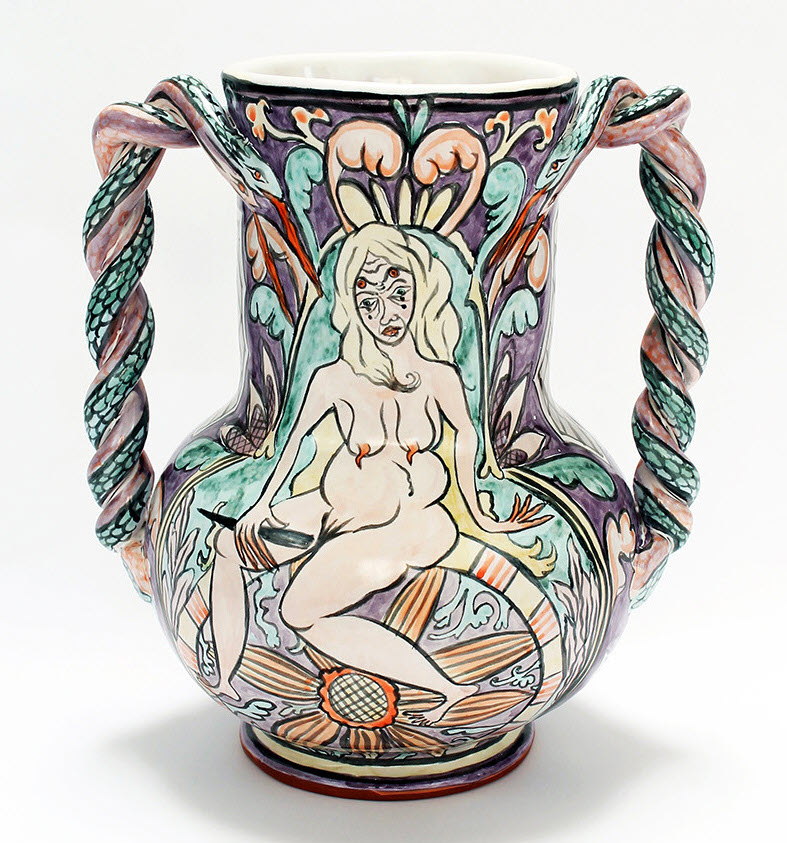
LM: Oh absolutely yes! I love Palissy’s work because it kind of bridges the whole Maiolica to Majolica evolution of European tin-glazed earthenware. It’s beautifully painted and focused on the plate like the Italian Maiolica of the renaissance, but also has all the sculptural elements and juicy glazes that exemplify English Majolica from the 19th century. I also love the story of Palissy as an artist. His work was really punk-rock and genuinely freaked people out to the point where he became a pariah in society. He was an artist way ahead of his time. Snakes and the symbol of the serpent play a huge role in the forms and meaning behind my work as well, so Palissy’s work offers endless inspiration for the patterns and forms of snakes.
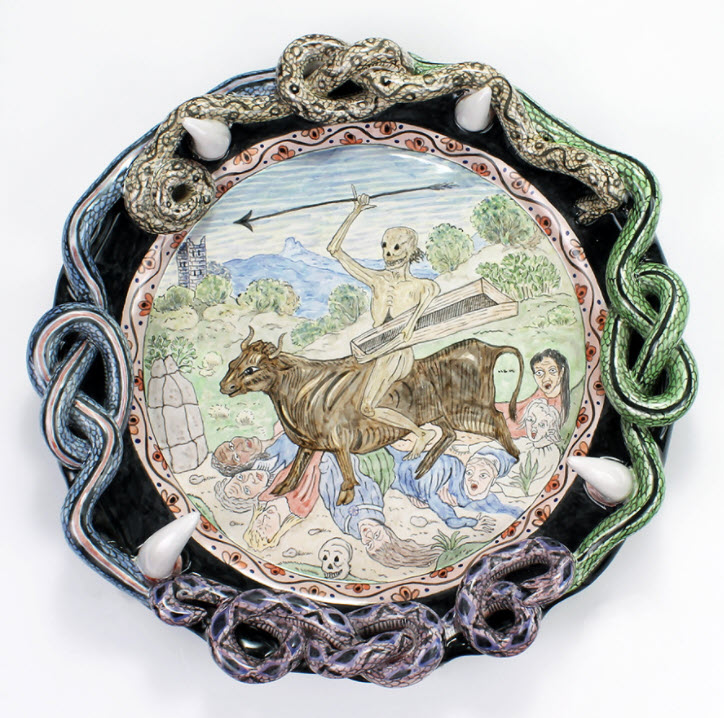
JW: How has the social turmoil caused by Covid influenced your work? I would think there are lots of stories that arose from the pandemic.

LM: My exhibition Year of the Flood that took place in 2021 in Quebec, was all about my experiences and feelings throughout the pandemic. My work feels extra urgent these days, and renaissance imagery is full of floods and fires and plague, so it’s eerie at times, the warnings of this moment we are living through have been there all along.

It’s really exciting to make the connections and find an image to work with that feels so perfect, and might have the power to help turn the direction we’re heading as a species.
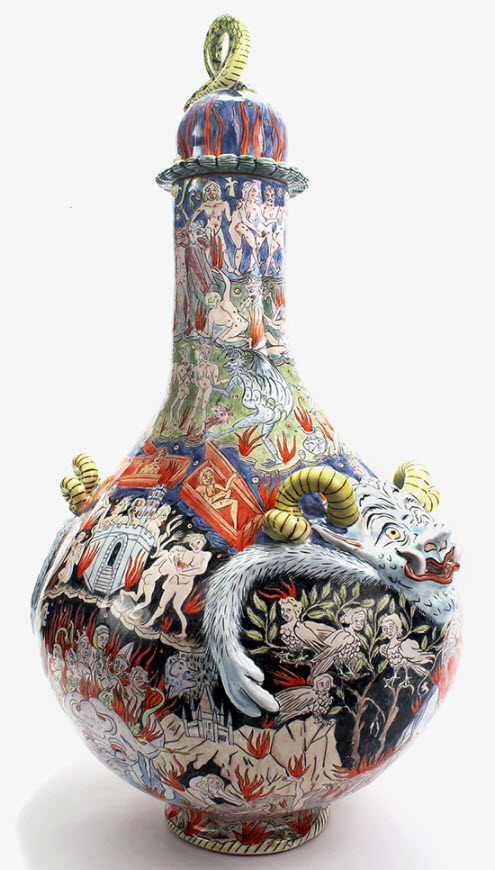
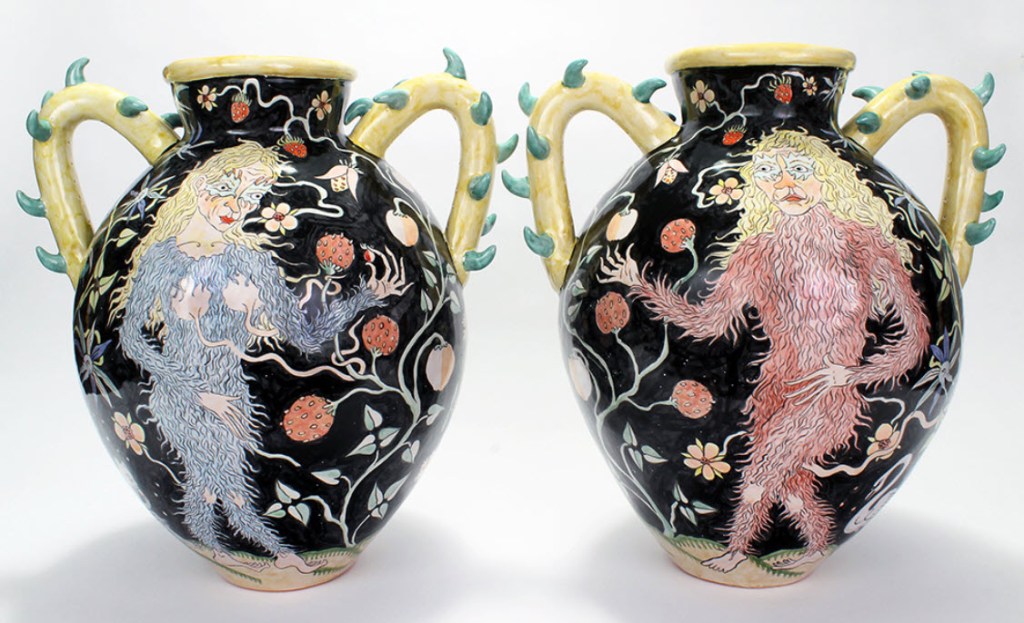
JW: How has your work evolved since you started this type of neoisotraito painting in 2015? I’m seeing a lot of decorative elements like handles on your 2021 urns – and perhaps some large scale work.

LM: Yes for sure the pieces are getting larger and more ambitious in the painting and form as the series evolves. I think also in terms of the imagery that has gone through quite an evolution as well. When I started this series it was really about taking these historical images and re-arranging them to say what I wanted to say, or sometimes just showing it as it was so make a point about humanities lack of spiritual or moral evolution since the renaissance, where now I feel like I have been drawing these figures and this world for so long that I can create any scene I want.
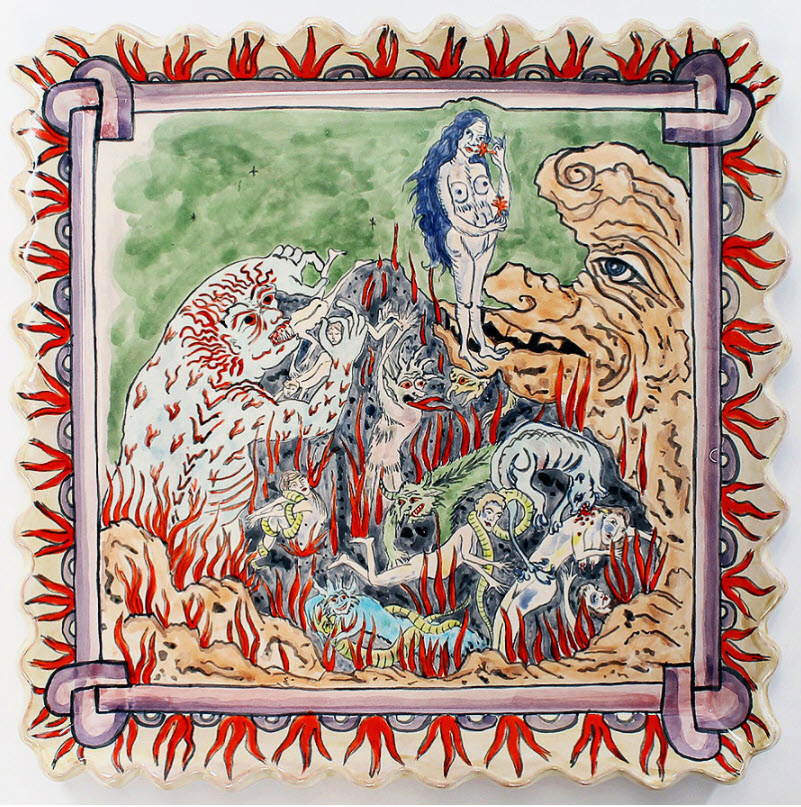
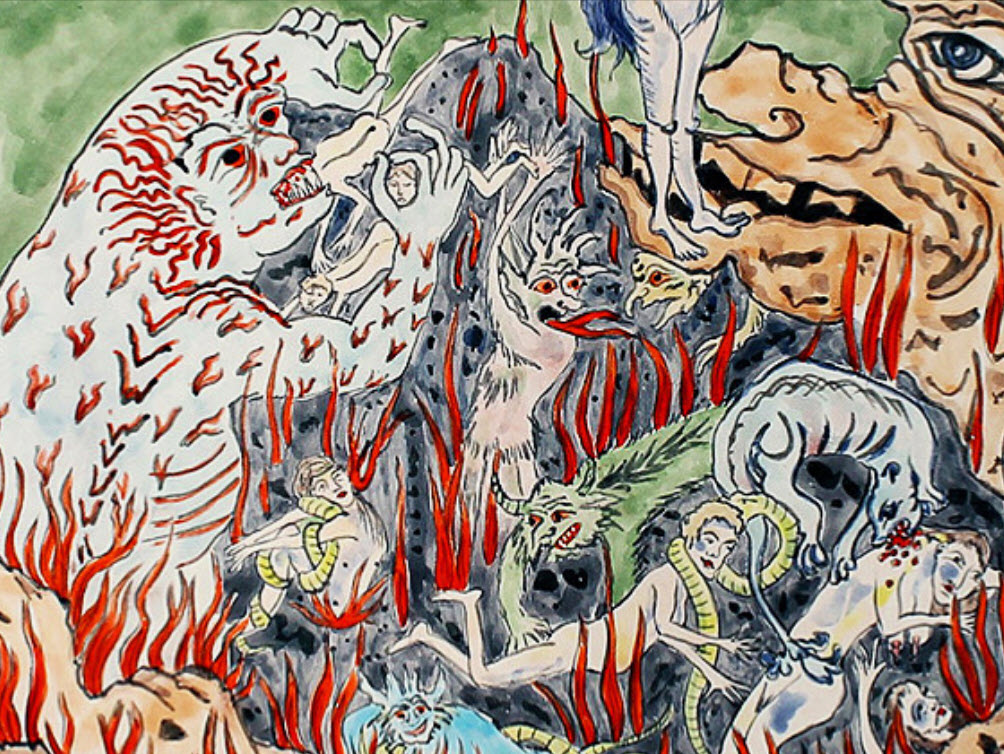
The imagery has become its own world in my imagination that I can mine, and my hand is much quicker at translating my ideas.
JW: What about plans for the future? Do you have new directions you may take (process, forms, topics) in mind to explore?

LM: I’m excited to have a couple of residencies coming up where I can explore larger-scale works that would be too challenging to complete at my studio in Toronto. I’ve been working on a lot of individual pieces or series of pieces recently and I’m starting to think about something more specific. I have fantasies about being given a really specific historical space to respond to.
JW: You started off as a painter and that foundation is very evident in your ceramic work. Do you ever see yourself working as a “traditional” painter again? Or are there elements of ceramics that you can’t walk away from?

LM: I think at the end of the day I am a painter first, and all the reasons I got into ceramics were from a painter’s perspective. These days I don’t think too much about medium or catagories, in some ways what I am doing is working way more in a sphere of “traditional” painters then most of the painters I know.
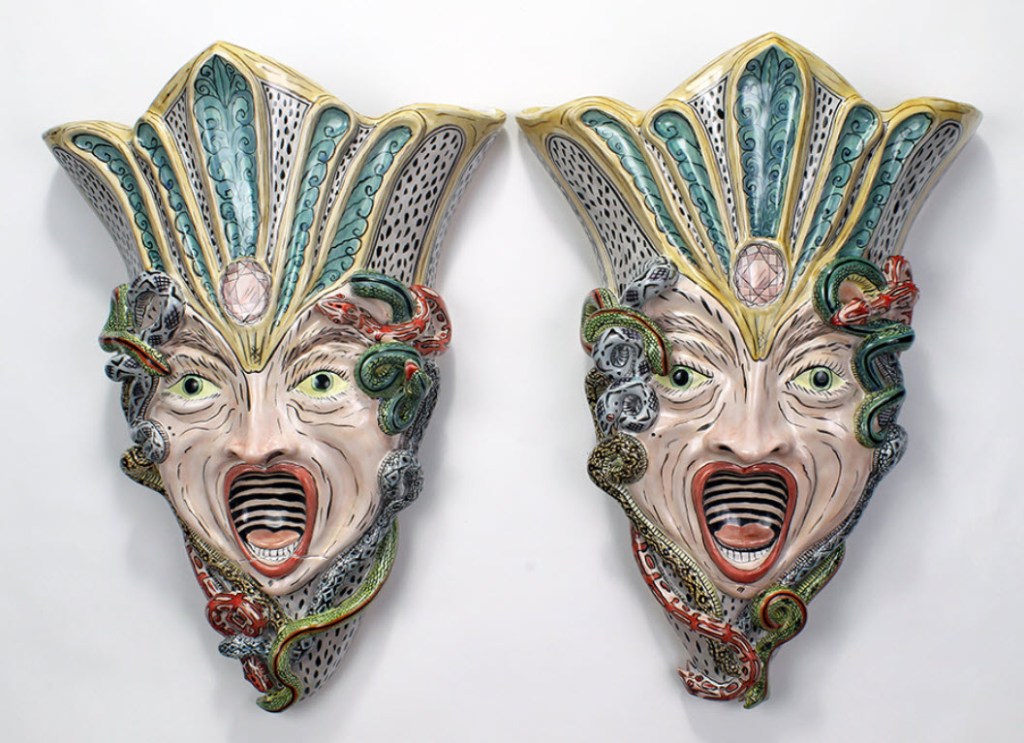
I feel like I’m a painter and a sculptor, and when I make plates I’m tapping deeper into the painter, and when I make figurative work it’s more about the 3D. Who knows what the future holds, but I’m feeling good and satisfied with my process at this present moment and just wake up each day excited to continue on with my work.
JW: What would you like people to know about your work?

LM: I guess that there is a story behind each piece. I’m experimenting more with this recently, as social media gives me the opportunity to share the myriad of sources and images that make up a piece. It’s nice to be able to tell those stories with the work in a way that doesn’t feel stuffy or didactic, but more the casual way I would speak to someone about it at an opening or gathering.
More of Lindsay’s work may be seen at Cargocollecive.com/lindsaymontgomery.

Leah Sandals did an interview with Lindsay for CanadianArts, which you can find here. Maakemagazine, an online magazine, included another interview with Lindsay here.

NCECA profiled Lindsay as an emerging artist in 2019. An article (including a short video of a speech by Lindsay) is available here.
Susan O’Byrne – Artist Profile

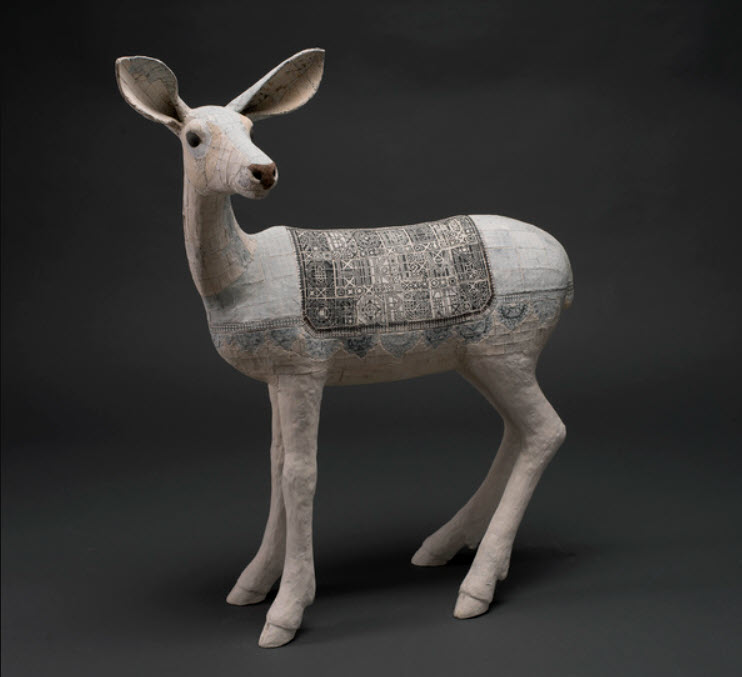
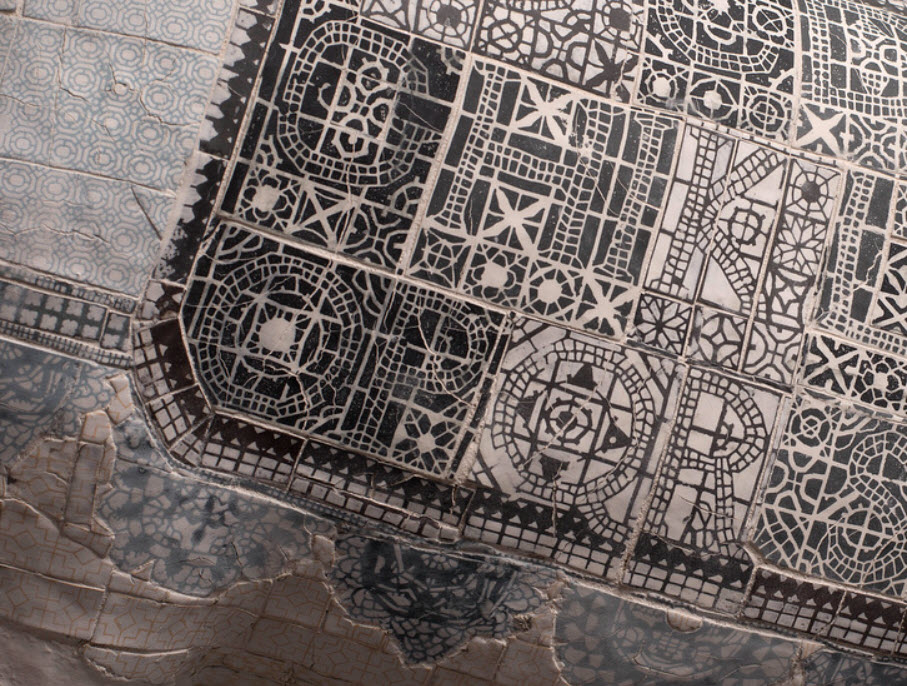
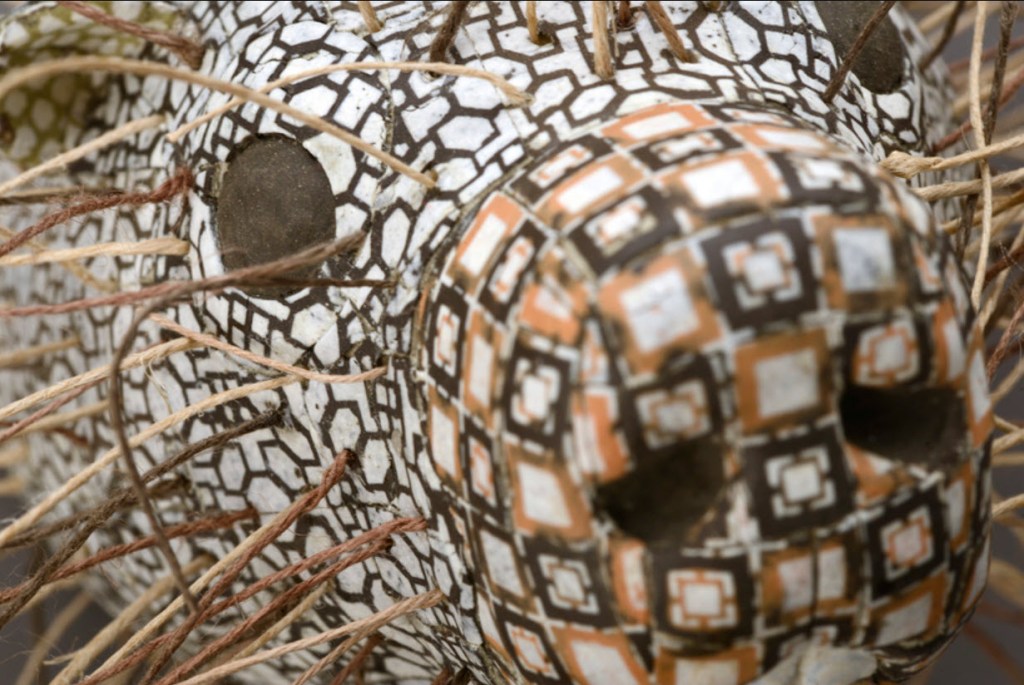
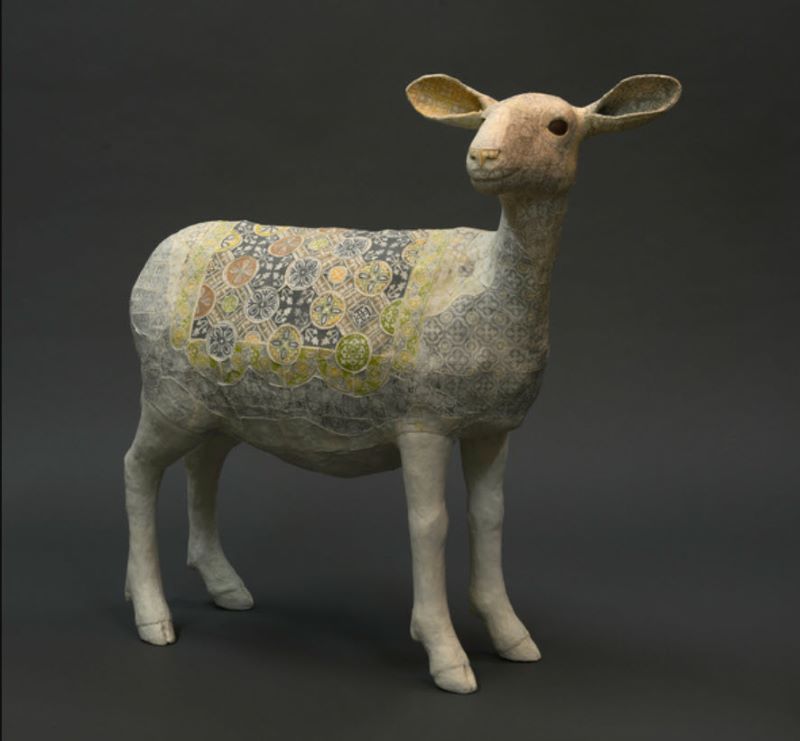
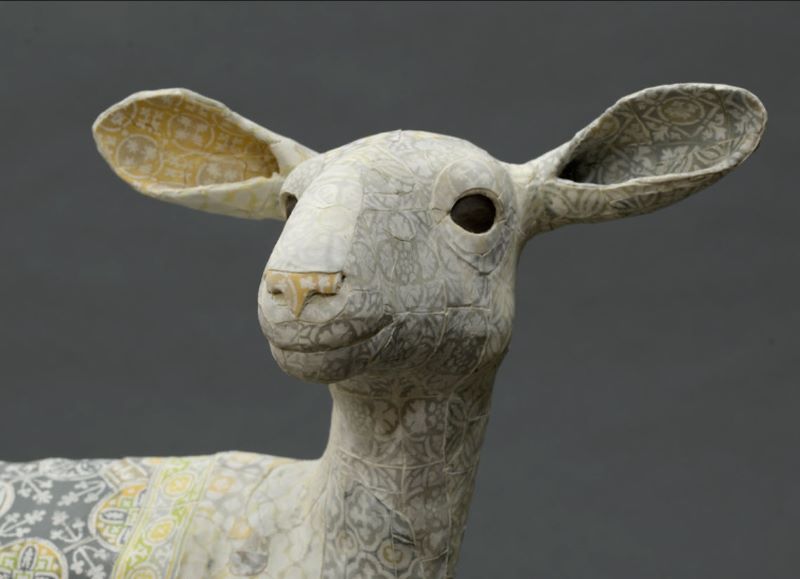
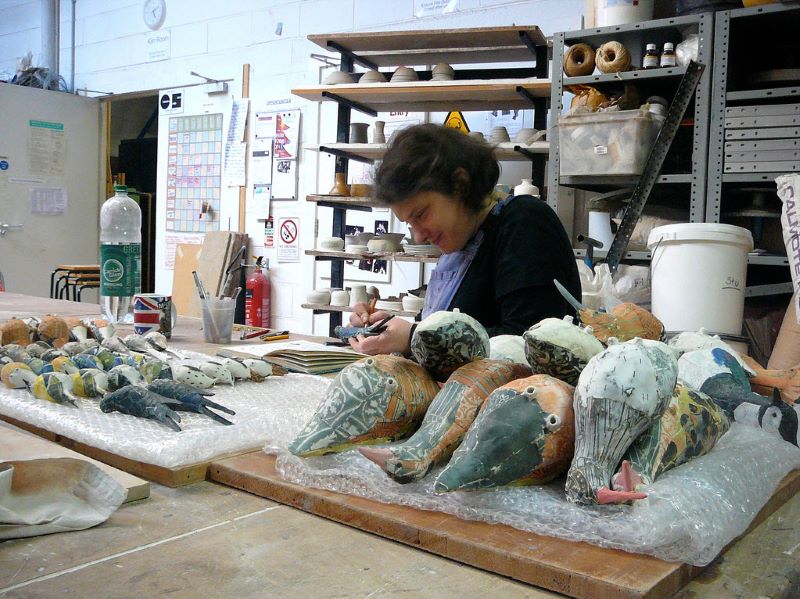
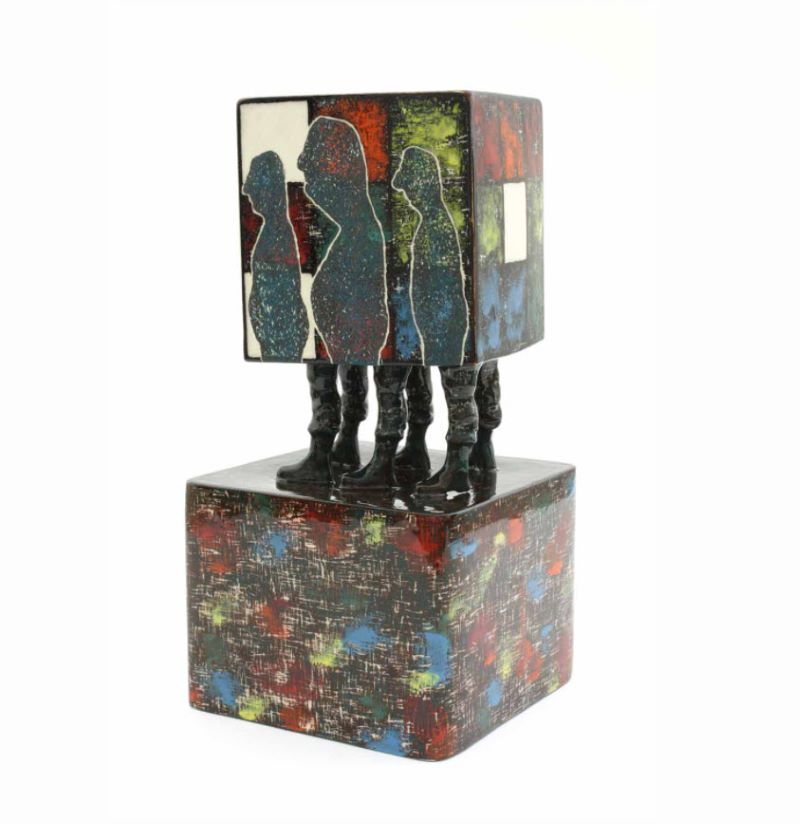
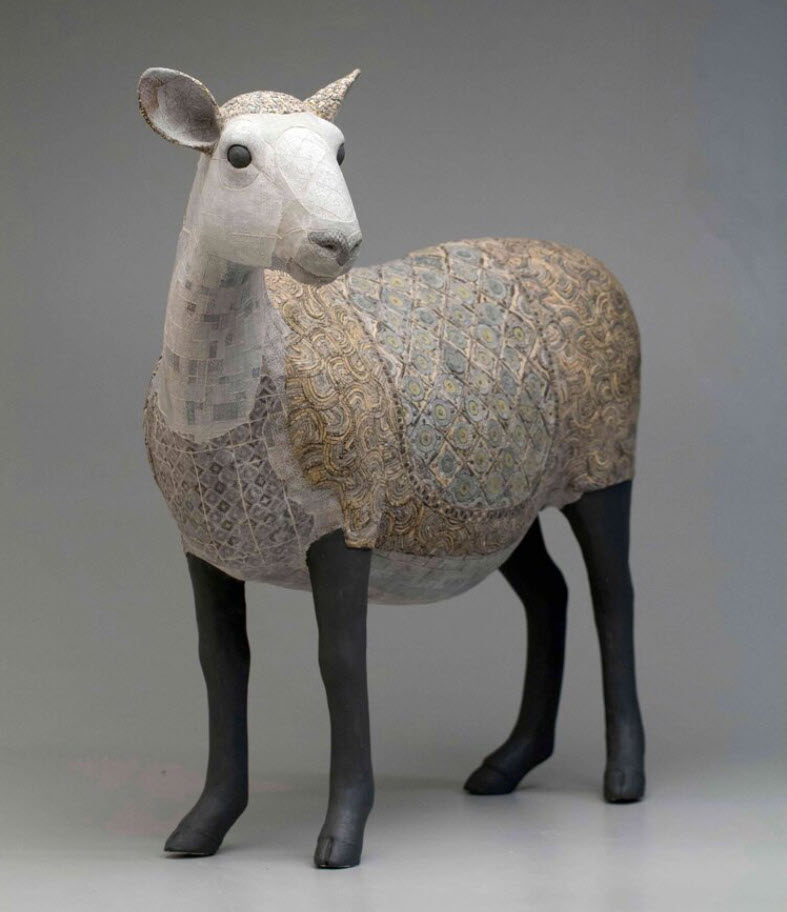
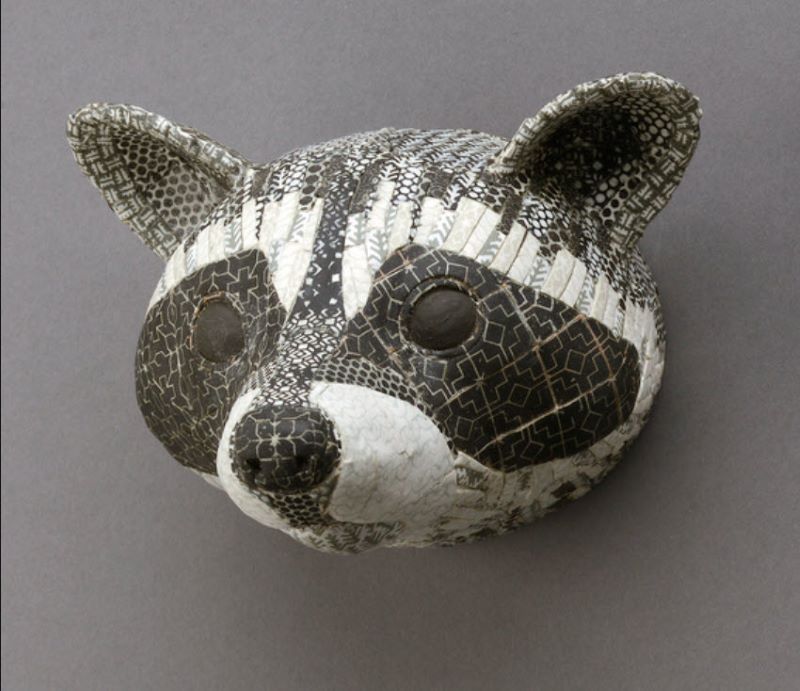
Susan O’Byrne employs richly patterned, mosaic-like designs on the surfaces of her ceramic sculptures of animals. It’s an interesting interplay of sculptural mass and ephemeral decoration. Susan studied tapestry as well as ceramics and that body of knowledge is evident in her work. Her work sets a quiet, contemplative tone.

Susan shared some information about her process, craftsmanship in general, and some of the stories behind the animals she portrays in her work.

JW: Can you share a little about your process?

SO: I begin with wire armature is made from iron-chrome, nichrome or Chantal wire (the stuff of kiln elements)

Once I’ve made a wire armature, I cover each wire with paper rods before hanging the armature from a frame. I make clay legs and attach these to the armature, and cover the whole form in sheets of a stoneware paper-clay body, much like working in paper-mâché. The paper rods allow for some shrinkage of the clay (onto the wire) during drying and when they burn away in the firing, create more space for further shrinkage during vitrification.

The stoneware paper-clay has been formulated to roughly the same shrinkage as the paper-porcelain I use as a second and modelling layer on each work before covering the forms in the patterned paper-porcelain layer.

In later years I have dispensed with the wire armature for smaller works. Instead, I make models from paper mâché or clay, make moulds, cast these in paper-porcelain slip, alter them, then add the patterns on the surface before firing.

JW: That is a unique way to work. How did you come to it?

SO: I studied art at Edinbugh College of Art, Scotland. At that time Edinburgh (ECA) was considered a more traditional art school than others, in the sense that it placed a very high emphases (and grade) on drawing in its many forms. I believe it was felt that drawing could lead students towards investigating ideas and aesthetics in quick diverse and accessible ways while also introducing students to the traditionally distinct concerns of the various principles of design, painting, sculpture and illustration. I have to admit I never cared much for painting (it was too soft) but loved line, its hardness, its expressive potential I loved paper. This led me to an interest in early and mid-20th century European and American expressionist artists like Egon Schiele and Larry Rivers, collage and mark-making. The idea of Oskar Kokoschka’s costume designs for his play “Murder Hope of Women” where nerves were painted on the surface of actor’s bodies, was a particularly influential image for me in the way it conveyed a type of painful sensitivity.

From here, I began to find ways to build, so that inner workings of the subject or animal could be traced on its surface. In much the same way as I began drawing with pencil and collage on paper, I found that I could build with wire and collage with paper-clay in 3 dimensions. At that time, I also enjoyed the unpredictability of the process. The wire armatures presented me (once covered with clay) with forms that were less contrived than I felt I could make using more traditional hand building methods.

These concerns are however less relevant to my making of late as I find myself more interested in surface and hopefully quieter /stiller forms in general.

JW: Are you using printed underglaze transfers (like those made by Isla Transfers) on your porcelain paper-clay? Or do you hand-make the patterned pieces you then transfer onto paper-clay?

SO: I refer to the patterns I use on my surfaces as a veneer because they are made from patterned sheets of paper porcelain, usually less than 1 mm thick, which cover all or most of the surface of forms. I don’t use decals but make pattered laser/plotter or hand cut stencils, and create the patterned sheets of clay by working back to front on plaster batts.

I use the stencils to first print slip onto plaster batts. The printed slip has a thickness and allows me to sometimes flood areas between the raised pattern on the plaster with other colours. At that point I build up the thickness of the clay slip on the batt (to about 1mm) It dries very quickly, and when at leather hard I can pull the patterns sheet from the batt. Because the initial printed slip has a thickness it is not just on the surface of the sheet but operates a bit like an encaustic tile offering a kind of visual depth to the pattern and allowing sanding at a finished stage without losing the decoration.

The paper in the slip grants enough strength to make these sheets very thin and also permits them to be applied to a dry paper-clay form. I make several sheets of pattern before cutting them up to collage the surface of an animal or birds. Dryer paper-clay sheets can we rehydrated with care and used months or even years after making them.

JW: What attracted you to ceramics as an art form in the first place? (vs more ‘traditional’ sculptural media or even papier mache?)

SO: I can’t say I was particularly attracted to clay from an early age, but I’ve always loved to make things I would become very excited as a child by the idea that I could make any toy I wished for from the contents of a cupboard (occasionally, I’m sure, to the annoyance of who ever owned the cupboard).

I grew up in a family of makers, by grandmother was always sewing and mending, my great aunt was an artist and made puppets, my dad built our house himself and thought me to use power tools very early on.

When I left secondary (high) school I studied for a year at Grennan Mill Craft School in Co. Killkenny, Ireland. It was a very practical course including subjects like ceramics, tapestry, weaving, jewellery, silversmithing, batik, printmaking drawing and patchwork. I loved the discipline of craft, of developing an understanding of material, what materials could and sometimes didn’t want to do and learning to appreciate the skill, patience and sensitivity involved of any craft.

I went on to study sculpture, but now realise I quickly became overwhelmed and confused by the broadness of that discipline. I knew I wanted to learn a practical skill in depth, but didn’t know where to start. I found it difficult to begin with a concept (which was the principle of the course) and then choose a material to work with.

I elected to switch schools (to ECA in Scotland) and to ceramics as a medium, initially to learn about a specific material and the skills involved in working with that material. In a sense, choosing to study in a material-based course, framed my direction for me and allowed me to investigate what I could make within a specific tradition.

I think that I was also aware of the community that ceramics attracted and enjoyed being part of that club.

Once I had some understanding of clay, I realised that I could draw on, as well as reference my interest in craft in my own practice. I believe that an interest in tapestry, textiles, mosaic, bricolage, historic and domestic crafts continues to inform what I make today.

JW: Some of your pieces carry underlying links to ancestry and family lineage (e.g., Five Sisters and a Family Tree). Can you tell me more about the background stories of your work?

SO: “Five Sisters and a Family Tree” reference my maternal ancestry, a clock making family who migrated to Ireland from the Black Forrest in 1860 (a very unusual time to move to Ireland as it was a period of mass immigration away from Ireland largely because of the great famine).

Growing up in the company of my grandmother and my grandmothers’ sisters, stories and names of this ancestry were often the topic of conversation at home. Their names were spoken often then but are less so now. The stories were however written down in my great aunt Ursula’s in written memoirs of her life.

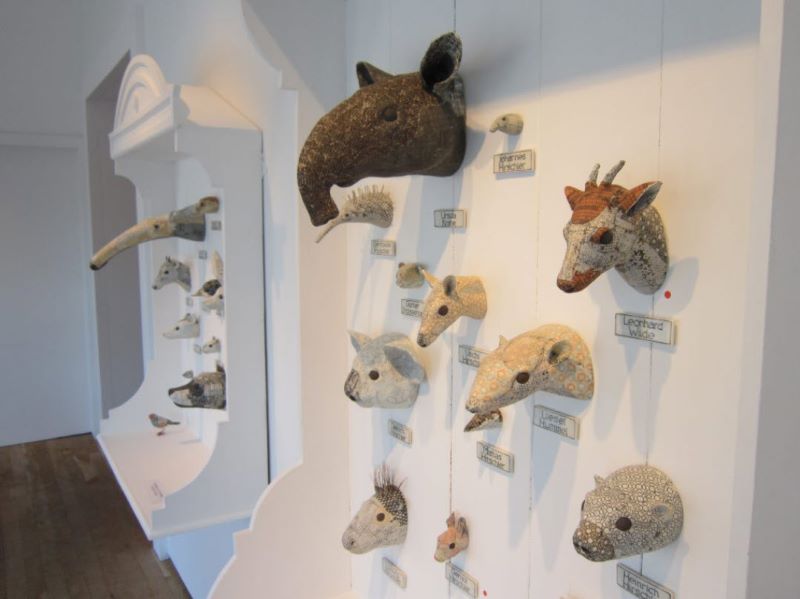
Acknowledging the important part the ancestors and stories had in my imagination, and my identity, I chose to represent them as animals who were “exotic to me” in ” A Family Tree” (An installation of 50 ceramic animal portraits with name plates. The activity of examining and of making “new” faces, provided me with a process to discover / reimagine characters in an intimate way, while celebrating the individual lives by speaking these names again.

Needle point patterns on the surface of the animal heads represent the consistent practice of sewing and textiles among the elderly women of my family who told these stories, and how their interest in patient careful making and mending became influential to me.

The “Five sisters” from the same exhibition represented my grandmother and her sisters, as deer from the Black Forrest. Each deer incorporates a “blanket” on their surface which hopes to celebrate the individual I knew. The decoration of these deer evolved from my grandmother and her sisters needlework patterns as well as 19th century white work samplers in the collection of the V&A [Victoria and Albert Museum in London].

JW: Is it possible to take one of your pieces and discuss it in more depth and detail? The story behind the piece, ways you’ve incorporated references to that story, decisions you make along the way, etc?

SO: I often make my work in series, and while the work “Five Sisters and a Family Tree” have a very specific and personal story, some of my works were initially made and have meaning as collections or part of a collection.

I am interested in the ways animals in their capacity for diversity have been used as metaphors to order and make sense of our world. These ideas also have roots in my own childhood. When I was about 3 years old, I would hunt the house every Sunday, for a small plastic animal that had arrived (my magic) for me the find.

I soon had a large collection of plastic animals, that I loved to sort out between the tiles of the kitchen floor.

Sorting was the best part of that game and was an introduction to me to the role animals have for children in the cognition and understanding of the world. I recognise that animals, particularity pets can be a comfort to children (being similarly outside the complicated concerns of adulthood) who are learning about the world. I noticed also how the naming of animals in zoos or museums can be an aid to cognition in children and animals can personify and simply complex themes or emotions in stories. By extension I am curious about catalogues made of animals in medieval times to explain philosophical or religious teachings and how/ why they were collected in the Victorian era.

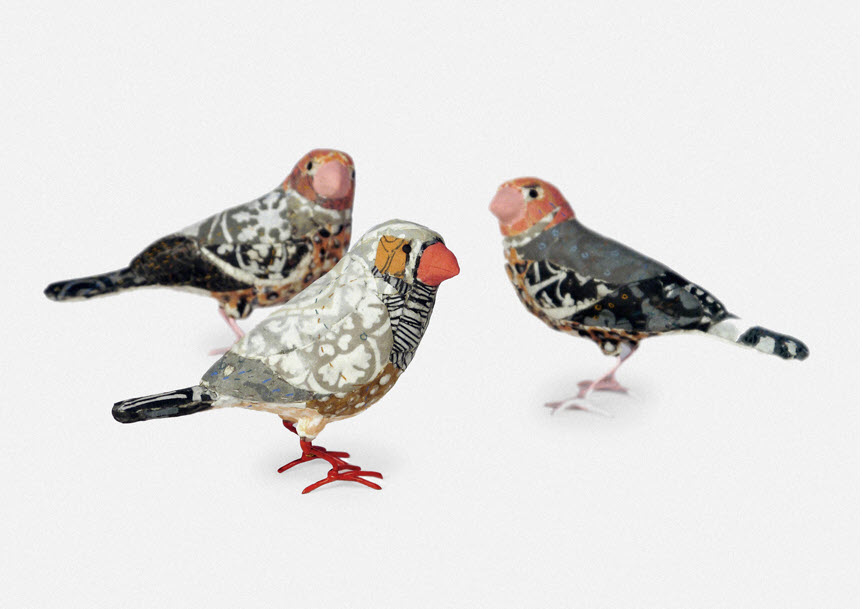
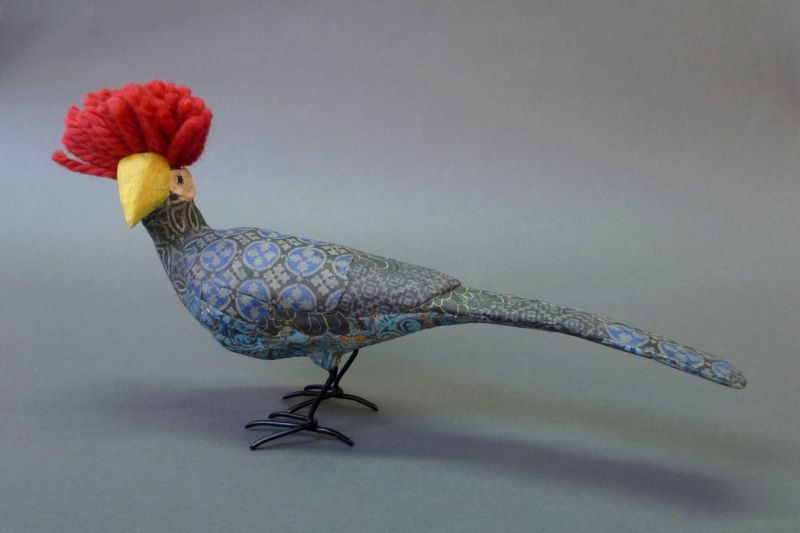
With these ideas in mind and in reference to medieval bestiaries I made a collection of 20 animals for a touring solo show. I developed my patterning technique in the creation of these animals which were decorated with designs taken from the encaustic tiles of medieval church floors. At that time, I also made a collection 100 birds of the British Isles which referenced Victorian menageries and were decorated with Victorian wallpaper patterns. The birds were displayed in labelled cabinets as a collection.

In short, I make animals but they are not intended to be direct interpretations of real animals. Instead, I aim to create animals that reference us, our relationship with and our curiosity about them. I would like my works to look as if they have been made by someone at some time in the past for some particular reason or function. My hope is that, like a museum object, they may instil some curiosity from the viewer while attempting to capture, distil and reflect a little of our own humanity.

Photographs of Susan O’Byrne’s studio are available on a blog post from the Pink Pagoda Studio.

From Pink Pagoda Studio (http://pinkpagodastudio.blogspot.com/2015/10/susan-obyrne.html)

Ben Carter interviewed Susan on his Tales of a Red Clay Rambler. The interview is here.

Susan’s website contains more examples of her work.

ASU’s Ceramics Research Center

Arizona State University has a “Ceramics Research Center” on it’s Tempe, AZ campus. I reached out to Amanda Urrea, Communications Program Coordinator at the ASU Art Museum to ask her some questions. (A special call-out to Amanda – she finished these responses just as she was heading out on maternity leave.)

JW: What types of ceramic research is conducted at the ASU Ceramic Research Center? 

AU: We have an extensive archive collection at the Ceramics Research Center. We have collections from Susan H Peterson, Don Reitz, Herbert Sanders and the Studio Potter Publication and original materials. We have curators, researchers, writers and students that come from all over the US to use these primary sources to aid in their publications, curatorial research and student dissertations. For those who can’t come to the physical space, we have people reach out globally to have materials scanned and digitized for their research.

An example of research using the archives:

Koki Tanka and Kumie Tsuda are the first visual artists to work with the ASU Art Museum’s Ceramic Research Center archives, specifically focusing on the archive of artist and historian Susan Peterson. Both artists were influenced by the correspondence between Peterson and Japanese ceramic artist Shōji Hamada. Sifting through ephemera, photography and film, Tanaka has created a new experimental video titled “Mashiko, Arizona,” based on the relationship between Peterson and Hamada.

JW: What is your source of funding?

AU: Like most museums in the US, our sources of funding come from a diverse set of revenue streams that include government, foundation, individual contributions and some earned income. We heavily rely on individuals and foundations to support the important work of stewardship of the collections and presentation of new art.

JW:  I read that the majority of the CRC’s permanent collection is accessible to people in open storage. What’s involved in accessing that part of the collection as a member of the public? 

AU: One of the unique spaces at the Ceramics Research Center is the open storage. It is available all year round and open for view to the public. We have over 800 objects in the space to view. This is about 20% of the ceramic collection. We have handouts to use as you walk through the space identifying the artists and object information. The open storage objects are placed chronologically starting with the 1950’s to current.

JW: Is any portion of the CRC collection accessible online?  Are there plans to expand that offering? 

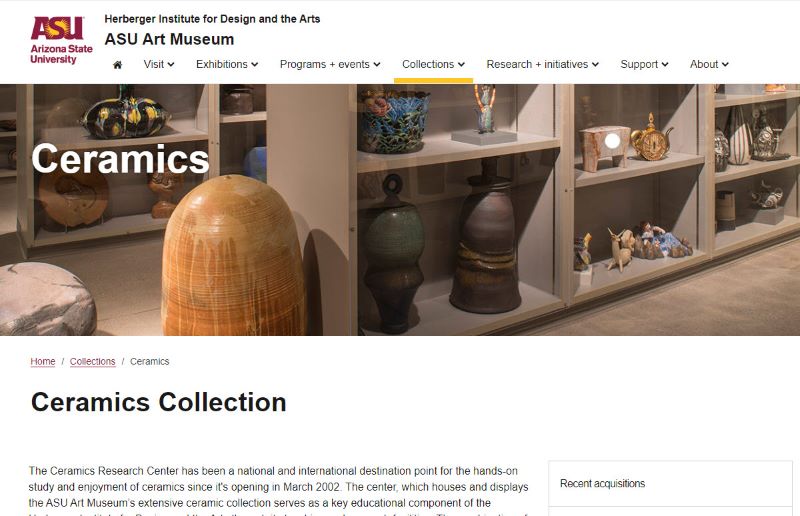
AU: You can view works from a past traveling exhibition, “Innovation and Change,” the most comprehensive selection of works from the ASU Art Museum Ceramics Research Center collection: https://asuartmuseum.asu.edu/collections/ceramics 

[Note: the images you have to click to see the works are located in a thin horizontal line when I view this site. Click somewhere on the line and a pop-up viewer will appear with larger images that you can scroll through.]

With a major grant from the Virginia G. Piper Foundation, we are currently in phase one of digitizing highlights of the museum’s permanent collection. Our goal for the next phase is to make these digital images available through our website, the ASU Library and in teaching tools.

There are also images online from our Susan H. Peterson Archive Collection. Susan Harnly Peterson (1925-2009) was a world-renowned ceramic artist, writer and professor. Her book publications include: Shoji Hamada: A Potter’s Way and Work, the Craft and Art of Clay, and The Living Tradition of Maria Martinez. A selection of these archives from these artists are here: https://asuartmuseum.asu.edu/research-and-initiatives/ceramics-research-archive/images-from-our-susan-harnly-peterson-ceramic-research-archives 

We are actively exploring grant opportunities as the next phase of the archives is the digitization of the materials so they can be accessible online, providing global access to technical, critical and historical information.

Our library collection houses over 3,000 titles of rare exhibition catalogues, books, periodicals and media. The collection includes personal library collections of Susan Peterson, Ralph Bacerra, Harry Dennis and James & Nan McKinnell. You can access our library database online: https://www.librarything.com/catalog/ASUCRC 

JW: Is the CRC collection integrated in any way with academic programming at ASU? 

AU: The Ceramics Research Center has a close relationship with the students at the School of Art. Faculty bring their classes in to sketch, utilize the classroom for lectures, collaborate projects with their students and the curator and take advantage of our programming. The Ceramics Research Center also mentors academic interns coming from a diverse range of majors (not just fine arts).

JW: I read in the ASU Art Museum’s strategic plan that one strategy to enhance experience is to “launch a workshop as an interactive makerspace in the museum and Ceramics Research Center.” What does that mean? 

AU: A laboratory for discovery, the Artists’ Workshop facilitates a deeper understanding of the exhibitions on view. Workshop is an on-site art activity space that allows visitors to “learn by doing,” creating art projects inspired by a diverse array of themes and issues. It includes digital tools and resources with information about the exhibitions, including artist images, art games, art blogs, documentaries and other relevant information. 

JW: What are the highlights of the CRC that you would like people to be aware of?

AU: The Ceramics Research Center has been a national and international destination point for the hands-on study and enjoyment of ceramics since it’s opening in March 2002. The center, which houses and displays the ASU Art Museum’s extensive ceramic collection, serves as a key educational component of the Herberger Institute for Design and the Arts through its teaching and research facilities. The combination of gallery space and open storage at the Ceramics Research Center enables visitors to enjoy part of our extensive collection at one time.

Every year, the Ceramics Research Center features three to five exhibitions on important movements and artists who have made significant contributions in the ceramics field. The holdings demonstrate the full range of technique, aesthetic approaches and possibilities within the medium.

Our archive collection is one of the most important archives in the ceramic field. Susan Peterson was a ceramist and educator whose research, writing and advocacy brought wider appreciation to clay. She traveled and lectured worldwide, and authored numerous books on ceramic techniques, glazes and ceramic artists. 

The Ceramics Research Center also holds the significant ceramic archives from The Studio Potter magazine, which document 30 years of creative activity in the field. Founded in 1972, the Studio Potter magazine, under Gerry Williams’ editorial vision, was at the forefront of offering insightful writings on technology, criticism, aesthetics and history within the ceramics community. An intrepid traveler, Williams, along with his wife Julie, amassed a trove of oral histories, transcribed interviews, photographs and journals. Many artists in the archive are represented in ASU Art Museum’s collection. The archives allow access to technical, critical and historical information for students, collectors, museum curators and scholars worldwide.

Pru Morrison – Artist Profile

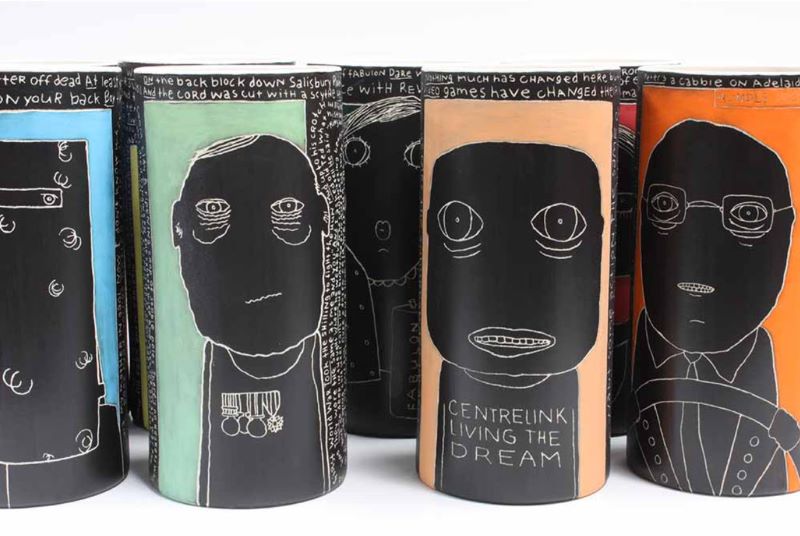
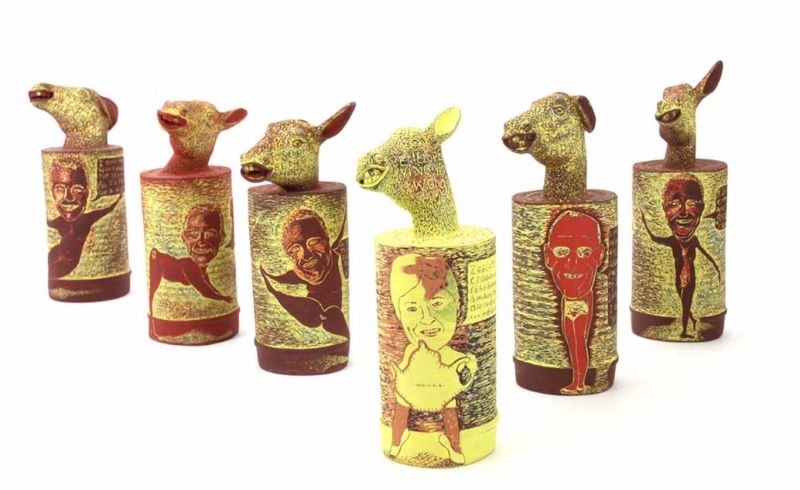
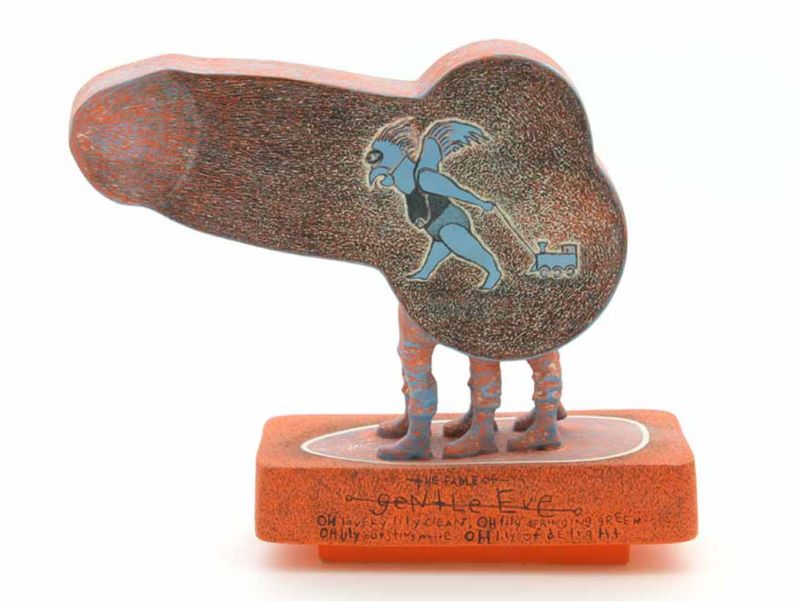
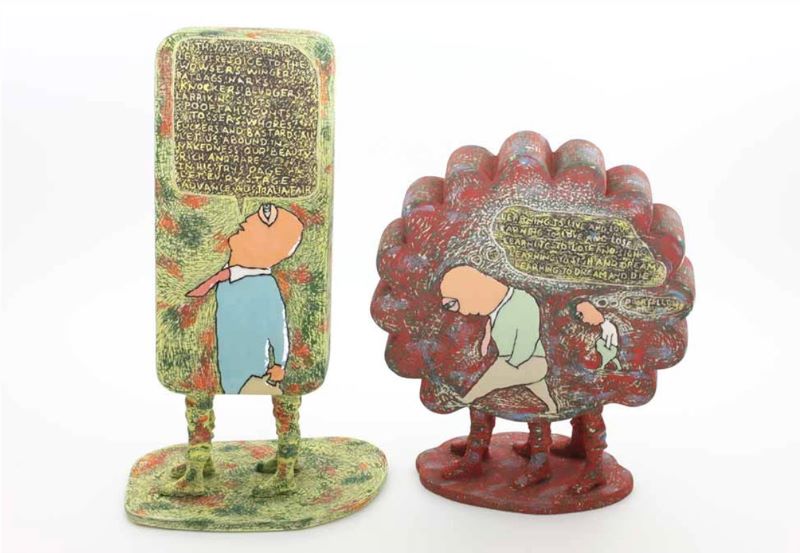
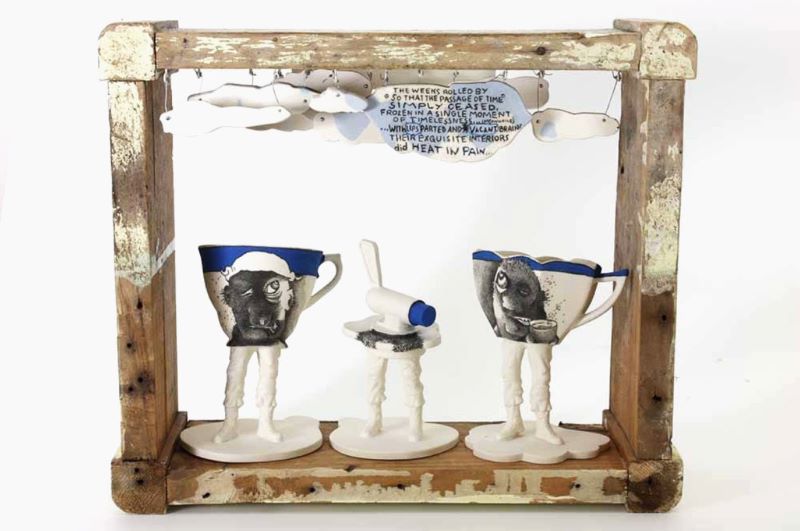
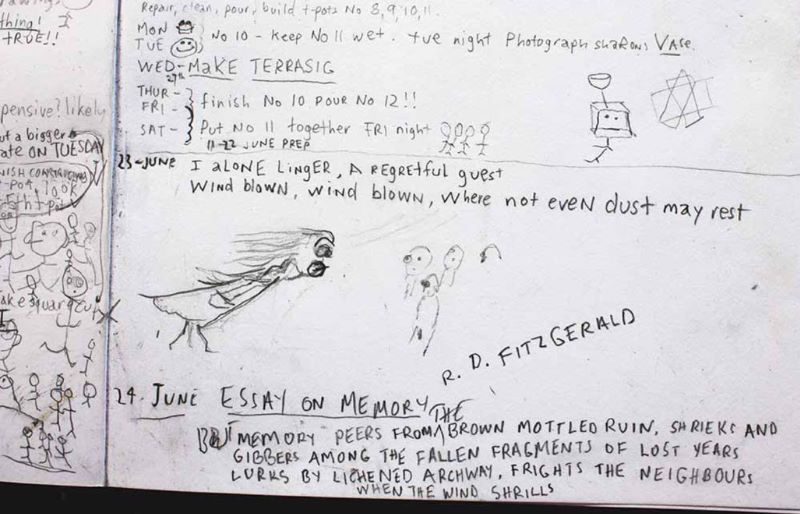
Pru Morrison is an Australian artist building porcelain sculptures, cups and teapots from her home base in Brisbane. Laced across her pieces are bits of text and commentary on everyday life in Australia. Her comments are wide-ranging: art, politics, current events, and observations of life and people around her. More of her work can be found on her website.

JTW: You mention you reference a variety of sources for inspiration. Can you name a few? Are there some that you keep coming back to over and over again?

PM: I have regularly referenced social politics of state and society. I generally read newspapers as I’ve found that truth is stranger than fiction. I also explore gender politics particularly as it’s portrayed in the media with captivating subheading. I draw and wrap forms with text straight from the newspaper. The words become another visual layer to the surface.

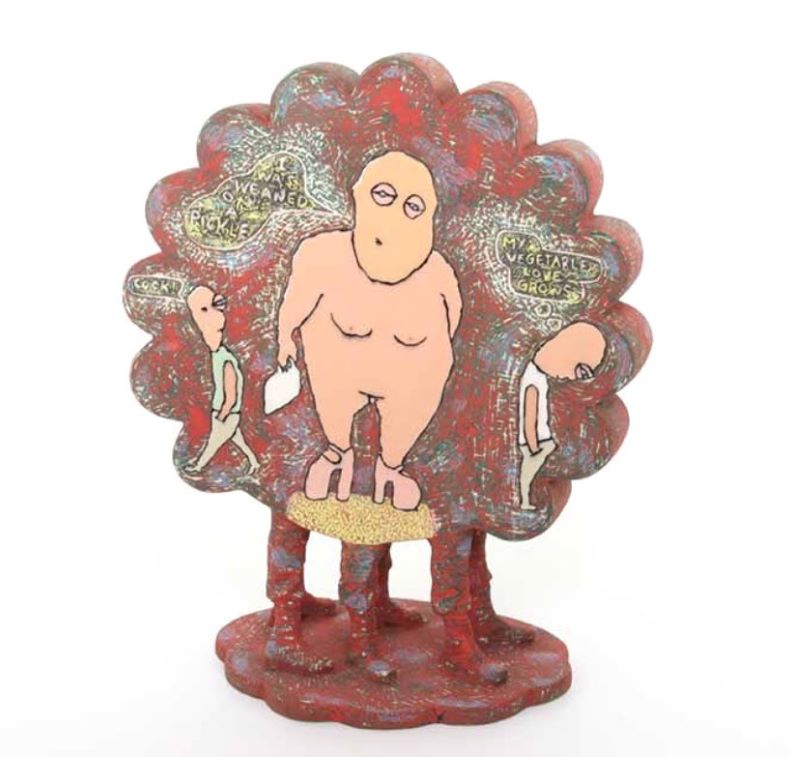
I repeatedly draw a heterosexual couple dressed in white cotton underwear. They’re a little overweight with pink, yellow, orange, brown or blue skin. They’re ordinary and unremarkable as they hold hands and twist their feet shyly. They have appeared on the back end of different works with words and rhymes floating around them. I also draw mermaids with moustaches and men with breasts. I’m loosely addressing my upbringing in a small town where the social and cultural system believed there were only two genders. – Feminine and masculine.

JW: Your process sounds eclectic: creating & combining forms, then slip, then Sgrafitto. How did this process come about?

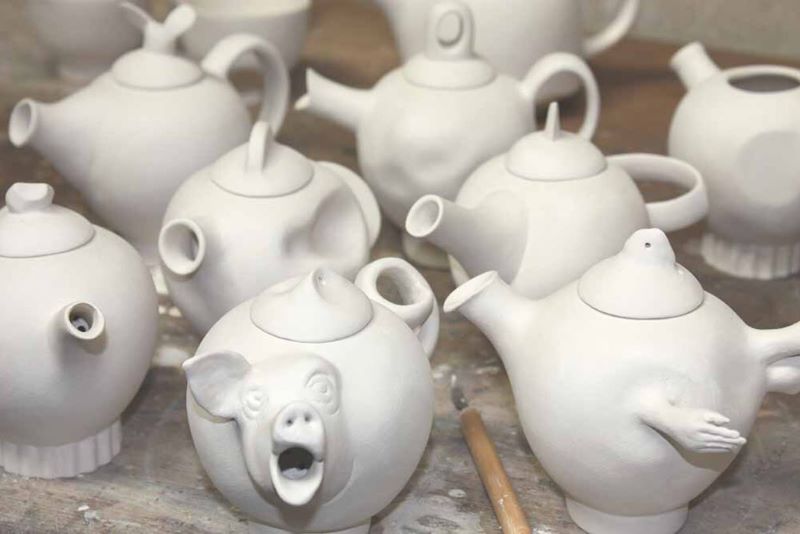
PM: When I first started working with clay I made functional forms and covered them with drawings and text. I later started making molds and slip casting work. I made molds of plastic farm animals, baby-dummies, wing nuts and action figures to name a few. I slip cast them and constructed spouts and legs which I attached to leather hard teapots and cups. This is when the form gained importance and worked alongside the drawings and text. They seemed to come together spontaneously with little forethought.

JW: How has your work evolved over the years? What has stayed constant and what has transformed?

PM: At the moment I’m working with porcelain slabs. I first sketch the form and write about the subject matter and the gist of the story. I roll out the slabs and start building the sketch with clay. The surfaces are layered with drawings, texture, and minimal words. The pieces are memorializing and celebrating people I have known in the past tense.  The introduction of slabs is new and it’s supported a different way of working- if I think it, then it can be built quickly. The one restriction to the form is the size of my kiln.

The constant to my work is the practice of telling a story. I regularly gather clues and small bites of life to put into a sketchbook for future work.

JW: You employ a lot of text. What is the story behind that? (I can’t read text around the work. Are they quotes or “conversations” or descriptions, or all of the above?)

PM: I first used text to convey a clear and absolute point of view to the observer. It later became another layer, difficult to read and more convincing as a bit of texture.  I then went through a poetry stage both with my own poems and old English poets and I did a couple of series of Australian song lyrics. At the moment I’m being sparse with text as I don’t want to weigh the pieces down. Text can be like seafood extender, low in calories and fat but highly processed.

JW: How planned out are your pieces?

PM: Firstly I begin planning a piece while cooking, going for a walk, watching netflix, having a shower etc. I feel around and find a way of making a thought or idea three-dimensional. I sketch and write down a few measurements as a guide to the size, and then I build the pieces. Most of the surfaces evolve, I don’t really plan it too much, just little sketches on the dry form. I follow my nose.

JW: What would you like viewers to know about you and your work?

PM: I’d like viewers to know that working with clay is like winning something really good. I started out studying art for five years, which was nice and interesting,  but it wasn’t until I touched clay that I found my voice.

JW: Do you have any big projects on the horizon? 

PM: On the horizon I’m continuing to work on my new gang of sculptural pieces. I’d like to do the Open Studios with The Australian Ceramics Association, if I can get organised. I’m in a show called Bric-a-Brac, which I’m still making work for, at Murky Waters Studio in Townsville. I’ll continue to make bread and butter pieces for the shops. There is the Christmas peak to start working towards.

JW: Where can someone buy your work?

PM: My work can be bought at the Institute of Modern Art Shop in Fortitude Valley Brisbane and at Artisan Shop in Bowen Hills Brisbane.

Paul Gauguin Ceramics

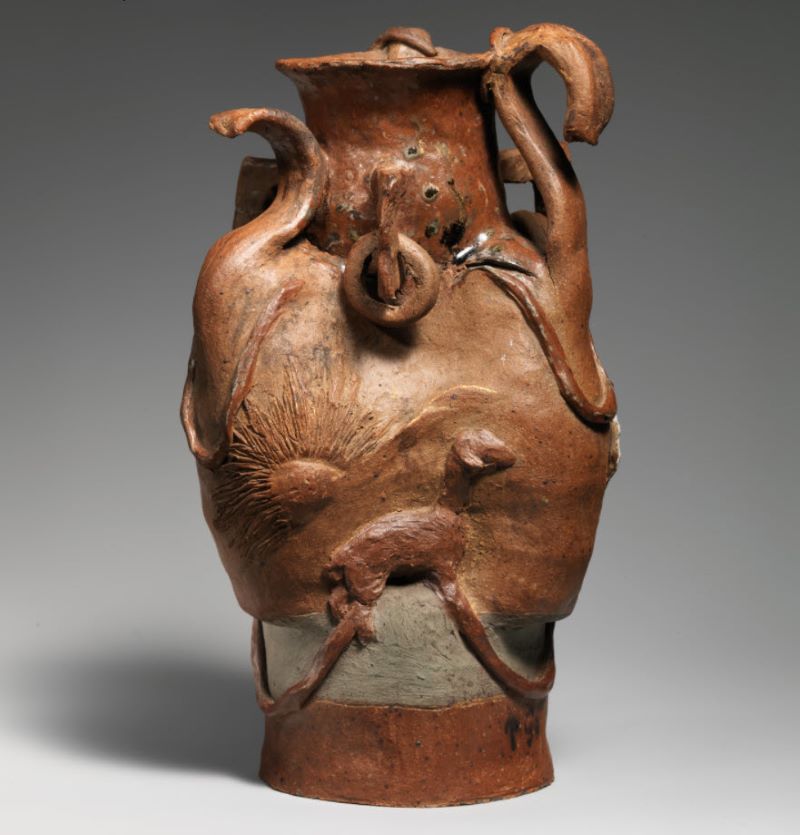
Paul Gauguin is known primarily as a painter. But he also explored ceramics, first during the period 1886-1888 (following his travels to Brittany, Panama and Martinique), and then again from 1893-1895 (after returning to Paris from his first trip to Tahiti). Gauguin did not work in ceramics while in Tahiti because clay was not available. Roughly 60 of his pieces survive to this day.

Paul Gauguin, Double-Necked Vase Joined by Stirrup-Shaped Handle, 1886/87. Stoneware with slip; 14 × 20 × 9.5 cm (5 1/2 × 7 7/8 × 3 3/4 in.). Musée du Petit Palais, Paris, PPO 3439.

While many painters were asked to decorate ceramics at this time, Paul Gauguin developed a deeper, more thorough approach to ceramics than most. He became a ceramic maker in a fundamental sense, employing slab and coil construction for most of his pieces.

Early Period Ceramics (1886-88)

Gauguin’s first encounter with ceramics came about through a friendship with ceramicist Ernest Chaplet. Chaplet helped Gauguin learn essential ceramics skills, and they worked collaboratively for awhile on the outskirts of Paris. Together, the two men created over 50 stoneware pots and sculptures. (Chaplet later also worked with August Rodin, the sculptor.)

Gauguin’s initial foray into ceramics did not lead to the commercial success he had hoped for. Indeed, for many years Gauguin’s ceramic work was essentially lost behind the success of his paintings.

Ernest Chaplet (France, 1835-1909), Haviland and Co. (ca 1882-1887) – Image: LACMA  http://collections.lacma.org/sites/default/files/remote_images/piction/ma-31239513-O3.jpg

Gauguin initial ceramic work is characterized by asymmetrical, hand-built shapes in dark brown stoneware, decorated with rough imagery reminiscent of themes found in his paintings of the time. Below are a few pieces from this early phase.

There is a really detailed examination (including a 3D model) of this first piece on the Art Institute of Chicago’s website. You have to dig for it, so I’ll include a few tidbits. Here is the full link (but you have to advance through the reader to get to this piece).

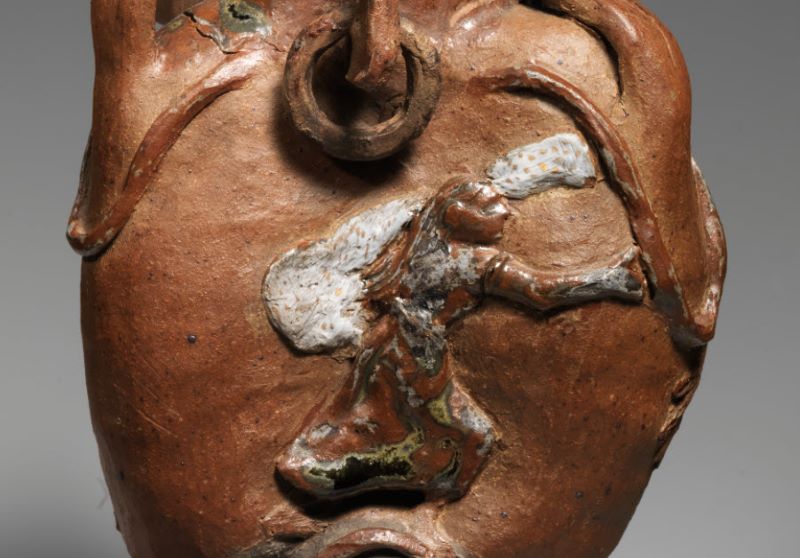
Paul Gauguin, Vase in the Form of a Tropical Plant with Bird and Deity, 1887/88, Art Institute of Chicago

Experts differ on when they think Gauguin made this vase (some say during the winter of 1886-87, others say during the winter of 1887-88). There are some sketches in Gauguin’s sketchbooks that he took to Martinique in the Caribbean. Regardless, Gauguin apparently liked the coarse, matt nature of the clay body, much as he enjoyed unvarnished surfaces of his canvases. He had little concern for the functional nature of his ceramic creations. And his additions of decorative elements (plant and animal forms) is typical of his work. One author notes, “The degree of abstraction that [Gauguin] favored introduces an ambiguity of scale and makes it difficult – and perhaps futile – to try to identify the plant, but it is probably a tree rather than a flower, with leaves standing for whole branches, as in medieval art or the reliefs of the Buddhist temple of Borobudur in central Java that Gauguin was beginning to use as models.”

Some other early ceramics:

Paul Gauguin, Vessel with Women and Goats, 1887-89, Metropolitan Museum of Art
Paul Gauguin, Vessel with Women and Goats (detail)

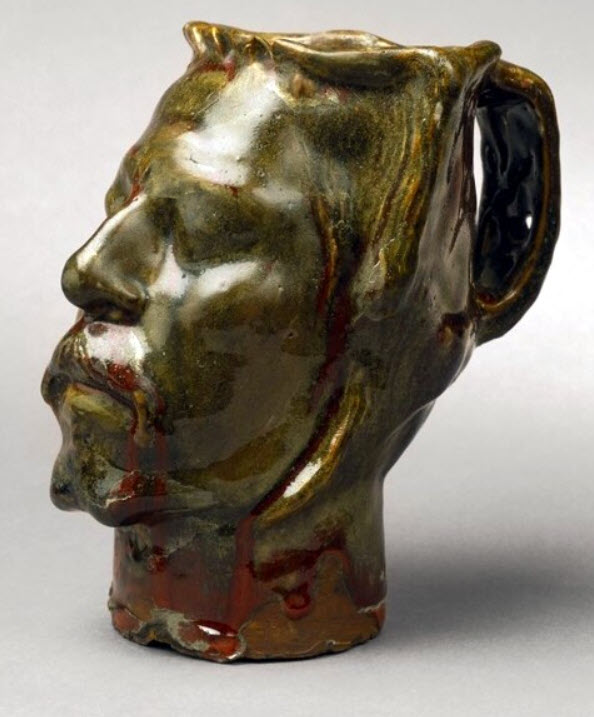
Gauguin created the following self-portrait in the form of a mug in early 1889 after experiencing two traumatic events. First, Gauguin had lived for several months with fellow artist Vincent Van Gogh in the south of France, and during this period Van Gogh cut off a portion of his ear. A few days later, Gauguin witnessed the beheading of a convict in Paris. It is hard to not recognize some of these elements in Gauguin’s mug: the deep red glaze gathering at the base of the mug, etc.

Later Period Ceramics (1893-95)

I found information on Gauguin’s later ceramics harder to come by. Here are a few images.

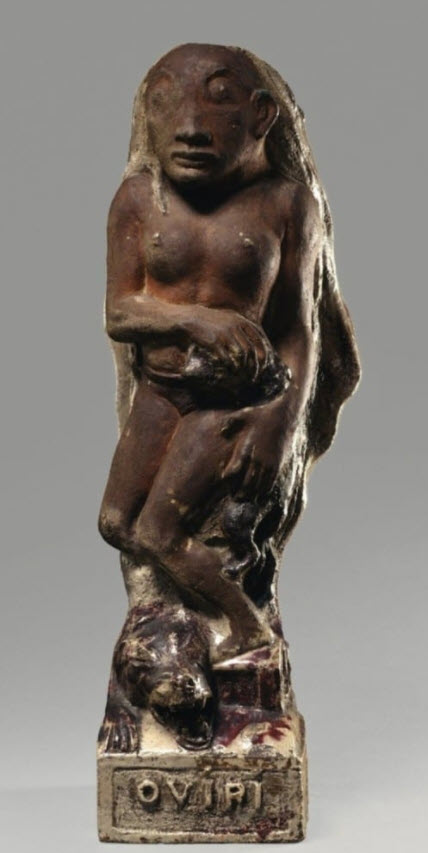
Paul Gauguin, Three Ceramic Heads, 1893-95, New Carlsberg Glyptotek

Finally, here is a link to an exhibit of Gauguin’s ceramics (and other, non-painting artwork) at the Museum of Modern Art in 2014.

International Museum of Dinnerware Design

The International Museum of Dinnerware Design (IMoDD) was established in 2012 and is located in Ann Arbor, Michigan. The IMoDD’s stated purpose is to “collect, preserve and celebrate masterpieces of the tabletop genre created by leading artists and designers worldwide.”

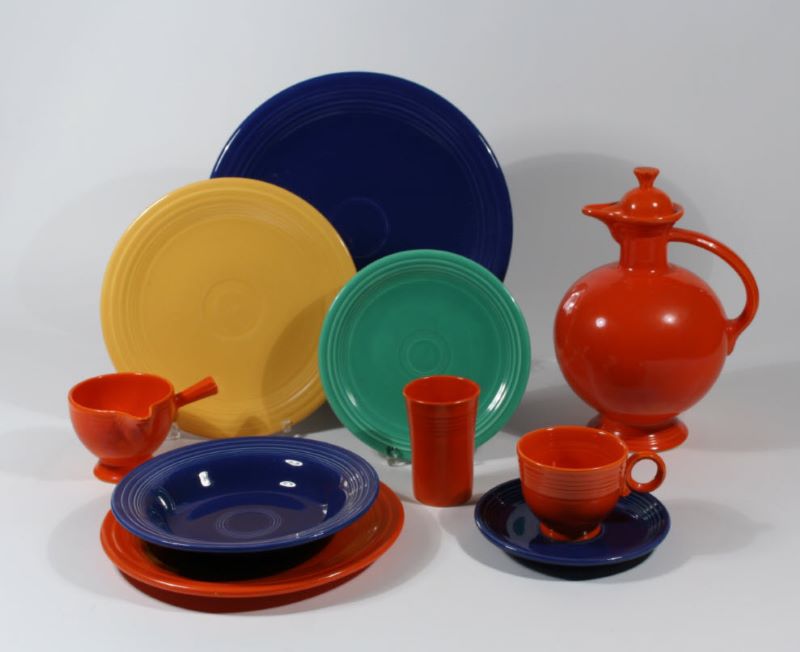
Homer Laughlin China Co., Fiesta ware designed by Frederick Hurten Rhead, 1936, IMoDD collection

I connected with the IMoDD founder and curator, Dr. Margaret Carney, to ask her about the Museum. She told me:

“Our collection is about 9,000 objects strong even though we were just founded in 2012.  It includes many materials, but ceramics is our major focus (we also collect glass, paper, metal, fiber, paper, lacquer, wood, etc.).  Our ceramics include functional (of course), but also fine art that references dining such as Bill Parry’s Knife Fork Spoon sculpture set.  We are all about good design, so we have manufactured ware by the leaders in designing for industry such as Eva Zeisel, the Schreckengosts, Russel Wright, etc.

“While we are currently located in Ann Arbor, we have been doing pop up exhibitions because commercial real estate is very expensive.  We have had 4 exhibitions at SOFA Chicago at Navy Pier. We are willing to relocate the International Museum of Dinnerware Design to wherever we can receive the strongest support in terms of endowment and a dedicated exhibition and museum facility.  Our current membership comes from all over the US and a bit abroad.”

In addition to her work at IMoDD, Margaret founded the ceramics museum at the New York State College of Ceramics at Alfred University, and taught ceramic world history there for 12 years. She obviously has wide expertise on topics relating to ceramics, both contemporary and historical. Her Ph.D. expertise is Chinese ceramics, from Neolithic times onwards, but especially Tang and Song eras.

I asked Margaret to pick out some interesting items from the IMoDD collection, and explain what makes them so special and interesting.

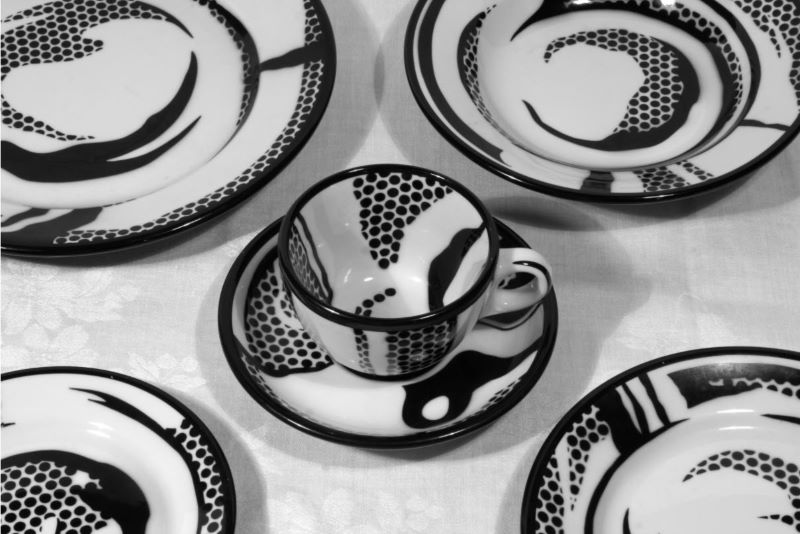
Roy Lichtenstein designed place setting, 1966, promised gift of Susanne and John Stephenson, IMoDD

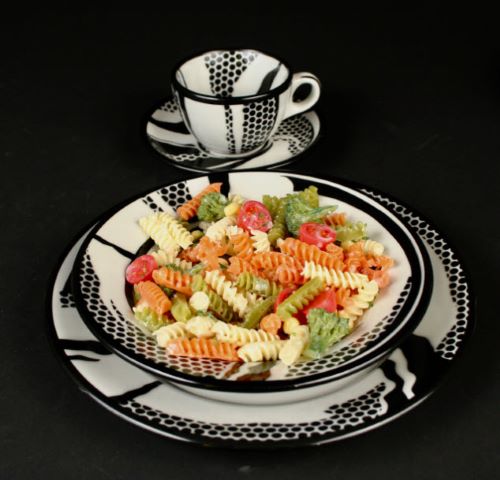
“I am attracted to the Roy Lichtenstein set because they were designed by the Pop Artist AND they are on heavy restaurant ware manufactured by Jackson China.  ALL food looks good on these dishes.  You can see that from the pandemic comfort food series of virtual images I posted last year which had ordinary comfort foods posed on these great dishes.

Furthermore, I love the work of Hui Ka-kwong, who went to school at Alfred, was a wonderful person, taught at Rutgers forever, and taught Roy L. everything he knew about ceramics. The set is a promised gift from ceramicists John and Susie Stephensen (John has since passed). I am all about people connections.  As you know, ceramics is a very small world.”

Cizhou ware ewer from Julu Xian, IMoDD collection

“I love the Cizhou ware ewer from China’s Song dynasty (960-1279).  I wrote my doctoral dissertation about “China’s Pompeii.”  Julu and the surrounding area were inundated by a flood of the Yellow River in 1108 A.D. It happened so suddenly that chopsticks and bowls remained on the tables, buried under the silt of the Yellow River for hundreds of years. The buried marketplace wasn’t fully rediscovered until about 1918 when farmers in the area were digging wells during a drought.  The ceramics began to surface at that time. They are in collections all over the world. I LOVE the simple organic form, and the slip with a clear glaze over it.  No decoration necessary on this form. I am working on organizing a major exhibition of pieces from the buried city. My dissertation dates to the 1980s when I lived in China for several years and they NEVER let me visit Julu as I was a foreigner AND Julu was a closed village. They invited me back in 2018 when they were celebrating the 100th anniversary of the discovery of the buried Song dynasty Julu.  They invited me back as the world’s expert AND translated my dissertation, gave me an honorary title AND have begun excavating the site for the first time in nearly 100 years.”

Leopold Foulem, Teapot, IMoDD collection
Kate Maury’s Lamb O’God  covered butter dish, IMoDD collection

“Kate Maury was a student of mine (ceramic world history) at Alfred.  The grad students were required to take my class.  Her work is monumental for the dining room table and belongs in the Smithsonian Institutions Renwick Gallery.  It makes dining a beautiful celebration and ritual.  Imagine serving your butter in the oversized lamb covered butter dish.  She’s a wonderful person and teacher.

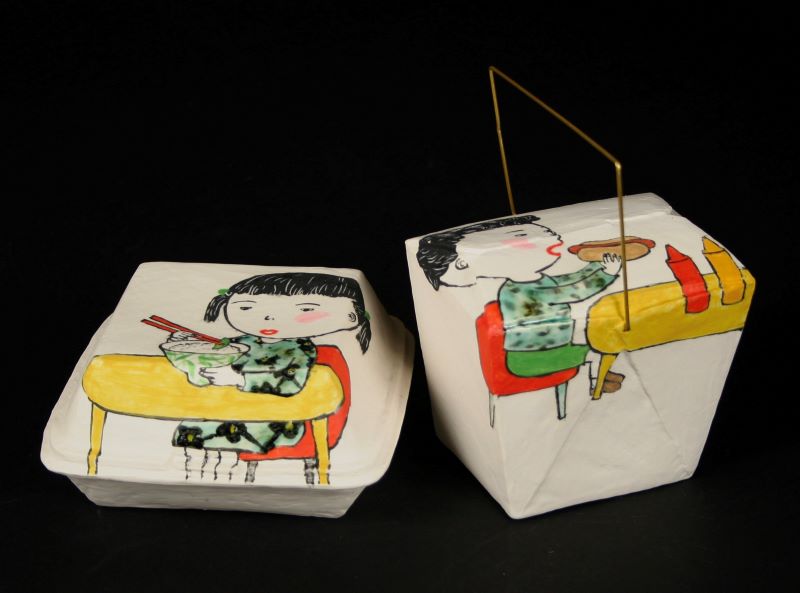
“I love work that has meaning or is just fun, so that would include Beth Lo and David Gilhooly.  I was sad when Gilhooly seemed to stop working in clay for a while.  His work makes one smile. Beth Lo’s images of children are nods to her Asian heritage and they show children as symbols of innocence, potential and vulnerability. She’s a wonderful artist.  I’ve never met her.”

David Gilhooly (American, 1943-2013), Frog Fruit Loops, 2010, IMoDD collection
Beth Lo, Porcelain take-out boxes, IMoDD collection

Margaret concludes, “Every time I acquire (bequest, gift, purchase) a major new piece for IMoDD, and then get to share it, it is like sharing a precious new baby with the world.  I learn so much from everyone with whom I communicate.  So many lifelong friends now.  I am trusted with their creations, to exhibit, educate and care for them. Quite a honor.”

Poke around the Museum’s website. There is some very fun stuff there. It will lighten your spirits:
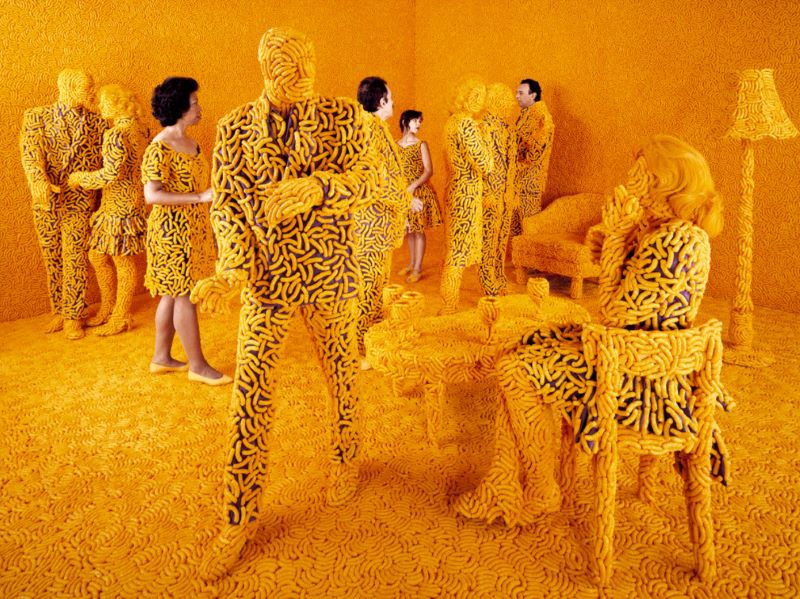
Sandy Skoglund archival photograph, The Cocktail Party © 1992 Sandy Skoglund

Katie Spragg – Artist Profile

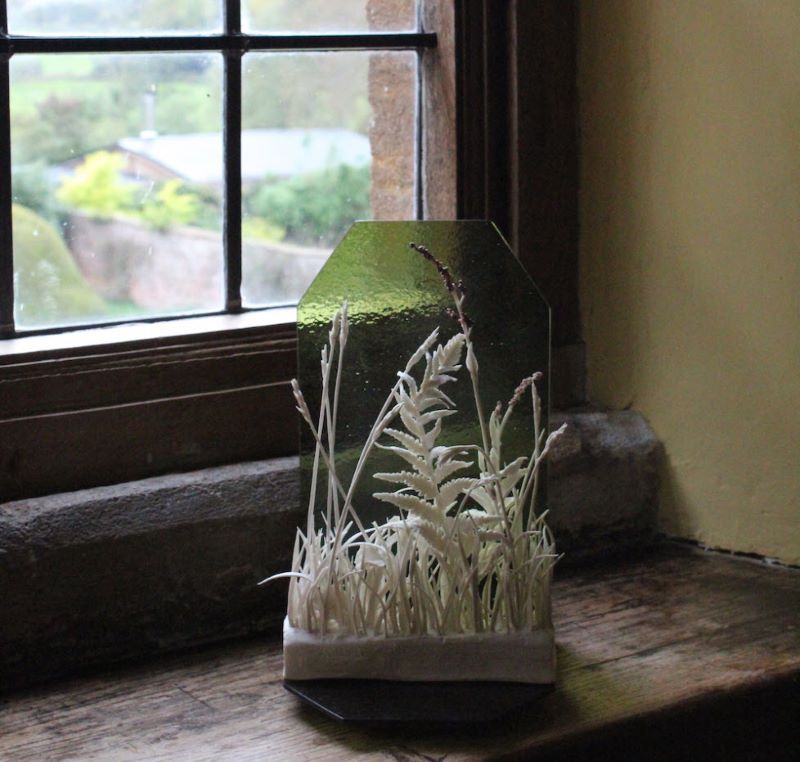
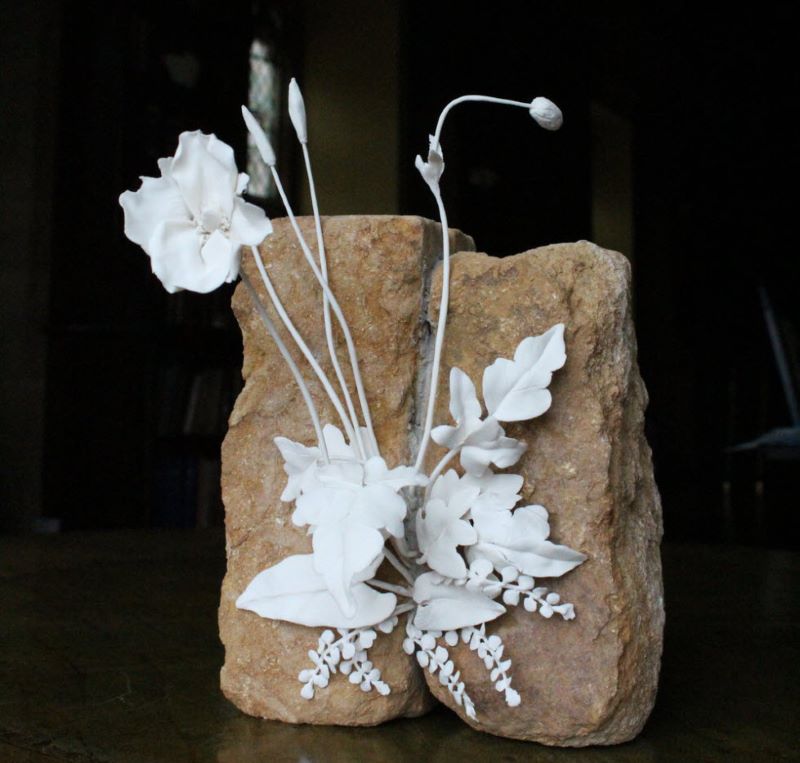
Katie Spragg creates intimate, plant-themed pieces that form an “environment” (of one scale or another). Behind each piece there is a story, or a collection of stories, essential to her creative process. The stories are not always evident to the viewer, but Katie regards them as essential to her work.

I spoke with Katie about her work and inspiration. She told me about the importance of stories in her work.

“My work has always been about storytelling. Before, [in my earlier work], there was more of an overtly humorous approach to what I did. I was making tableware that was then produced in Stoke-on-Trent [a major British ceramics center] with different stories about animals doing strange things.

“There was a transition in my work when I got my master’s degree in ceramics and glass at the Royal College of Art,” she continued. “My pieces now all have a story or agenda behind them, but on a more subtle level. The look of the work is much more serene and contemplative.

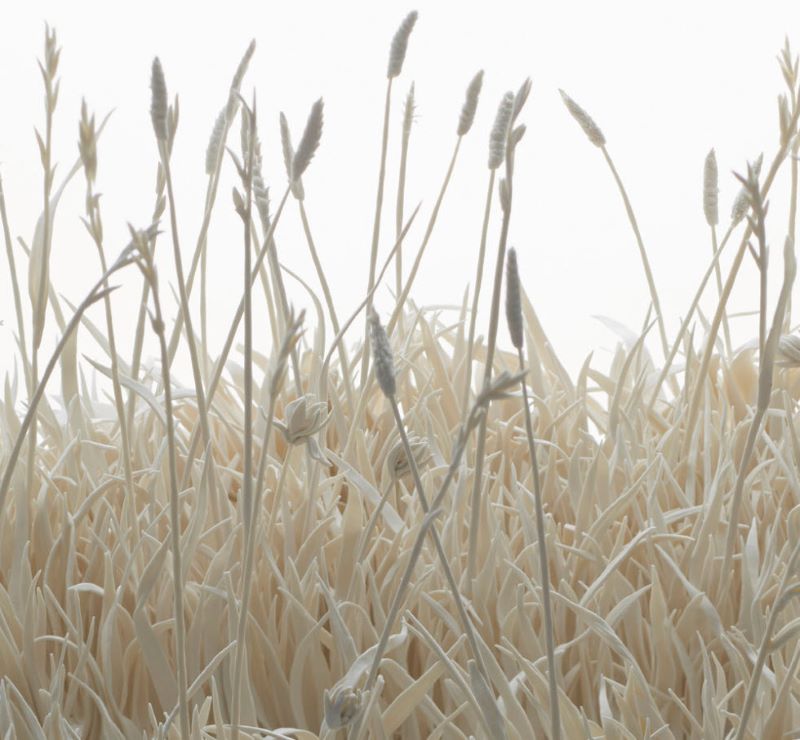
“My ‘Lambreth Wilds’ piece, for example, is about working with other people and collecting their stories, then distilling those stories into a large scale installation. For the project, I worked with Lambeth Young Carers, a group of young people who have unpaid home-care duties, normally for a family member. I ran a series of workshops and asked people about their memories of wild plants and the stories behind those memories. At the same time I was looking at botanical prints and drawings in the Garden Museum in central London. The ultimate project resulted in a combination of a heritage element and memories of everyday lived experiences. All the plants featured in the piece are plants mentioned in the stories or in the Museum collection, or both. The work, then, involves drawing connections across time through these porcelain plants.
“In this project I used wild plants as a metaphor for communities that surround the Museum. Many wild plants, as well as these communities, are overlooked or forgotten.

“I do other types of work – small pieces available for sale – but “Lambeth Wilds” is the type of project I most enjoy doing. I like working with other people and incorporating their responses into the work, rather than just creating a piece for a singular perspective.”

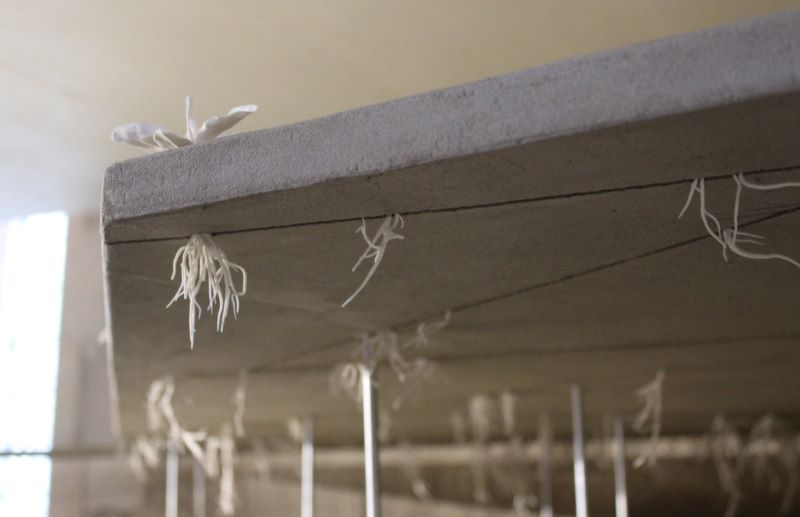
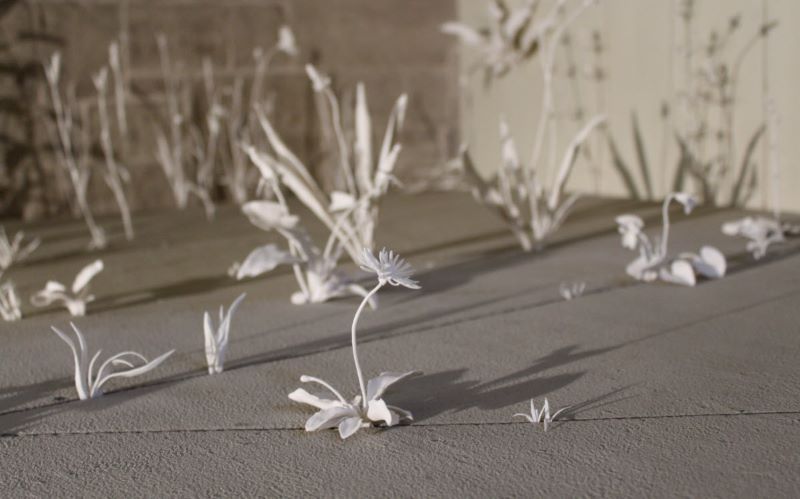
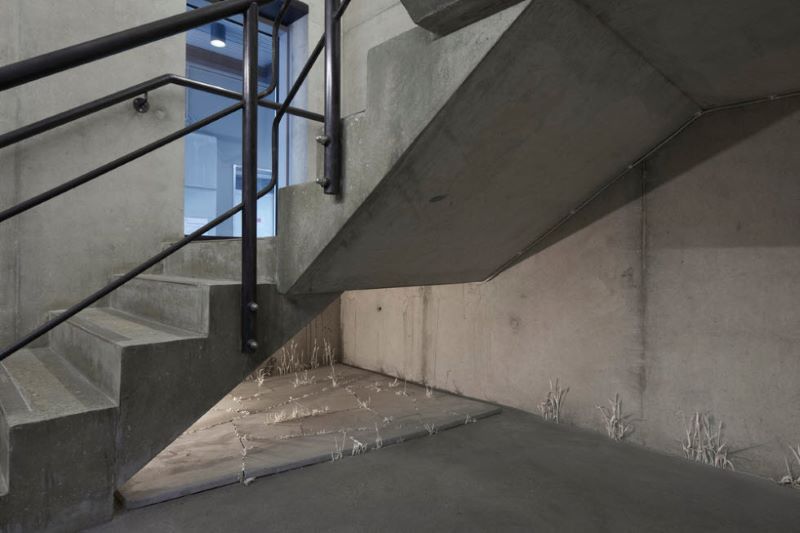
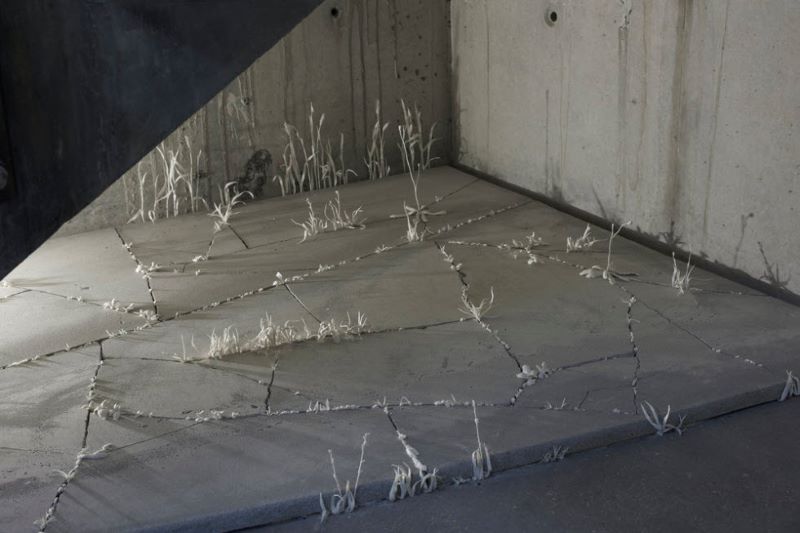
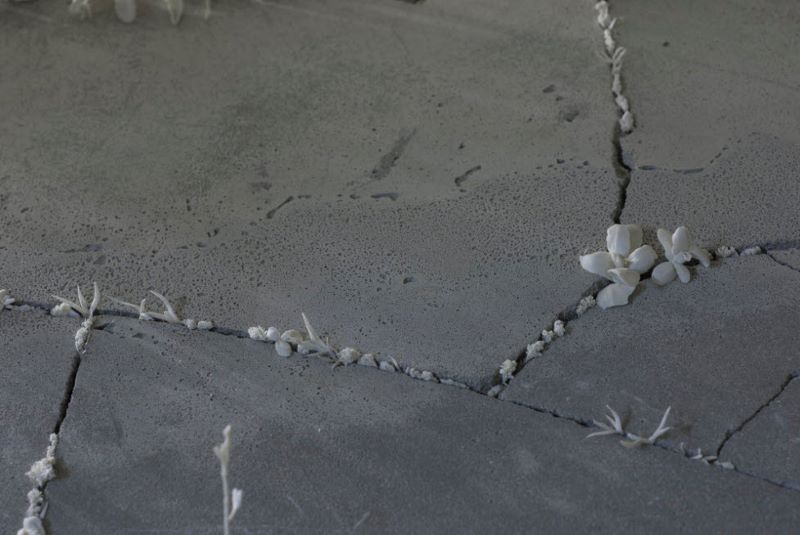
An earlier project, similar to “Lambeth Wilds” that Katie and I discussed is called “Wildness”. She created this unique “environment” populated with small plants underneath a concrete stairway. She tells me that she’s able to do these types of projects now that she’s found a part-time teaching position at the Royal College of Art. It provides some financial security and gives her blocks of time to pursue in-depth projects which she finds very satisfying.

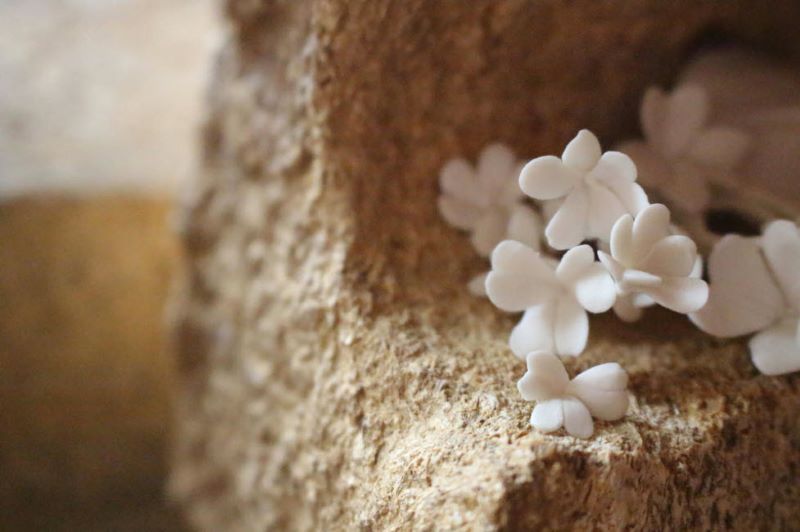
I like Katie’s work. I like the way she creates intimate environments combining brutal materials such as concrete and rock with delicate porcelain wisps that mimic natural plant forms. I’m struggling to appreciate the storytelling elements of her work. Had I not spoken to her I wouldn’t have known anything about that, and I would still enjoy the visual impact of her work. That’s good enough for me.

Here is a YouTube video interview with Katie about some of her project work (around the 20 min mark).

Robert Ellison Collection of Ceramics

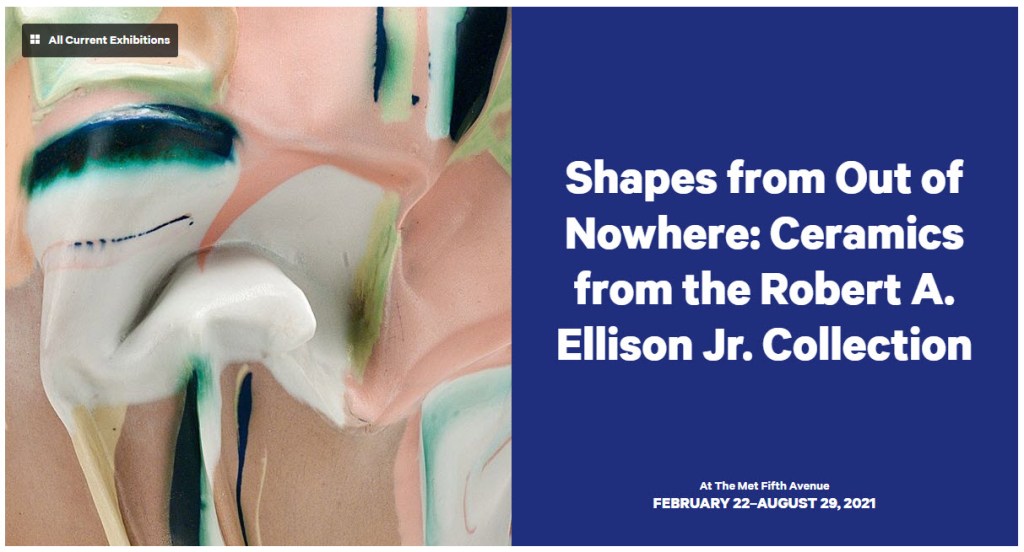
The Metropolitan Museum of Art in New York received another large donation of ceramics from Robert A. Ellison, Jr., and recently rolled out a new exhibition of 80 pieces entitled “Shapes From Out of Nowhere: Ceramics from the Robert A. Ellison, Jr. Collection.”

Robert Ellison started collecting ceramics in the 1960s – pieces that attracted him as an abstract expressionist painter. Over the years, his collection grew to over 600 items. In 2009 he began donating pieces from his collection to the Met, including this latest donation of 125 pieces which form the core of the new exhibition.

Andy Battaglia published an interview with Robert Ellison in ARTnews on March 18, 2021 entitled “Collector Robert Ellison Is Transforming the Way Ceramics Are Seen at the Met and the World Over.” In the interview, Ellison describes how he started collecting ceramics during breaks from painting, and gradually developed his sense of what to look for in ceramics. He sought out people doing “interesting work” and slowly built up his expertise. He tended to focus on one type of ceramic, build out his knowledge and his collection in that area, and then move on.

The interview inspires me because Ellison, a regular guy, started collecting things that interested him on a microscopic budget, and through diligence and persistence amassed what turned out to be a world-class art collection.

The Bellarmine Museum

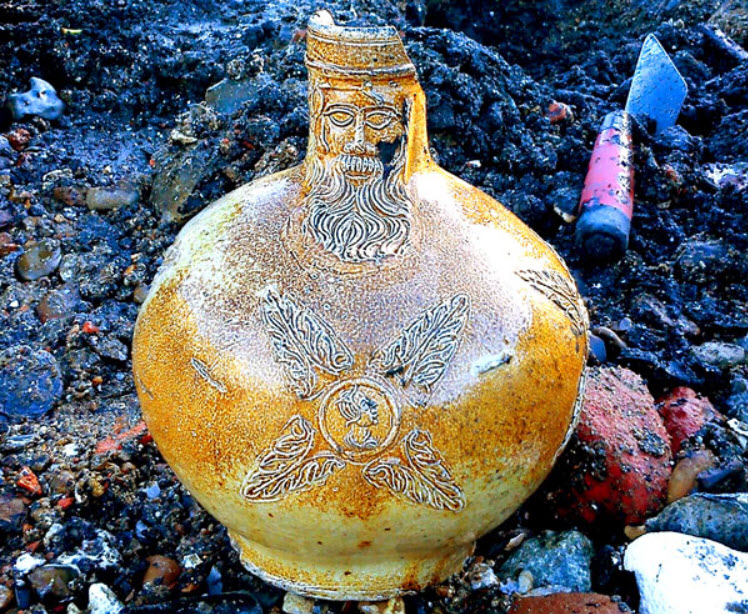
I came across an online article in Beachcombermagazine.com by Jason Sandy entitled “Mudlarking: Bellarmine Jugs and Witch Bottles” The article follows the story of Jim Ward’s discovery of a Bellarmine jug partially exposed in the muck while walking along the Thames River.

Photo: Sharon Sullivan

Bellarmine jugs were salt fired stoneware vessels produced in 16-18th centuries In what is now Germany. They were widely exported into England as well as elsewhere in Northern Europe and even to the American colonies. Bellarmine jugs are immediately recognizable by two features: a round, bulbous shape topped by a thin neck, and a bearded face decoration carved into that neck where it met the shoulder of the vase. The Bellarmine is said to be named after a Cardinale Roberto Bellarmino, a famous anti-Protestant who proposed banning alcohol, prompting Protestant drinkers to toast him with alcohol poured our of jugs named in his honor. 

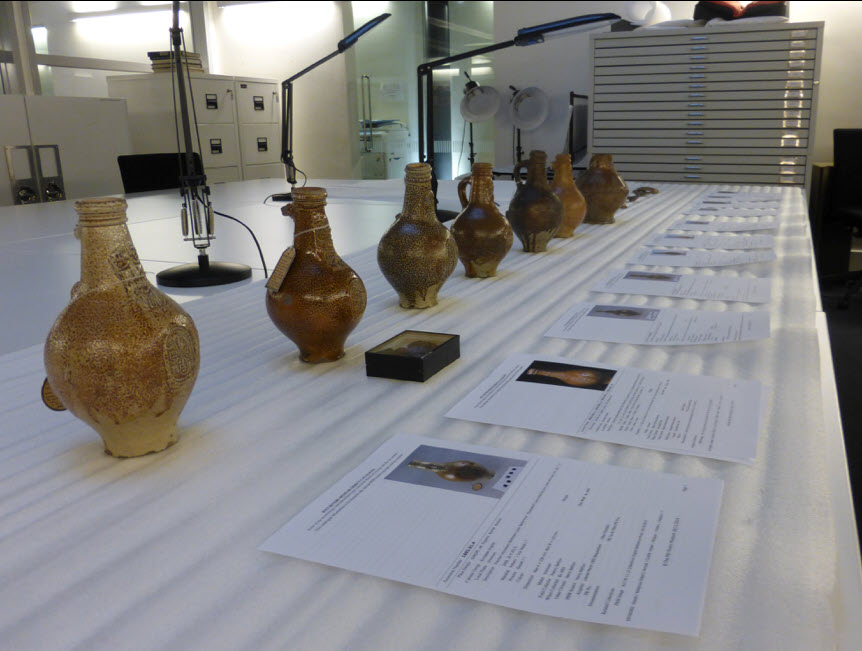
In putting together his article for Beachcombermagazine.com, Jason referenced the Bellarmine Museum located in the small English town of Swaffham, northeast of London. The Bellarmine Museum was founded by Alex Wright 4 1/2 years ago. The museum holds 150 Bellarmine jugs and over 300 other Germanic pots in its collection.

An extensive article about the Bellarmine Museum in the Eastern Daily Press explains more about the museum, its establishment by Alex Wright, and detailed information about Bellarmine jugs. Rather than repeat that information here, I’ll point the reader directly to the articles.

I found additional information about Bellarmine jugs on Wikipedia and at the Pitt-Rivers Museum (part of Oxford University’s museum complex).

Michael Kline – Artist Profile

I would characterize Michael Kline as a scholar of ceramics, not in the academic sense but in the sense of finding wisdom and deep satisfaction through the action of living a creative life as a potter. As you will see in our discussion below, he did not come to pottery easily. He struggled with what to do in life. But he ultimately did discover pottery, and made the leap to pursue life as an artist. This interview is primarily about how he found his path, and thoughts and concerns about staying on that path.

JW: I’m looking at your website and it looks like you basically have no pieces for sale. And when I look in your “archive” section everything is marked “sold.” That’s great – congratulations! My question is: Are you mainly selling your work through the shows that you do, online, or some combination of the two?

MK: In the last year, I had a couple of gallery shows – a consignment situation where the gallery handled the promotion, sales and shipping. In the rest of 2020 I sold online only because of COVID. It turned out to be one of my best years ever. In a normal year I tend to do a combination of direct sales from my studio to visitors or students at the Penland School of Crafts which is nearby. Also, I would sell online, at least 4-5 times in a year, and sometimes as many as monthly online sales. The other outlets I have for selling my work are occasional individual or group shows, online or in galleries, and 2-3 shows per year where I’m in person in a booth. All the shows I do are pottery specific, meaning they are not craft fairs or art fairs. In North Carolina there are several of these types of shows. One show I produce with several other local potters. The other show is a juried show in Charlotte, N.C., the Potter’s Invitational. I also do one national show in Washington, D.C., curated by Dan Finnegan, at the Hill Center, called “Pottery on the Hill,” a small show of about 16 artists displaying their work.

JW: How would someone know when you have new work for sale?

MK: I have an email list that I send out regularly whenever I have a sale or a show. The other way is to follow me on social media. I usually broadcast any sales or anything I’m doing on Instagram and Facebook. I would say my mailing list is where my blue-chip, gold-level customers find out about my activities.

JW: Has the COVID pandemic affected you at all (from a business perspective and/or a creative perspective)?

MK: That’s a really interesting question that I’ve thought about a lot because I usually have a diversified kind of experience in my business, whether its teaching, making pots, taking visitors through my studio, or doing shows. All these activities inform what I do when I go back to the studio and work. I get inspiration from other artists that I meet or see, maybe some pots or artwork that I’ve purchased myself. When I’ve travelled I’ve traded with other artists and those pieces may influence what I do.

During the pandemic I was here by myself most of the time. I found the psychic space caused by the pandemic affected my work. I moved, maybe not consciously, toward working on pretty safe pieces, nothing too challenging. Financially I wasn’t sure where we were going. I kinda’ “played the hits” most of the year which was interesting. I enjoy my work and what I’m doing, and I have a fair amount of variety within my work activity in the studio. I felt that if I could have done something differently, I would have taken some time off to work on something new and different. But with 2 children in high school and college I didn’t want to take a lot of risk so I played it safe.

I guess I didn’t realize how much going out into the world influenced my work. I like the rhythm of working and that’s something that changed. I didn’t really go anywhere during the lockdown. I was able to work and I felt a little bit of guilt, perhaps, or I felt lucky that I was able to work. Whenever I had a sale I felt grateful to have my customer base that I’ve been building for a long time. A lot of people my age – I’m 60 now – don’t have that base to work from. I spent a lot of time on the phone with friends from my generation who didn’t have a web or online presence. I helped them onboard to the online selling experience. That was very gratifying as well.

JW: You became a full-time studio potter after attending a workshop at the Penland School of Crafts in 1989.  What was so motivating about that workshop?

MK: That was a very long time ago but I remember it vividly. It was a workshop by Michael Simon who was a student of Warren MacKenzie. I met Michael Simon as a student at a workshop at the University of Tennessee. My teacher, Ted Saupe, had a lot of Michael’s pots and I was a devotee even at that early stage of my career. In 1989, after school, I was living in New York City, waiting tables, and working on a lot of artwork in my apartment. I was itching to get back into ceramics. I saw that Michael Simon was teaching at Penland, so I came for a 4 week workshop. That was pivotal for me. Michael made it clear that I could become a full-time artist if I was willing to live frugally. Michael made it clear that you don’t need to be a professor or an academic to make it as a potter. That was very revealing to me; I felt it was possible to quit my job and become a potter.

JW: I’ve read about your process in your “About” page and it doesn’t seem to match up to what I see in your pieces. (Many of your pieces seem more layered.) Could you please describe your current process – and how you came to work this way?

MK: There are a few processes I use. One body of work is tableware – stoneware that is fired in an atmospheric gas kiln called a soda kiln. So it’s essentially a salt glaze process. Pots are painted with a brush, and various patterns are painted using wax resist, and the the pieces are dipped in slip. That slip is then glossed during the soda firing and the sodium vapor that’s introduced into the kiln at peak temperature forms a glaze on the pots. It’s a 15th century German technique or discovery that is used in various ways today.

The other body of work is an inlay techniques where pots are carved, stamped and inlaid with white porcelain slip brushed into the impressions. Usually it’s a stoneware clay or an iron-rich clay and the porcelain slip inlay is a lighter color. I overfill the inlay, then scrape it away to reveal the original carved or stamped pattern. I use a lot of different tools and stamps. I put a final glaze over these pots and fire them in either an electric kiln or in a soda kiln.

Sometimes I do a combination of brushwork and stamped inlay work on a single pot. Sometimes the pot is carved or stamped and then filled with glaze.

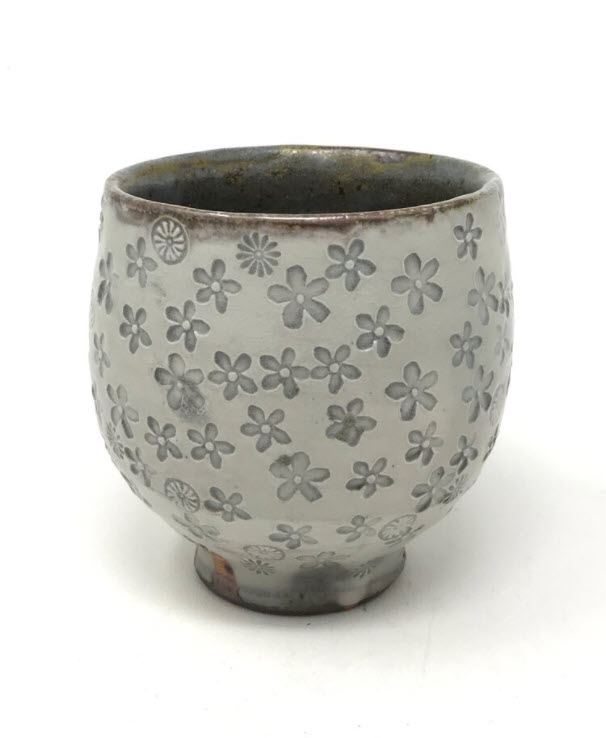
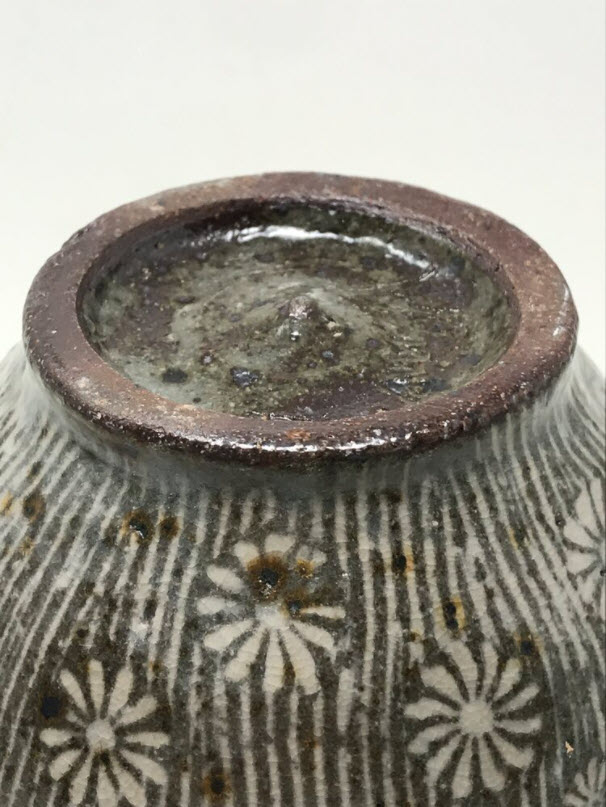
JW: When you do some floral design coupled with lines – how are you creating those lines? Are those stamps too? (e.g., Yunomi-00406)

MK: That pot is an inlaid piece, and those vertical lines are created with a serrated metal edge, creating those little channels. After that’s done, I stamped the piece with floral patterns.

After all that, I covered the entire piece with white porcelain slip and carefully scraped the excess slip away. Each step probably takes about 15 minutes, so it’s fairly time-consuming process.

JW: How has your work evolved over time?  Big leaps and bounds, or a gradual evolution?

MK: My work has been a very gradual, slowly evolving process. Each of my firing cycles takes 4-6 weeks. Almost always I have ideas while I’m working (either making pots or decorating, or when I’m unloading the kiln), rather than by sitting down and brainstorming apart from working. Usually I make notes and keep track of experiments I try; I take pictures and notes in a journal for each piece in a firing. I try to build on the successes of each previous firing.

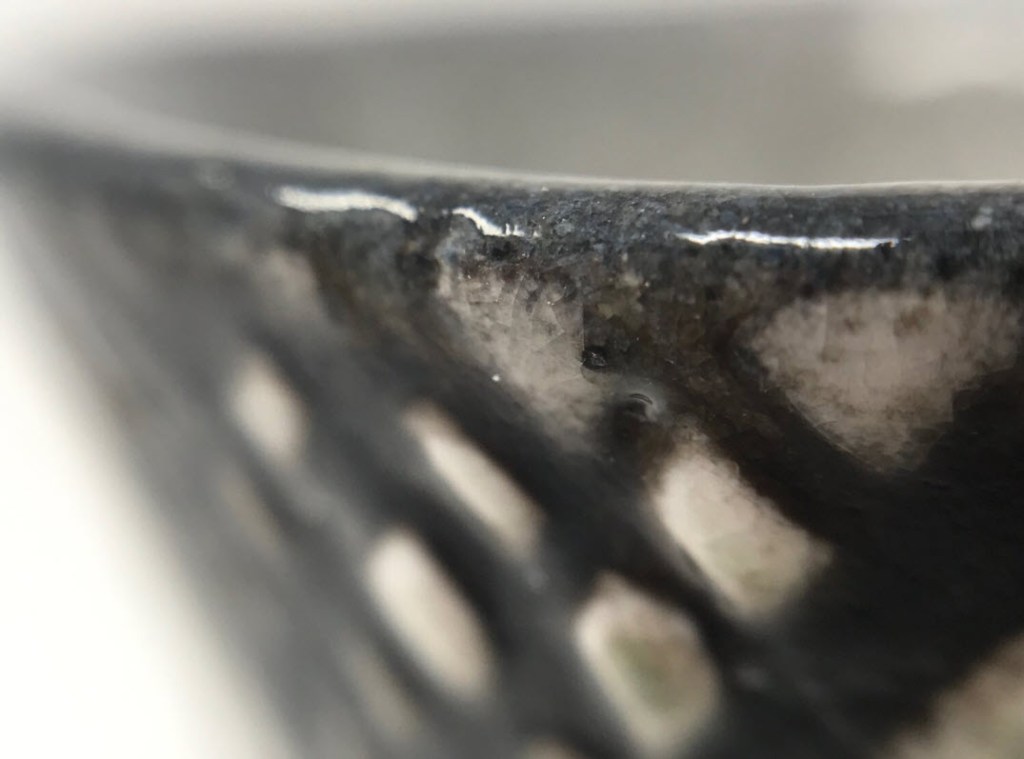
There was a time, about 5-6 years ago, when I was struck by a piece in the Smithsonian collection, a 15th century Korean bowl. I was with a curator and 15 other potters and we were looking at the collection, handling them and speculating on how they were made. This particular bowl had a very interesting Kinsugi (gold leaf) repair to the lip of the bowl; it was very unusual because it had a raised pattern in the repaired surface. That experience propelled me in a different direction which was very different but still related to floral patterns and surface design. I played with this idea, watching videos, and saw some Korean potters doing this technique. Over 6-8 months of trial and error experimentation, I developed this technique myself and began selling these pieces. So that was an example of a “leap and a bound” – but generally my evolution is pretty slow and gradual.

JW: I also see some workshops on your website. Do you do a lot of those?  Do you have a preference for the type of workshop you do?

MK: Up until last year, most of the workshops are me demonstrating my techniques, trying to focus on sharing the sequence of how I do things. The students are usually either serious amateurs or professional potters, sometimes students, depending on the venue. I teach at a lot of different venues. The last workshop I did last year was a departure from my normal workshop. I did go through my techniques, but I also focused on how one finds joy in their work and how, by repetition, one develops their own style. It’s hard to do in 5 days, but I had a lot of exercises prepared, some not pottery-specific but like painting with ink on different objects, lots of mimicry, and other elements of teaching that I’m interested in during future workshops.

I’m teaching a few workshops in 2021, including a workshop in Italy at La Meridiana.

I like to do a few (4-5) workshops each year, but I don’t want to do it all the time. I like to travel and meet people willing to share what I do and my passion for what I do. I get a lot of energy from teaching. I get a lot of ideas from students. I’m a student of what my students do and I keep my eyes open for how students interpret my techniques. And there’s also good discussion in my workshops and I enjoy that. There’s a lot of value in interaction with other potters.

JW: What is the most satisfying thing you’ve gained from your years as a ceramic artist?

MK: I take satisfaction in knowing that I’ve found a path. When I was young, it was very bleak. I didn’t know what I would do. I went to college as an engineering student. My parents thought it would be good for their son to learn a profession. In 1979, there were limits to professional degrees: law, medicine, engineering, science. It was never business, that was never a consideration which I find interesting because I now think of myself as a business person as well as an artist, of course.

Anyway, I emerged from college and it was kind of bleak. I went into engineering when I didn’t want to. I didn’t really have the attitude for it. I had the aptitude for engineering and that’s why my parents promoted it. I found in engineering school I wasn’t very happy. After 3 years I flunked out and was on my own. I took a pottery class and immediately fell in love with the clay.

So I take a lot of satisfaction in finally finding that path. It’s very difficult as a young person to find meaning in life. I try to teach that in my workshops: how do you recognize joy or something you like to do. How do you recognize it and go above the noise of what you think you should do – and what your parents and friends think you should do – and make individual choices, selfish choices sometimes, to find that path.

More of Michael’s work may be seen on his website.